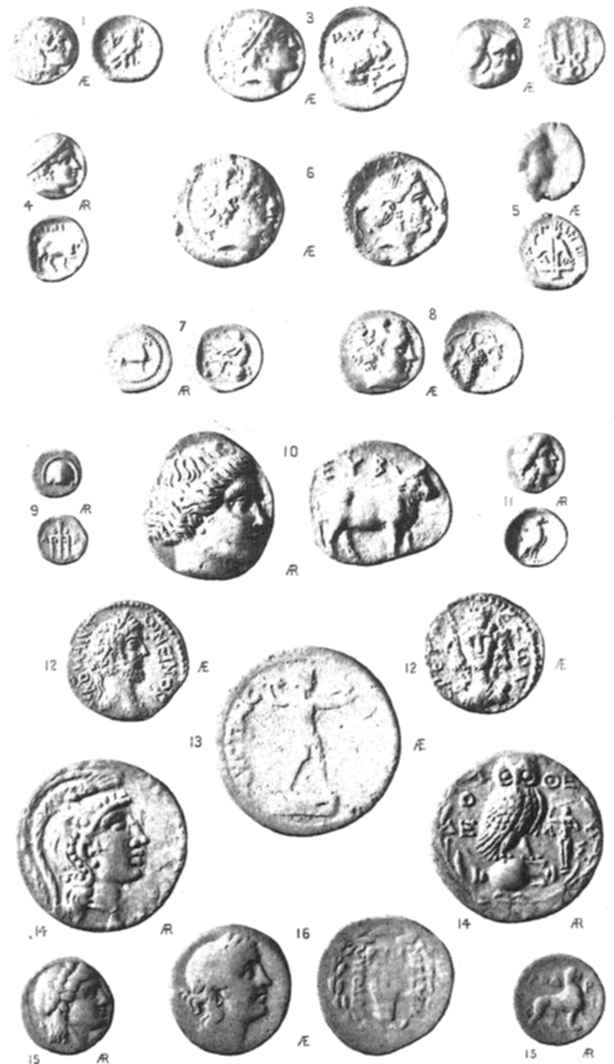
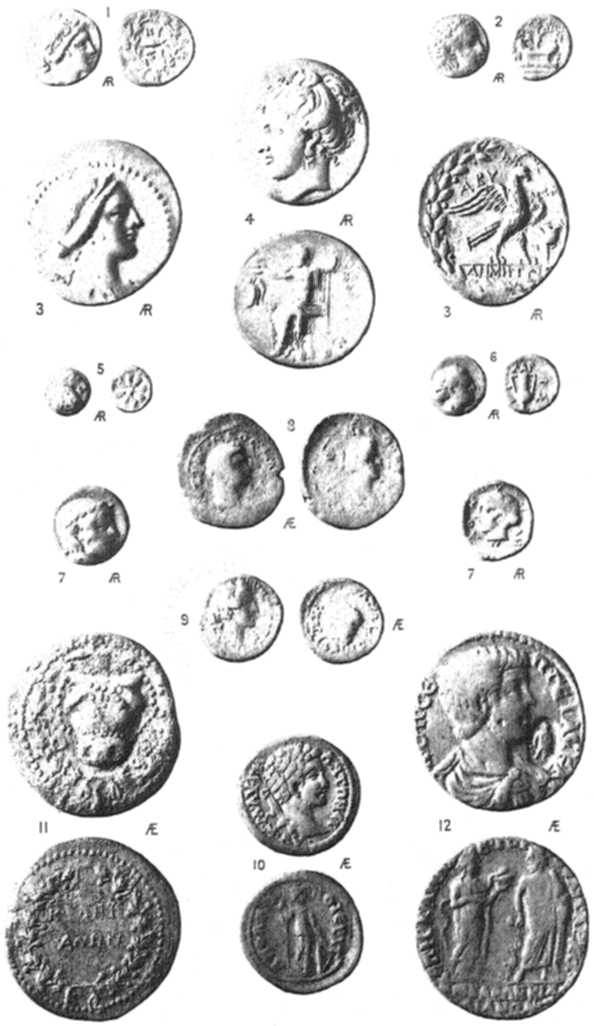
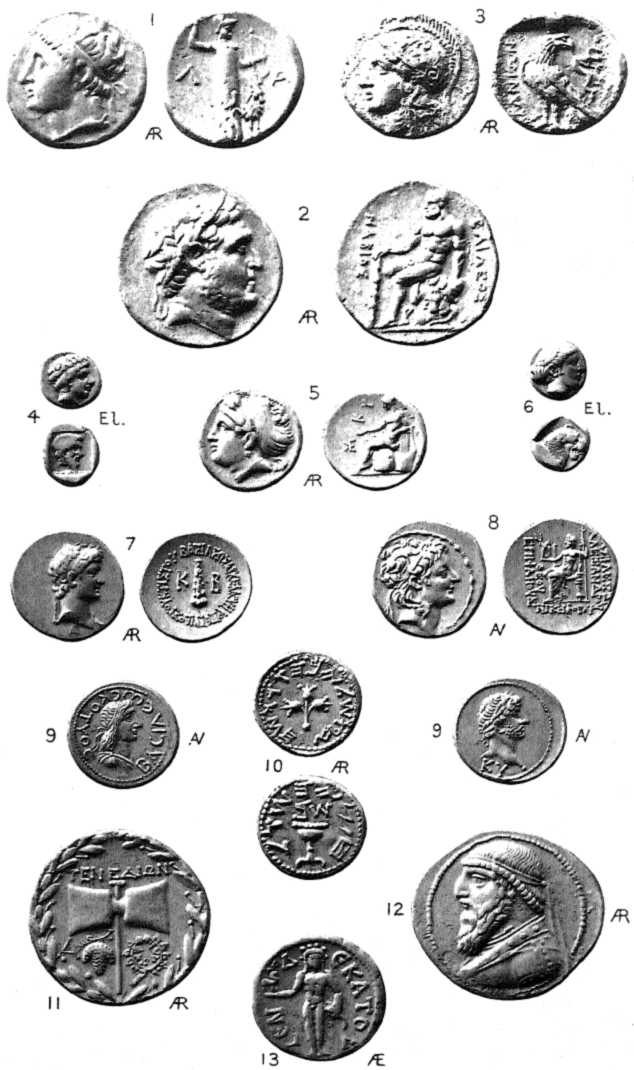
The history of the coinage of the Peloponnesus, regarded as a whole, may be summed up in a few words. From the age of Pheidon of Argos down to the Persian wars the only coins generally current in Pelopon- nesus were on the north coast the Corinthian Pegasos staters, elsewhere the staters of Aegina. In the interior the Arcadian triobols served the purpose of small change. The Aeginetic standard continued to be everywhere prevalent in Peloponnesus.
The splendid and varied series of Elis does not begin before the close of the period of archaic art (circ. B.C. 471). Between the Persian and Peloponnesian wars we note an increase in the number of Arcadian mints, Cleitor, Heraea, Mantineia, Pallantium, Paroreia, and Psophis all issuing small silver coins in addition to the money of the Arcadian League. In the next period, B.C. 430-370, the Arcadian Federal money is entirely superseded by the local issues of the various Arcadian cities. The place occupied of old by the Aeginetic stater is now filled by the beautiful staters of Elis, Sicyon, and Argos.
With the restoration of Messene and the renewal, under Theban auspices of the Arcadian Confederation, B.C. 370, Messene and Megalo- polis were added to the now considerable number of Peloponnesian mints. After B.C. 322, when Peloponnesus had for the most part fallen under Macedonian dominion, the greater number of the Peloponnesian towns ceased to strike silver in their own names, and between B.C. 280 and 146 the Federal coinage of the Achaean League became little by little the chief currency in Peloponnesus, the types and style of which the few mints which held aloof from the League tended more and more to imitate.
With the constitution of the Roman Province in B.C. 146, all silver money (except perhaps at Patrae) was put an end to. Bronze coins continued, however, to be issued at many towns. As a rule the Imperial coinage is confined to the time of Sept. Severus and his family.
Phlius, in N.E. Peloponnesus, was situated at a point commanding three narrow valleys through which flowed the tributary head-streams of the R. Asopus. At the junction of these valleys was a fortified summit, Τρικαρανον. The following staters of Euboïc weight, formerly assigned to Phaselis in Lycia (Hist. Num., 1st ed., p. 579), are attributed by J. P. Six (Num. Chron., 1888, p. 97) to Phlius. The triskeles, he thinks, is an indication of the geographical conformation of the territory of the city.
 between the legs of a triskeles. between the legs of a triskeles.[Babelon, Traité, p. 813.] |
Incuse square of eight triangles.
AR Euboic Stater.
|
The incuse on the reverse is of the early Aeginetic rather than of the Euboïc pattern, and the fact that all the later coins of Phlius are of Aeginetic weight is sufficient to show that the commercial relations of Phlius were more intimate with Aegina than with Athens or Euboea. Cf. the stater of Aegina (?) with the Phliasian (?) triskeles on the reverse (see Aegina, p. 397). The next series of Phliasian coins dates from the latter part of the fifth century B.C.
| Bull with head lowered (tauriform Dionysos, or river-god Asopos). In exergue ΦΛΕΙΛ (sometimes retrogr.). | ΣΙΟΝ (end of obv. inscr.) in the four
corners of an incuse square, within
which a wheel. AR Drachm.
|
In the centre of the wheel there is usually a pellet enclosed in a circle, which may symbolize the omphalos, a sacred stone at Phlius, which the inhabitants, with unaccountable ignorance of distances, affirmed to be the centre of Peloponnesus (Paus. ii. 13, 3).
The hemidrachms and smaller coins are uninscribed, but bear on the reverse a large Φ instead of the wheel, sometimes accompanied by pellets or bunches of grapes.
The types of the Phliasian coins remained unchanged down to the time of the Macedonian conquest, circ. B.C. 322, except that on the latest class the Φ on the reverse is encircled with an ivy-wreath. After B.C. 322 the coinage of Phlius comes to an end.
The bronze coins of the fourth century for the most part resemble the silver, but on some specimens the bull on the obverse is replaced by a head of Athena or of Zeus. See also Achaean League.
Imperial of Severus, Domna, Caracalla, and Geta. Types: Artemis
huntress, Herakles standing, Asklepios, Tyche sacrificing.
[Annali di Corrispondenza archeologica, 1830, p. 336; B. M. C., Pelop.; Lambros, Pelop., 34 ff.; Babelon, Traité, pp. 816 ff.]
Sicyon, during the period of its greatest prosperity, consisted of an acropolis about two miles from the Corinthian Gulf, a lower town at its foot, and a port-town. The large number of its coins still extant sufficiently attests the ancient wealth and commercial importance of the city. It does not appear to have struck many coins before the Persian wars, nor indeed does its money become plentiful much before B.C. 400, but from this time down to the Roman conquest (B.C. 146) the Sicyonian mint would seem to have been the most prolific in the whole of Peloponnesus.
| Dove with open wings, in act of alight- ing. | Large Σ in incuse square; within the
letter, sometimes a floral ornament.
AR Drachm.
|
| Chimaera; beneath, Σ. | Dove flying in incuse square; in corners
W [= Σ] and Δ (for Δραχμαε).
AR Drachm.
|
| Chimaera. | Dove flying in incuse square; in corners
Σ and Τ (Τριοβολον). AR Triob.
|
| Forepart of chimaera. | Id. Σ and Ο (Οβολος). AR Obol.
|
| Dove with closed wings. | Σ in incuse square. AR ½ Obol.
|
| Id. | Dove flying in incuse square; in corners
Σ and Η (Ημιοβολιον). AR ½ Obol.
|
| Dove’s head. | Id. AR ¼ Obol.
|
| ΣΕ Chimaera. | Flying dove. AR Triob.
|
| Apollo, kneeling on one knee, with bow and arrows. | ΣΕ in laurel-wreath. AR ½ Obol.
|
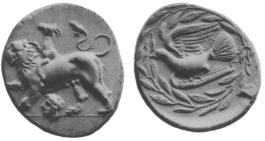
| ΣΕ (later ΣΙ) Chimaera; above, some- times, wreath; beneath, sometimes, kneeling Apollo with bow or head of river-god Asopos (?), &c. | Dove flying in laurel-wreath, often with
letters in field, Α, Ε, Ι, N, ΛΟ, ΑΡ,
ΠΑ, ΣΙΒΥΡΤΙΟ[Σ, &c., or symbols,
bow, ivy-leaf, &c. (Fig. 222)
AR Stater and Drachm.
|
| ΣΕ or ΣΙ Dove alighting. | Id. AR Drachm.
|
| Σ Ε or Σ Ι Chimaera. | Dove flying. Letters in field.
AR Triobol.
|
| Id. | Id. AR Diobol.
|
| Σ or Σ Ι Dove alighting. | Id. AR Obol.
|
| Σ or Σ Lion walking. | Id. AR ½ Obol.
|
| Head of Apollo. | Id. AR Obol.
|
| Id. | Lyre in wreath. AR Obol.
|
| Apollo kneeling with bow and arrows. | Lyre. AR ½ Obol.
|
| Apollo with lyre, seated on rock. | ΣΕ in wreath. AR ½ Obol.
|
| Head of Apollo. | ΣΕ in monogram. AR ½ Obol.
|
The two following gold coins (wt. c. 47 grs.), if they are genuine, which is very doubtful, must be assigned to this period :—
| Σ Ι Head of Apollo r. laur. [Z. f. N. xvii. Pl. I. 5.] | Dove flying; beneath, minute dolphin:
the whole in laurel-wreath.
AV ½ Drachm.
|
| Same die. [Paris, Ibid., p. 5.] | Dove flying with taenia in beak: the
whole in laurel-wreath.
AV ½ Drachm.
|
The bronze coins of Sicyon are numerous. Some of them certainly belong to the latter part of the fourth century and to the first half of the third century B.C. Weil (Z. f. N., vii. 376) would attribute them to an earlier period, because some of them bear on the reverse the letters ΕΥ which he believes to stand for Euphron, one of the tyrants of Sicyon, shortly after B.C. 368.
| Naked Apollo holding up a long fillet, which falls behind his back; in field, dove. [Imhoof, Num. Zeit., 1884.] | ΣΙ in wreath. Æ .65
|
| Dove flying. | Tripod in wreath. Æ .65
|
| Id. | Σ in wreath. Æ .55
|
| Head of Apollo. | Σ in wreath. Æ .75
|
| Dove flying. | Magistrates’ names, ΕΥ, ΔΗ, ΘΕΥ, ΚΛΕ,
ΜΕ, ΤΕ, within a wreath. Æ .65
|
| ΣΙ Dove feeding. | ΣΙ Tripod in wreath. Æ .7
|
Later in style than these Alexandrine tetradrachms are the following series of Aeginetic triobols (or Attic tetrobols) and bronze :—
| Flying dove. | Large Σ surrounded by magistrate's
name: all in shallow incuse square.
AR Triobol.
|
Among the magistrates’ names the following occur:—ΑΙΝΕΙΑΣ, ΑΛΕΞΙΩΝ, ΑΜΕΙΝΙΑΣ, ΑΝΔΡΩΝΙΔΑΣ, ΘΡΑΣΥΚΛΗΣ, ΚΛΕΑΝΔΡΟΣ, ΛΥΔΙΑΔΑΣ, ΞΕΝΟΤΙΜΟΣ, ΟΛΥΜΠΙΑΔΑΣ, ΠΟΛΥΚΡΑΤΗΣ, ΠΡΟ- ΜΑΧΙΔΑΣ, ΣΩΣΙΚΡΑΤΗΣ.
| Flying dove and one of the above names. | ΣΙ in wreath. Æ .65
|
| Dove feeding, ΑΝΔΡΟΣΜΟΣ. | ΣΙ Tripod in wreath. Æ .7
|
| Head of Apollo. | ΣΙ Dove flying, carrying fillet, and
magistrate’s name. Æ .75
|
From the late style of these coins it seems certain that they are auto- nomous issues struck for local use after B.C. 251, in which year Sicyon joined the Achaean League. They are consequently contemporary with her silver and bronze money of the Federal types. See p. 417.
Concerning the coins of Sicyon, Leake remarks (Num Hell., p. 95) that ‘the change from ΣΕΚΥΩΝ or ΣΕΙΚΥΩΝ to ΣΙΚΥΩΝ occurred about the time of Alexander the Great. The bird is probably the rock pigeon, great numbers of which still inhabit the cliffs that surround the ancient site. They were perhaps sacred to Apollo or Aphrodite, whose temple was one of the principal edifices of Sicyon, and in which there was a seated statue of the goddess by Canachus (Paus. ii. 10).’
The Σ, which so frequently occurs as a coin type, was the device of the city, and was placed by the Sicyonians on their shields (Xen. Hell. iv. 4). The use of the initial letter as a blazon was common in the Peloponnesus. Cf. on coins, Argos, Heraea, Epidaurus, Cleonae, &c., and for shields, Lacedaemon and Messene.
Imperial coins exist from Nero to Geta. Inscr., CΙΚΥΩΝΙΩΝ. Types, various; the most remarkable is a representation of a tomb (cf. Paus. ii. 7, 2). The coin shows a small distyle temple on a rock, flanked by two tall terminal figures, and by two cypress trees. Another coin has for type a Maenad in attitude of frenzy, holding a sword and a bunch of grapes, perhaps one of the Maenads in the temple of Dionysos at Sicyon mentioned by Pausanias (ii. 7. 5). Another very frequent type is a
Aegae was one of the most ancient cities in Peloponnesus. Its coins, the oldest of which must be as early as B.C. 500, are triobols of the Aeginetic standard. The goat is clearly a type parlant, as at Aegae in Macedon, Aegeira, Aegospotami, &c. The town gradually fell into decay, and was destroyed circ. B.C. 370, when its coinage ceased. For illustrations see Zeit. f. Num., v. Pl. I; B. M. C., Pelop., Pl. IV; and Babelon, Traité, Pl. XXXVII. Cf. Imhoof, Mon. gr., p. 157, who, how- ever, attributes the coins to Aegium.
| ΑIC (=ΑΙΓ) Forepart of goat. | Irregular incuse square, sometimes quar-
tered. AR Triobol.
|
| ΑΙC Similar. | ΑΙΟΝ Head of bearded Dionysos ivy-
crowned, in incuse square. AR Triobol.
|
| ΑΙC Similar. | ΑΙCΑΙΟΝ Similar. AR Triobol.
|
| ΑΙC Similar. | ΑΙCΑΙΟΝ or ΑΙΓΑΙΑ Similar head
of fine style. AR Triobol.
|
| Head of young Dionysos, ivy-crowned. | ΑΙCΑΙΟΝ Goat standing. AR Obol.
|
Aegeira. To this town, which stood between Aegae and Pellene, the inhabitants of the former place removed when it fell into decay (B. M. C., Pelop., Pl. IV. 7-11).
| Head of Athena in close-fitting crested helmet. | ΑΙΓΙ Forepart of goat in wreath.
Æ .55
|
For Federal coins see Achaean League, p. 417.
| ΑΙΓΙΡΑΤΑΝ Veiled female head. | Goat standing in wreath. Æ .65
|
Imperial, Severus, Domna, Geta, and Plautilla. Inscr., ΑΙΓЄΙΡΑΤΩΝ, rarely ΑΙΓΙΡΑΤΩΝ. Types, Zeus seated; Nike; Artemis huntress. (Cf. Paus. vii. 26. 2.)
Aegium, the chief political and religious centre of Achaia, and the meeting-place of the delegates of the various cities which composed the League. With the exception of the federal money (p. 417), bronze coins only are known, unless the silver coins described under Aegae belong, as Imhoof thinks (Mon. gr., p. 157), to this town.
| ΑΙΓΙΕΩΝ Head of Zeus. | ΚΛΗΤΑΙΟΣ ΘΕΟΞΙΟΣ (magistrates’
names) The boy Zeus hurling fulmen
and holding eagle. Æ .95
|
| „ Head of young Dionysos. | ΚΛΗΤΑΙΟΣ ΘΕΟΞΙΟΣ Eagle, wings
closed. Æ .8
|
| Bust of Artemis. | ΚΛΗΤΑΙΟΣ ΘΕΟΞΙΟΣ Eileithyia (?)
standing, holding torches (cf. Paus.
vii. 23, 5). Æ .7
|
Also of Imperial times, without or with heads of Emperors, Hadrian to Geta. Inscr., ΑΙΓΙЄΩΝ. Types numerous. (See Imhoof and Gardner, Paus., Pl. R.) Among those of interest are the following:—ΖЄΥC ΠΑΙC, the boy Zeus as above, copied from the archaic statue of Zeus as a boy at Aegium by Ageladas (Paus. vii. 24. 4; N. C., 1902, Pl. XV. 13). Asklepios seated before altar, round which a serpent coils, in ex. ΑC·Γ (= 3 Assaria) M. Aurelius. Another coin of M. Aurelius, also with ΑC·Γ, has on the reverse the archaic temple of Eileithyia with two long torches standing in front of it (Paus. vii. 23. 5). The following smaller coins are half obols in bronze :—
| ΗΜΙΟΒЄΛΙΝ Head of Zeus. | ΑΙΓΙЄΩΝ River-god (Selinos).
Æ .8
|
| ΑΙΓΙЄΩΝ Head of Zeus. | ΗΜΙΟΒЄΛΙΝ Boy Zeus hurling ful-
men. Æ .9
|
| ΑΙΓΙЄΩΝ Head of Zeus. | ΗΜΙΟΒЄΛΙΝ Nymph Phthia with in-
flated veil, following a dove, which
looks back at her. Æ .85
|
The type of this coin alludes to a local myth, which told how Zeus in the form of a dove seduced the nymph Phthia (Athenaeus, ix. p. 395; Aelian, Var. Hist., i. 15). ΗΜΙΟΒЄΛΙΝ is a variant of ημιωβολιον (J. H. S., 1897, p. 83).
| ΑΙΓΙЄΩΝ Head of Zeus. [Imhoof and Gardner, Paus., Pl. R. 14.] |
ΗΜΙΟΒЄΛΙΝ Infant Zeus suckled by
goat between two trees; the goat
looks up at an eagle. Æ .7
|
This type is explained by Strabo viii. p. 387 ιστορουσι δ ενταυθα και τον Δια υπ αιγος τραφηναι καθαπερ φησι και Αρατος.
Bura, destroyed by an earthquake B.C. 373, but subsequently rebuilt, joined the Achaean League B.C. 275, but none of its federal coins have as yet been found. Imperial, of Severus and his family. Inscr., ΒΟΥΡΑЄWΝ and ΒΟΥΡЄΑΤWΝ. Types: Herakles holding club, perhaps a copy of the statue of Herakles Βουραικος in the oracular cavern, sacred to Herakles, between Bura and the Corinthian Gulf. Temple on hill, at foot of which a portico containing a statue of Herakles (?) (Paus. vii. 25). Eileithyia facing, holding torch. Demeter seated facing, &c. (Hunter Cat., Pl. XXXVII. 22).
Ceryneia. Federal coins only (see p. 417).
Dyme, the most western city of Achaia, bordering upon Elis, struck small silver and bronze coins circ. B.C. 350 (Zeit. f. Num., vii. 366). Inscr., ΔΥ or ΔΥΜΑ.
| ΔΥ Female head. | Amphora. AR Obol.
|
| Id. | ΔΥΜΑ Broad fish. Æ .65
|
| Head of Athena. | ΔΥ in wreath. Æ .65
|
| Female head, veiled. | Id. Æ .65
|
For other varieties, and for coins struck at Dyme as a Roman colony, reading C. I. D. or C. I. A. DVM. (Colonia Julia Augusta Dumaeorum), J. Caesar to Tiberius, sometimes with names of the Duumviri quin- quennales followed by the formula EX. D. D. (ex decreto decurionum), see Imhoof, Mon. gr., p. 162 sqq.
See also Federal Coins, p. 417.
Helice, the most ancient of all the cities of Achaia, was totally destroyed in the earthquake of B.C. 373, when its territory was in- corporated with that of Aegium. The following bronze coin can hardly have been struck long before the destruction of the city.
| ΕΛΙΚ (retrog.) Head of Poseidon dia- demed within a circle of waves. | Trident between dolphins, in wreath
(Z. f. N., vii. Pl. VIII. 6). Æ .7
|
At this city was a famous temple of Poseidon, called Helikonios, to whose anger the destruction of the town was attributed (Num. Chron., 1861, p. 216).
Patrae, originally known under the name of Aroë, was a port on the Corinthian Gulf between Aegium and Dyme. As a member of the Achaean League from B.C. 280 it issued silver coins (p. 417), but apparently none of bronze.
After the dissolution of the League it appears to have been allowed to retain the exceptional privilege of striking money both in silver and bronze.
| Head of Aphrodite (?). | ΠΑΤΡ (in mon.) and ΔΑΜΑCΙΑC, all
in wreath. AR 36 grs.
|
| Head of Zeus. | Same mon. and ΑΓΥC ΑΙCΧΡΙWΝΟC
in wreath. AR 36 grs.
|
| ΠΑΤΡЄWΝ Cista mystica of Diony- sos; all in wreath of ivy. | Same mon. and ΑΡΙCΤΑΡΧΟC ΔΑ-
ΜWΝΟC Dionysos holding thyrsos.
Æ .75
|
Among other types are the following, bearing the names of various magistrates in full :—
| Head of bearded Herakles. | Monogr. of ΠΑΤΡΕ Athena, with shield
and spear, advancing (cf. Paus. vii.
20). Æ .95-.8
|
| Head of Athena. | Same mon. Poseidon wielding trident
(cf. Paus. vii. 21). Æ .85-.75
|
| Owl; magistrate, ΔΑΜΑCΙΑC. | Trident, between Π Α. Æ .55
|
It was at Patrae that M. Antonius passed the winter before the battle of Actium, B.C. 32-31, and it must have been on this occasion that coins were struck at Patrae with the portrait of Cleopatra, rev. Head-dress of Isis. After the battle of Actium, Augustus established a colony at Patrae, which continued to strike money until the time of Gordian III, Inscr. C. A. A. Ρ. (Colonia Augusta Aroë Patrensis). Among the remark- able types are copies of the statue of Artemis Laphria, with her dog beside her, by Menaechmus and Soidas, in the temple of that goddess at Patrae. This statue was transported to Patrae by Augustus from Aetolia. Pausanias (vii. 18. 6) thus describes it, σχημα του αγαλματος θηρευουσα εστιν ελεφαντος δε και χρυσου πεποιηται. A coin of Nero shows the hound, bow, and quiver of the goddess, with the inscr. DEANAI AVGVSTAI (Imhoof, in Rev. Suisse, xiv. Pl. VI. 15).
In honour of this goddess a splendid festival was celebrated at Patrae, in which, as Pausanias tells us, the priestess of the goddess, a maiden drawn in a biga of stags, closed the festal procession. This type occurs on coins of M. Aurelius. Another statue mentioned by Pausanias (vii. 20. 5), which is copied on coins of Commodus, is that of Asklepios. Other types show Hermes seated on a rock, with a ram before him, perhaps copied from a statue at Corinth (Paus. ii. 3. 4). The following topographical type is also worthy of remark:— Plan of the town and harbour of Patrae; above, three temples; below, a statue on a pedestal. This type is varied on coins of Gordian, where we see a colossal statue in the centre of the harbour, galleys within the port, and several small buildings over it.
Pellene, the most eastern town in Achaia, struck silver and bronze coins in the latter half of the fourth century.
| Head of Apollo. | ΠΕΛ in laurel-wreath. AR Triob.
|
| Lyre. | Π Ε Tripod. Æ .5
|
| Head of Apollo. | ΠΕ (in mon.) Ram’s head in wreath.
Æ .65
|
Apollo Theoxenios was the god chiefly worshipped at Pellene, εστι και Απολλωνος Θεοξενιου Πελληνευσιν ιερον το δε αγαλμα χαλκου πεποιηται (Paus. vii. 27).
Pellene became a member of the Achaean League about B.C. 274 (see p. 417).
On the Imperial coins (Severus and family), inscr. ΠΕΛΛΗΝЄΩΝ, are figures of Dionysos Lampter (Paus. l. c.), standing naked with kantharos
[Leicester Warren, Greek Federal Coinage, London, 1863; Lambros, P., Zeitschrift für Numis- matik, 1875, p. 160; Weil, R., Zeit. f. Num., 1882, p. 199; Clerk, M. G., Coins of the Achaean League, 1895.]
The earliest Federal coinage of the Achaeans, if the following attribu-
tion is correct (N. C., 1902, 324), shows that after the battle of Leuctra,
B.C. 371, the Achaean Communes, like those of Arcadia, combined to
strike money in the common name of the entire people, and, moreover,
that one of the hemidrachms of this first federal coinage, obv. Head of
Zeus, rev.  (the monogram of the Achaeans), was the prototype of the
well-known coinage of the famous League, as it was reconstituted after
the lapse of nearly a whole century, circ. B.C. 280. The coins of the
earlier League are the following :—
(the monogram of the Achaeans), was the prototype of the
well-known coinage of the famous League, as it was reconstituted after
the lapse of nearly a whole century, circ. B.C. 280. The coins of the
earlier League are the following :—
| Head of Artemis Laphria (?) with neck-
lace and earring of three pendants,
her hair gathered up and tied in
a knot on the top of her head. [N. C., 1902, Pl. XVI. 4.] |
ΑΧΑΙΩΝ (each letter separately punched)
Zeus Amarios or Aphesios enthroned,
three quarters towards l.; from his
extended r. hand an eagle takes flight;
his l. rests on sceptre. Symbol in
field, crested helmet.
AR Stater, 185.2 grs.
|
| Same head. [B. M. C., Thes., Pl. X. 17.] |
ΑΧΑΙΩΝ (punched letters) Athena,
Amaria, or Panachaia (?) charging r.
AR 39.2 grs.
|
| Head of Zeus of fine style, r. laur. [B. M. C., Pelop., Pl. I. 1.]. |
in laurel-wreath, concave field.
AR 41.5 grs.
|
| Similar head of Zeus. [Ibid., Pl. I. 2.] | Id. Æ Size .55
|
The head of Artemis on the above-described beautiful stater is apparently Peloponnesian in style (cf. the contemporary staters of Stymphalus), and the reverse type of Zeus seems to have been suggested by the seated Zeus on the early Arcadian coins. The attribution of these coins to the Achaeans of Phthiotis, proposed by Gardner (B. M. C., Thes., xxix), is therefore open to grave doubt.
It was not, however, until the reorganization of the League in B.C. 280, when Patrae and Dyme succeeded in throwing off the yoke of the Mace- donians, that the plentiful coinage, which for about 130 years formed the staple of the currency of Peloponnesus, regularly commenced. Gradually, as town after town was brought within the political union, the circle of federal mints went on widening, each town on its admission to the League agreeing to adopt a uniform coinage, not only in silver, but also
The types of the federal silver coin were as follows :—
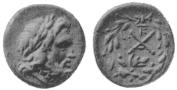
| Head of Zeus Amarios (Fig. 223). | The Achaean monogram; around which
various letters, monograms, local sym-
bols, names of magistrates or of cities,
usually abbreviated; all within wreath
of bay. AR 40-32 grs.
|
It is upon these symbols, &c., that the classification to particular cities is with more or less probability based.
The bronze coinage is historically much more important than the silver, since it offers the name of each city in full, preceded by the name of the Achaeans collectively, e. g. ΑΧΑΙΩΝ ΚΟΡΙΝΘΙΩΝ, &c. Types as follows :—
| Full length figure of Zeus Amarios holding Nike and leaning on sceptre. | Demeter Panachaia (?) seated, holding
wreath and resting on sceptre.
Æ .85-.65
|
On one side is the name Of the city, on the other a local magistrate's name, nearly always at full length.
Zeus Amarios (Strab. 385), called Homagyrios by Pausanias, and Demeter Panachaia were the protecting divinities of the League. Their temples stood side by side at Aegium, where the central assembly held its meetings, εφεξης δε τω Ομαγυριω Διι Παναχαιας εστι Δημητρος (Paus. vii. 24. 2).
The towns which took part in this federal currency were about forty- three in number. The probable date B.C. of admission to the League is added wherever I have been able to ascertain it.
| Aegeira, 274(?) | AR Symb. Half-goat. | Æ ΑΧΑΙΩΝ ΑΙΓΕΙΡΑΤΩΝ. |
| Aegium, 275 | AR Symb. freq. Fulmen. | Æ ΑΧΑΙΩΝ ΑΙΓΕΩΝ. |
| Ceryneia, 273 | AR „ Trident. | Æ ΑΧΑΙΩΝ ΚΑΡΥΝΕΩΝ. |
| Dyme, 280 | AR „ Fish. | Æ ΑΧΑΙΩΝ ΔΥΜΑΙΩΝ. |
| Patrae, 280 | AR „ Dolphin. | |
| Pellene, 274(?) | AR Symb. Lyre or vase. | Æ ΑΧΑΙΩΝ ΠΕΛΛΛΝΕΩΝ. |
| Sicyon, 251 | AR Symb. Dove, tripod. | Æ ΑΧΑΙΩΝ ΣΙΚΥΩΝΙΩΝ. |
| Phlius, 228 | Æ ΑΧΑΙΩΝ ΦΛΕΙΑΣΙΩΝ. | |
| Corinth, 243 | AR Symb. Q or Pegasos. | Æ ΑΧΑΙΩΝ ΚΟΡΙΝΘΙΩΝ. |
| Megara, 243 | AR „ Lyre. | Æ ΑΧΑΙΩΝ ΜΕΓΑΡΕΩΝ. |
| Pagae, 208 | Æ ΑΧΑΙΩΝ ΠΑΓΑΙΩΝ. | |
| Tenea | Æ ΑΧΑΙΩΝ ΤΕΝΕΑΤΩΝ. |
| Argos, 228 | AR Symb. Wolf's-head, harpa, club. | Æ ΑΧΑΙΩΝ ΑΡΓΕΙΩΝ. |
| Cleonae, 229 | Æ ΑΧΑΙΩΝ ΚΛΕΩΝΑΙΩΝ. | |
| Epidaurus, 243 | AR Symb. Serpent, cupping-vessel. | Æ ΑΧΑΙΩΝ ΕΠΙΔΑΥΡΕΩΝ. |
| Hermione, 229 | Æ ΑΧΑΙΩΝ ΕΡΜΙΟΝΕΩΝ. |
| Alea, Before 235 | Æ ΑΧΑΙΩΝ ΑΛΕΑΤΑΝ. | |
| Alipheira, 194 | Æ ΑΧΑΙΩΝ ΑΛΙΦΕΙΡΕΩΝ. | |
| Asea, 194 | Æ ΑΧΑΙΩΝ ΑΣΕΑΤΑΝ (or ΩΝ). | |
| Callista, 194(?) | Æ ΑΧΑΙΩΝ ΚΑΛΛΙΣΤΑΤΑΝ. | |
| Caphyae, 227 | AR Symb. Head of Athena. | Æ ΑΧΑΙΩΝ ΚΑΦΥΕΩΝ. |
| Cleitor | AR Letters ΚΛΗ Symb. Head of Helios. | Æ ΑΧΑΙΩΝ ΚΛΕΙΤΟΡΙΩΝ. |
| Dipaea, 194 | Æ ΑΧΑΙΩΝ ΔΙΠΑΙΕΩΝ. | |
| Elisphasii, 194 | Æ ΑΧΑΙΩΝ ΕΛΙΣΦΛΣΙΩΝ. | |
| Gortys, 194 | Æ ΑΧΑΙΩΝ ΚΟΡΤΥΝΙΩΝ. | |
| Heraea, before 234 | Æ ΑΧΑΙΩΝ ΗΡΑΙΕΩΝ. | |
| Lusi | AR Letters ΛΟΥ. | Æ ΑΧΑΙΩΝ ΛΟΥΣΙΑΤΑΝ. |
| Mantineia, before 222 | AR Symb. Trident. | |
| Mantineia, called Antigoneia, 222 | AR Letters ΑΝ | Æ ΑΧΑΙΩΝ ΑΝΤΙΓΟΝΕΩΝ. |
| Megalopolis, 234 | AR Symb. Syrinx, pedum, fulmen. | Æ ΑΧΑΙΩΝ ΜΕΓΑΛΟΠΟΛΙΤΩΝ |
| Methydrium | Æ ΑΧΑΙΩΝ ΜΕΘΥΔΡΙΕΩΝ. | |
| Pallantium, 194 | AR Symb. ΠΑΛ, Trident. | Æ ΑΧΑΙΩΝ ΠΑΛΛΑΝΤΕΩΝ. |
| Pheneus, 234 | AR „ Caduceus. | Æ ΑΧΑΙΩΝ ΦΕΝΕΩΝ. |
| Phigaleia, 208 | Æ ΑΧΑΙΩΝ ΦΙΓΑΛΕΩΝ or ΦΙΑΛΕΩΝ. | |
| Stymphalus, before 234 | Æ ΑΧΑΙΩΝ ΣΤΥΜΦΑΛΙΩΝ. | |
| Tegea, 222 | AR Letters ΤΕ | Æ ΑΧΑΙΩΝ ΤΕΓΕΑΤΑΝ. |
| Teuthis | Æ ΑΧΑΙΩΝ ΤΕΥΘΙΔΑΝ. | |
| Theisoa, 194 | Æ ΑΧΑΙΩΝΘΙΣΟΑΙΩΝ (or ΕΩΝ) | |
| Thelpusa, before 234 | Æ ΑΧΑΙΩΝ ΘΕΛΠΟΥΣΙΩΝ. |
| Elis, 191 | AR Letters FΑ, Eagle, dove, fulmen. | Æ ΑΧΑΙΩΝ ΑΛΕΙΩΝ. |
| Hypana | Æ ΑΧΑΙΩΝ ΥΠΑΝΩΝ. |
| Asine | Æ ΑΧΑΙΩΝ ΑΣΙΝΑΙΩΝ. | |
| Corone, 184 | Æ ΑΧΑΙΩΝΚΟΡΩΝΑΙΩΝ. | |
| Messene, 191 | AR Letters ΜΕΣ or ΜΕ. | Æ ΑΧΑΙΩΝ ΜΕΣΣΑΝΙΩΝ |
| Lacedaemon, 192 | AR Symb. Pilei of Dioskuri. |
The only Imperial coins of the Roman Province of Achaia which call for special notice are the following, which belong rather to the class of dedicatory medallions than to the ordinary currency, although it is possible that they also circulated as money. It was no unusual thing for wealthy individuals to undertake, on behalf of their native cities, the entire expenses of religious festivals, games, dedications of temples, or other solemnities, in return for municipal honours of various kinds. The sums paid into the local exchequer by such public benefactors, when issued in the form of coin, frequently bore the name of the donor in the nominative case, together with his honorary title and the verb ανεθηκε, followed by the name of the city or province in the dative or genitive.
Such dedicatory pieces are not uncommon in Asia Minor, but in Europe they are very rarely met with.
The following examples were struck at Corinth by Hostilius Marcellus, the priest of the cultus of the deified Antinoüs, and by him dedicated to the Achaeans and Corinthians :—
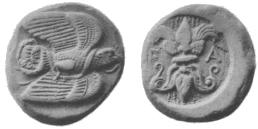
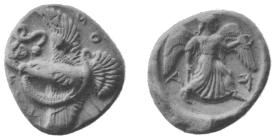
The beautiful silver coins of Elis, of the Aeginetic standard, form a series which, for the variety of treatment and the high artistic ability which it displays, is excelled by no other class of coins in European Greece.
There are no coins of Elis which apparently belong to the period of archaic art before the Persian wars, for the Eleians down to B.C. 471 were not collected into a single city (Diod. xi. 154); Babelon, however
The inscriptions are FΑ, FΑΛΕΟΝ or FΑΛΕΙΟΝ variously abbreviated, and in one instance ΟΛVΝΠΙΚΟΝ, clearly indicating an intimate con- nexion between the coinage and the Olympic games. Babelon (Traité, p. 887) would date the last-mentioned coin as early as, if not earlier than, B.C. 500.
The whole land of Elis was sacred to the Olympian Zeus, and the symbols of this god, the Thunderbolt, and the Eagle with a tortoise, a serpent, a hare, or other animal in his claws, the well-known omen of victory sent by Zeus, Διος τερας αιγιοχοιο (Il. xii. 211), form the constant
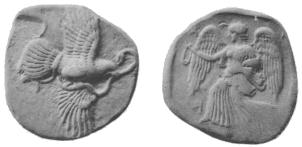
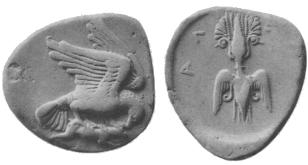
types of the coins of Elis from about B.C. 471-421 (Figs. 226, 227). Other varieties in this period exhibit Nike in various attitudes, running to crown a victor in the games, standing with the sacred fillet in her hand, or seated on a basis, with spread wings and holding palm, fillet, or wreath in her hand. This type is one of the finest compositions in
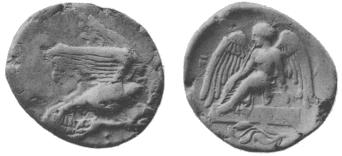
The later series of the period, ending about B.C. 421, are as follows :—
| Round convex shield on which is an
eagle with closed wings, clutching a
serpent or a ram, with beak and claws. [B. M. C., Pelop., Pl. XI. 11, 12.] |
F Α (one or both letters frequently in-
cuse) Fulmen, sometimes with furled
wings, or wingless and flaming at one
end, the whole within the concave
side of the shield which is conspicu-
ous on the obverse; the rim and
inside handles of the shield are some-
times indicated. AR Stater.
|
The fabric of the coins of this series is peculiar. The flans, before striking, were evidently cast together in a mould consisting of a number of circular chambers connected by a passage for the silver to run through from one to another.
| Eagle with closed wings, tearing a hare. [B. M. C., Pelop., Pl. XI. 9.] |
F Α Fulmen with wings at one end
and volutes at the other; the whole
in wreath of olive. AR Stater
|
On the reverse of these staters the olive-wreath surrounding the type, henceforth very prevalent, makes its first appearance.
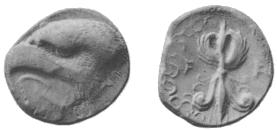
| Large eagle’s head, usually above an ivy-
leaf; beneath, sometimes, ΑΛ or ΠΟ.
(Fig. 229). [B. M. C., Pelop., Pl. XII. 1-8.] |
F Α Fulmen as above, in olive-wreath.
AR Stater and divisions.
|
On the drachm the Eagle’s head is sometimes accompanied by a Lizard (cf. Frazer, Paus., iv. 5). The smallest divisions of this series have the simple mark of value Τ (= Tetartemorion), in place of a type, on the reverse. A stater in Sir H. Weber’s Coll. has the eagle’s head on a convex shield and a large incuse F as countermark. Cf. the shield series described above.
The first introduction of the head of Hera as a coin-type is sup- posed by Gardner (op. cit.) to have taken place both at Elis and Argos about the time of the alliance contracted, circ. B.C. 420, between Elis, Argos, and Mantineia. But, although it is quite conceivable that in the worship of Hera the Argives and Eleians may have found a bond of union, which they expressed upon their respective coinages, we must not
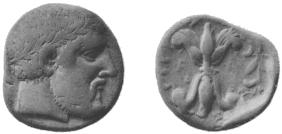
A somewhat earlier head than that of Hera (cf. the older type of fulmen on the reverse) is the powerful and severe head of Zeus (Fig. 230) (B. M. C., Pelop., Pl. XII. 10). The smaller denominations which appa- rently belong to this stater are the following :—
| Head of Zeus. [B. M. C., Pelop., No. 81.] |
Three letters Τ arranged in triskeles
fashion; in the spaces F Α Λ.
AR Tritetartemorion 9.7 grs.
|
| Female head. [B. M.] | Τ, on either side of which, F Α.
AR Tetartemorion 3 grs.
|
The series which I would place next in chronological order is that which is distinguished by the noble head of Hera on the obverse and by a more realistic type of fulmen on the reverse :—
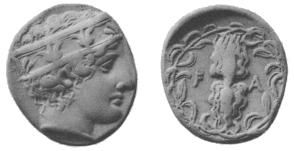
| Head of Hera wearing lofty stephanos
adorned with conventional floral de-
sign. On some specimens is the
legend ΗΡΑ either above the head or
on the stephanos (Fig. 231). [B. M. C., Pelop., Pl. XII. 11-18.] |
F Α Fulmen flaming at both ends; the
whole in olive-wreath.
AR Stater, Drachm, ½ Drachm
and Obol.
|
It is instructive to compare the bold and large treatment of the features of the goddess on the coins of this series with the weaker, if more delicate, work which characterizes the coins with the same head struck some years later.
The period ending about B.C. 400 also includes the following highly interesting specimens.
| FΑΛΕΙΟΝ Head of Zeus bound with
olive (?)-wreath. [B. M. C., Pelop., Pl. XIII. 1.] |
ΟΛΥΜΠΙΑ Head of Olympia; hair
confined in sphendone. AR Stater.
|
| FΑΛΕΙΟΝ Head of Zeus; same die as
preceding coin. [B. M. C., Pelop., Pl. XIII. 2.] |
Eagle with closed wings standing on
capital of Ionic column. AR Stater.
|
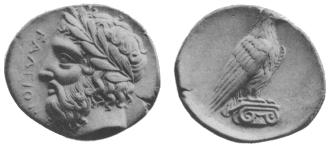
The head of the Olympian Zeus on these coins is softer and more ornate in style than the large and more severe conception of the same god (B. M. C., Pelop., Pl. XII. 10) noticed above. It is no less dis- tinguishable from the Zeus-heads which follow it, first, by the smooth and flowing beard instead of the crisp and curly one which characterizes the coins of Arcadia (B.C. 370), and secondly, by the large-leaved wreath which encircles the head and dominates the brow, while the wreath on the later coins is comparatively inconspicuous and often half-hidden in masses of hair.
The head of the nymph Olympia, accompanied by her name ΟΛΥΜΠΙΑ, is easily distinguished from that of Hera by her head-dress. The Eleians in the choice of this type perhaps intended to emphasize their claim to the sole administration of the Olympic games.
On the following series a similar head of Olympia occupies the obverse instead of the reverse.
| F Α Head of Olympia; hair confined in
sphendone. [B. M. C., Pelop., Pl. XIII. 3-5.] |
Eagle standing with closed wings in
olive-wreath.
AR Stater and divisions.
|
It is also to the close of the period ending about B.C. 400 that I would ascribe the fine Hera-head on the following stater. In style (though it is difficult to compare a female head with a male one) it strongly resembles the head of Zeus above described (ibid., Pl. XIII. 1).
| F Α Head of Hera wearing stephanos
bound with large olive-wreath. [B. M. C., Pelop., Pl. XIII. 12.] |
Eagle standing with closed wings in
olive-wreath. AR Stater.
|
During the next half-century there are fewer varieties of coin-types. Hera seems to be the only divinity represented, and the predominant type is a more feminine rendering of the bold and large-featured head of the same goddess on the coins of the previous period.
| F Α Head of Hera wearing ear-ring,
necklace, and stephanos adorned with
various floral patterns, and sometimes
inscribed, ΗΡΑ or FΑΛΕΙΩΝ. [B. M. C., Pelop., Pl. XIII. 13-15; XIV. 1-11, 13, 14.] |
Eagle with open wings, sometimes on
stag’s head or hare; the whole in
olive-wreath.
AR Stater and divisions.
|
This is the last series of Eleian staters on which the wreath of wild olive surrounds the reverse type, although it recurs on small coins of
In the year B.C. 364 the Pisatans, under the protection of the Arcadians, succeeded in wresting from the Eleians the presidency of the Olympic games, and struck on that occasion some small gold coins (see Pisa) with a head of Zeus similar in style to that on the coins of Elis of the last period. Elis, however, before the next festival, was again in a position to assert her supremacy, and from this time down to the Macedonian conquest issued, as occasion required, silver staters bearing on the obverse heads of Zeus. Stylistically these heads differ very considerably from those above described. At first they closely resemble the ideal Zeus-head on the fine coins of the newly founded Arcadian κοινον; cf. the thick and curly beard, and luxurious growth of hair streaming downwards from the temples over the back of the neck in grand wave-like fashion and high relief, which throws into the background the laurel-wreath, hitherto the predominant emblem of the kingship of Zeus. This new and more leonine type of Zeus-head was henceforth universally adopted through- out the Hellenic world (cf. the coins of Philip of Macedon, Alexander of Epirus, &c.) as the final and perfect expression of an almighty god, father and king of gods and men. No further improvement on this noble conception of the head of the supreme deity was possible. It thus became conventional and a type to be copied by successive die-engravers, who, little by little, became more and more careless in workmanship, content with roughly reproducing its most salient feature.
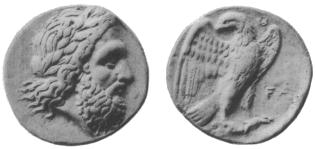
The earliest and finest examples of this new conception of the head of Zeus on coins of Elis are the following :—
| Head of Zeus, r. laur. [B. M. C., Pelop., Pl. XIII. 8.] |
FΑΛΕΙΩΝ or F Α Eagle, wings closed,
standing r. on capital of column.
AR Stater and divisions.
|
| Id. (Fig. 233). [Ibid., Pl. XIV. 12.] | F Α Eagle, wings open. AR Stater.
|
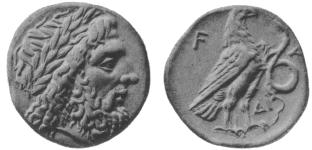
The later and inferior examples (B. M. C., Pelop., Pl. XV. 1-3, 7, 8) have on the reverse F A and an eagle with closed wings, sometimes standing on a capital of column or ram’s head, &c., and with various symbols and letters in the field :—fulmen, coiled serpent and ΔΙ (Fig. 234); fulmen, coiled serpent and Η; coiled serpent and ΑΡ; fulmen, wreath, and ΑΡΙ, &c. These coins are all more or less degenerate in style, but it is questionable whether their issue extended beyond the beginning of the Macedonian dominion, B.C. 323. Those reading ΑΡΙ are attributed by Gardner to the tyrant Aristotimus, B.C. 272-271; but this conjecture is
If any coins were struck at Elis during this period of Macedonian supremacy, they will probably be identified among the Alexandrine tetradrachms with symbol, fulmen (cf. Müller, Nos. 894-5).
On the expulsion of Telesphorus, the general of Antigonus, Elis recovered her autonomy and renewed the issue of silver coins, but either on a debased or on a different coin-standard which is identical with that of the coins of the Achaean League.
| Eagle, wings raised, clutching hare. [B. M. C., Pelop., Pl. XV. 9, 10.] |
F Α Winged fulmen, sometimes with
symbol and letters in field. AR 70 grs.
|
| Head of Zeus, r. laur. [Ibid., 12.] | F Α Fulmen within olive-wreath, often
with letters ΑΡΙ. AR 40 grs.
|
The first of these coins is a curious reversion to an ancient type long fallen into disuse. The same type of fulmen occurs on late Æ of Lacedaemon.
It is improbable that Elis issued bronze coins much before Macedonian times. The following types are chiefly subsequent to B.C. 312. Obv. Head of Zeus or of Hera. Rev. F A Eagle, Free horse, Zeus hurling fulmen, Fulmen in wreath (B. M. C., Pelop., Pls. XV. 13-16 and XVI. i; Wroth, N. C., 1905, p. 334).
In B.C. 191 Elis was compelled by the Achaeans, much against her will, to join their League (p. 418, supra).
With the Roman conquest the series of the silver coins of Elis comes to an end, but the town still continued to issue bronze money of base style.
| Head of Zeus. | FΑΛΕΙΩΝ in wreath of wild olive.
Æ .8
|
Hadrian to Caracalla. Inscr., ΗΛΕΙΩΝ or ΗΛΕΙWΝ. The following types deserve especial mention. Hadrian, rev., Figure of Zeus Olympios seated on throne, holding Nike, and resting on sceptre. Hadrian, rev., Head of Zeus Olympios (Gardner, Types of Gk. Coins, Pl. XV. 18 and 19). There can be no doubt that these two remarkable coins are copies of the head, and of the entire statue, of the world-renowned chryselephantine Zeus of Pheidias at Olympia, and moreover that they are the most faithful copies of this masterpiece which have been handed down to us (cf. Gardner, Coins of Elis, p. 47 sq., and J. H. S., 1908, p. 48 sq.). Hadrian, rev., River-god Alpheios reclining, holding in his right hand a wreath and in his left a reed, at his feet a prize crown containing a palm. It was on the banks of this river that the Olympian games were solemnized, to which the palm in a prize crown here alludes. Aphrodite riding on goat. Dionysos to front holding rhyton and thyrsos, between panther and tympanum (Imhoof and Gardner, Num. Comm. on Paus., 73, 74). Goddess (Olympia ?) standing; holding eagle and olive-branch, between two recumbent river-gods (Z. f. N., xxiv. Pl. III. 1).
Pisa. The ancient city of Pisa, a little to the east of Olympia, had been destroyed by the Eleians in B.C. 572, but the descendants of its former inhabitants continued to be distinguished as Pisatans, and in B.C. 364 the Arcadians determined to restore to them their ancient right of presiding over the Olympic games. This attempt proved successful on the occasion of the 104th Olympiad. The Pisatans then seized the temple treasures, and converted them into coin for the payment of troops. A few specimens of this money, which is of gold, have been preserved (R. Weil, Pisa, Z. f. N., xxii. 1900, 1 ff).
| Head of Zeus. [Num. Chron., 1879, Pl. XIV. 7.] |
ΠΙΣΛ Three half-thunderbolts.
AV Trihemiobol, 24 grs.
|
| Id. [Ibid., Pl. XIV. 8.] | „ Thunderbolt. AV Obol.
|
After this bold attempt on the part of the Pisatans, the Eleians recovered the presidency of the games, and forthwith ordered the 104th celebration, as having been illegal, to be omitted from the official list of Olympiads.
Cephallenia, the largest of the Ionian islands, derived its name from the hero Kephalos. In historical times this island was a tetrapolis, the land being divided between the four towns, Same, Proni, Pale, and Cranii, each of which seems to have been independent of its neighbours. The money standard of the Cephallenian towns was the same as that
Cranii, B.C. 500 or later. The archaic silver money of this town, Inscr., ΚR, ΚRΑ, ΚRΑΝΙ, &c., shows on the obverse a ram’s head (Stater); ram (Triob.); forepart of ram, Rx. ΤRΙ (Trihemiob.); head of ram (Obol). The usual reverse type is a bow.
Somewhat later than the foregoing are the following coins which have been assigned to Cranii on account of their reverse type.
| Archaic bust of Prokris (?) wearing stephane, ear-ring and necklace. | Ram’s head in incuse square.
AR 57.4 grs.
|
| Id. [Babelon, Traité, Pl. XXXIX.] | Id. AR 19.4 grs.
|
| Ram’s head. | ΚΡΑ Animal’s hoof. AR Obol.
|
| Gorgon-head. | „ ΤΤΤ. AR Tritetartemorion.
|
| Ram’s head. | „ Η. AR Hemiobol.
|
On the bronze coins of the fourth century the usual types are :—Ram, rev., bow; Bull’s head, rev., Κ; Ram, rev., Η; Kephalos standing resting on spear, rev., ΚΡΑ, ram’s head or hoof; Head of Athena, rev., Κ or Η; Head of Athena, rev., Kephalos kneeling with bow in hand; Helmet, rev., Κ; &c.
It will be seen that the types for the most part refer to the myth of Kephalos, and to the cultus of Hermes, his reputed father, to whom the ram was sacred.
In B.C. 189 Cephallenia became subject to the Romans, and hence- forth no coins seem to have been issued in the island until the time of Augustus, when C. Proculeius issued coins bearing his own name in Latin with the monogram of Cranium in the Greek character (B. M. C., Pelop., Pl. XVII. 7, 8).
Imperial—Domna, Maximinus, Philip I, and Otacilia. Inscr., ΚΡΑΝΑΙΩΝ. Types :—Man leading bull to the sacrifice; head of Athena, &c. (Lambros, Pelop., 61, cf. Num. Zeitung, 1837, 113).
| Π Ram. | Incuse square, in which pine-cone and
leaves. AR Triobol.
|
| ΠΑ Head of Kephalos, bare. | ΚΕΦΑΛΟΣ Kephalos naked, seated on
rock holding spear.
AR Tetrobol and Diobol.
|
| Head of Prokris in sphendone; behind,
stork. [B. M. C., Pelop., Pl. XVII. 13.] |
ΚΕΦΛ Head of Kephalos in pilos;
symbols, dog’s head and spear-head.
AR Diobol.
|
| Π Α Female head crowned with corn, copied from the prevalent Syracusan type, but possibly intended for Prokris. | ΚΕΦΑΛΟΣ Kephalos seated on rock
[B. M. C., Pelop., Pl. XVII. 14-17].
AR Tetrob. and Diob.
|
| Head of Prokris (?) in sphendone. | ΠΑ Dolphin [Ibid., Fig. 18].
AR Tetrob.
|
| Similar. [N. C., 1895, Pl. X. 4.] | Three corn-grains between letters
Τ Τ Τ arranged foot to foot.
AR Tritetartemorion.
|
| Π Α Ear of corn, copied from coins of Metapontum. | Rudder between dolphin and spear-head
[Ibid., Fig. 19]. AR Triob.
|
| Head of Athena. | Corn-grain within the letter Π [Hunter
Cat., Pl. XXXVIII. 12].
AR Tetartemorion.
|
Some of these types occur on the bronze coins. The most frequent reverse type is the corn-grain within the letter Π, or the letters ΠΑ in monogram.
Proni, on the south-eastern coast of Cephallenia, was dominated by Mt. Aenus, on the summit of which was the temple of Zeus Αινησιος. This mountain is still covered with forests of fir-trees, which the fir-cone shows must also have been the case in ancient times.
| Head of Kephalos. | ΠΡΩΝΝΩΝ Club. AR Triob.
|
| Head of Prokris. | Corn-grain within letters ΠΡ in mono-
gram. AR 1 ½ Ob.
|
| Head of Zeus Aenesios. | ΠΡ Fir-cone. Æ .85 and .65
|
Same, the most ancient city in Cephallenia, stood upon the eastern cost of the island.
| Head of Kephalos with short hair, laureate. | ΣΑΜΑΙΩΝ Hound.
AR Tetrob., Diob., and Obol.
|
| Head of Athena to front. | ΣΑΜΑΙΩΝ Ram. AR Triob. and Æ.
|
| Head of Prokris (?), laur. | ΣΑ Hound. AR Obol.
|
For other varieties see B. M. C., Pelop., and Lambros, op. cit.
The dog on the silver coins of Same is the hound Lailaps presented to Kephalos by Prokris.
Ithaca. This island, which derives its chief interest from the poems of Homer, issued autonomous bronze coins, which appear to belong chiefly to the fourth and third centuries. Inscr., ΙΘΑ, ΙΘΑΚΩΝ (B. M. C., Pelop., Pl. XXI. 8-13).
| Head of Odysseus in conical pilos. | Fulmen in olive-wreath. Æ .65
|
| Head of Athena. | Head of Odysseus. Æ .85-.6
|
| Id. | Odysseus naked, standing resting on
spear [1]. Æ .65
|
| Id. | Cock. Æ .75
|
| Head of Odysseus. | Id. Æ .65
|
1 This coin is attributed by Earle Fox, more probably, to Mantineia.
Zacynthus, an important island about ten miles south of Cephallenia, and the same distance west of the coast of Elis, contained but one city, which bore the same name as the island, derived, it is said, from Zakynthos, son of Dardanos. The coin-types, however, suggest that Zakynthos was locally identified with Apollo (cf. the epithet Κυνθιος). The crescent moon, on early Zacynthian coins, also suggests a cultus of Artemis Selene or Κυνθια. The chief deities of Zacynthus were certainly Apollo, to whom there was a temple in the lower town, Dionysos, and Artemis. Pliny (xxxv. 15) mentions Mt. Elatus as a remarkable feature in the island, ‘Mons Elatus ibi nobilis.’ On this mountain fragments of an inscription have been found which show that a temple of Artemis once stood there (Bursian, Geog., ii. 379). The silver money of Zacynthus falls into the following chronological periods. (For illustrations see N. C., 1885, Pls. III, IV; B. M. C., Pelop., Pls. XIX-XXI; Lambros, Pelop., Pl. IX, and Babelon, Traité, Pl. XXXIX.) The weight standard of the silver money corresponds with that of Cephallenia. The stater weighs about 180 grs. (max.). Its divisions are thirds, 60 grs., sixths, 30 grs., and eighteenths, 10 grs.
Tripod with • and  between legs. between legs.[N. C., 1885, Pl. III. 1.] |
Incuse square divided into six triangles.
AR 55 grs.
|
| ΖΑ Crescent; symbol, sometimes, ivy- leaf. [Ibid., Pl. III. 3, 4.] | Tripod in incuse square. AR 29.5 grs.
|
| ΖΑ Amphora. [Ibid., Pl. III. 2 and 5-7.] |
Id. AR 58.2 grs. and divisions.
|
| Head of Apollo laureate, of early style. | ΖΑ or ΖΑΚΥΝΘΙΟΝ Tripod; symbol,
on larger coins, cock’s head.
AR Stater, Tetrobol, Diobol, &c.
|
| Id. | „ Two laurel leaves. AR Obol.
|
| Id. | „ Laurel leaf in incuse square.
AR ½ Obol.
|
Some of the small coins of variable weights bear marks of value, Ο for Obol, Η for Hemiobol.
| Head of Apollo laureate, of early style. | ΖΑΚΥΝΘΟΣ Zakynthos (?) naked,
seated on rock, playing lyre.
AR Stater and Tetrobol.
|
| Head of Apollo laureate, of fine style. | ΖΑΚΥΝΘΟΣ Zakynthos seated l. on
rock, placing his hand on the head
of a coiled serpent. AR Stater.
|
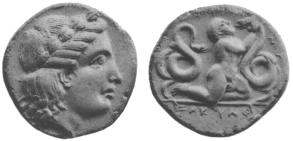
| Head of Apollo laureate, of fine style (Fig. 235). | ΖΑΚΥΝΘΙΩΝ Infant Zakynthos (?)
fondling two serpents. AR Stater.
|
The reverse type of this coin was perhaps suggested by that of the alliance coins issued by Byzantium, Cnidus, Ephesus, Samos, Iasus, and Rhodes, after the battle of Cnidus, B.C. 394. Cf. similar borrowed types on contemporary coins of Thebes and Locri Epizephyrii. Von Sallet (Z. f. N., xviii. 197) would identify the child on the Zacynthian coin with the infant Asklepios, but his arguments are not convincing.
| Head of Apollo laureate, of fine style. | ΖΑΚΥΝ or ΖΑΚΥΝΘΙΩΝ Tripod and
magistrate’s name, ΑΓΕ. AR Stater.
|
| Id. | Ζ Α Tripod in laurel-wreath.
AR Tetrobol.
|
| Id. | ΖΑΚΥ Tripod and symbol. AR Diobol.
|
| Id. | Ζ Α Κ Altar of Apollo, laur.
AR Obol or ½ Obol.
|
| Lyre. | Ζ Α Tripod. Æ .75
|
| Head of Apollo laureate. | Ζ Α Tripod, around which the name
ΔΙΩΝΟΣ, ΑΝΑΞΙΠ., or ΔΙΟ-
ΝΥΣΟΔΩΡΟΥ. AR Stater.
|
| Id. | Ζ Α Tripod. Symbol, large crescent.
Mag. ΣΤΡΑ, or no name.
AR Tetrob., Obol, &c.
|
| Head of Apollo laureate. | Large Ζ within which ΖΑ and ΔΙ.
Æ .55
|
| Head of Apollo laureate. | Ζ Α Tripod in wreath, ΔΙ, &c. Æ .55
|
It is quite possible that the magistrate Dion, whose name occurs on some of the Zacynthian staters, may have been Dion of Syracuse, who, while preparing his expedition against Dionysius the Younger, B.C. 357, made Zacynthus his head-quarters, and before embarking offered solemn sacrifice with great magnificence to Apollo (Plut. Dion. xxii).
The remaining silver and bronze coins of autonomous times are of various types, mostly small, and of careless work. The half-Pegasos on some of them points to relations with Corinth (B. M. C., Pelop., Pl. XX. 7-10).
The next series of coins which can be accurately dated are bronze pieces issued by C. Sosius, the general of M. Antony, who must have been for a time governor of the island. Some of these bear the head of Antony, others those of Apollo, Poseidon, or a Dolphin, with ΖΑ, and, in successive years (B.C. 39-32), C. SOSIVS Q[uaestor], IMP[erator], COS. DES[ignatus], and COS. (Lambros, Pelop., 73).
The Imperial coins of Zacynthus range from Antoninus Pius to
Messene. From the close of the second Messenian war, B.C. 668, for the space of 300 years Messenia was subject to Sparta and incorporated in Laconia. It was not until after the battle of Leuctra that the exiled descendants of the Messenians were restored to their country, under the auspices of Epaminondas, and the city of Messene founded B.C. 369 on the western slope of Mt. Ithome, where stood a temple of Zeus Ithomatas, whose figure appears on the coinage, and in whose honour an annual festival (‘Ιθομαια) was held (Paus. iv. 33). The coins of Messene fall into the following periods :—
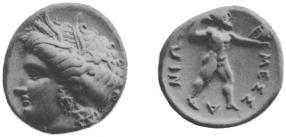
| Head of Demeter crowned with corn,
of the finest style of art (Fig. 236). [B. M. C., Pelop., Pl. XXII. 1.] |
ΜΕΣΣΑΝΙΩΝ Zeus Ithomatas strid-
ing to right, wielding fulmen and
holding eagle. AR Aeginetic Stater.
|
| Similar. [Ibid., 2, 3.] |  Σ Tripod. Σ Tripod. AR Obol and Æ .4
|
| Similar. [Ibid., 4.] | ΜΕ in plain concave field. Æ .65
|
The beautiful head of Demeter crowned with corn on these coins is a free copy of the popular type first introduced by Euaenetos, the Syracusan engraver. Cf. the contemporary coins of the Opuntian Locrians and of Pheneus in Arcadia.
The temple of Demeter on Mt. Ithome is mentioned by Pausanias (iv. 31) as a place of peculiar sanctity, Δημητρος ιερον Μεσσηνιοις εστιν αγιον. The figure of Zeus on the reverse was probably suggested by the statue executed by Ageladas for the Messenians while they were settled at Naupactus, το δε αγαλμα του Διος ‘Αγελαδα μεν εστιν εργον, εποιηθη δε εξ αρχης τοις οικησασιν εν Ναυπακτω Μεσσηνιων (Paus. iv. 33.). On the restora- tion of the Messenians to their native land the statue appears to have been transported to Messene. It was not, however, placed in the temple of Zeus on Mt. Ithome, but kept in the Priest’s house in the lower city.
The Messenians after Macedonian times adopted the Attic standard in place of the Aeginetic previously in use. Tetradrachms were now issued with the old types modified.
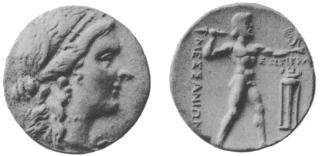
| Head of Demeter of poor style (Fig.
237). [B. M. C., Pelop., Pl. XXII. 6, 7.] |
ΜΕΣΣΑΝΙΩΝ Zeus Ithomatas as be-
fore, but of more slim proportions;
behind, sometimes ΙΘΩΜ. In front,
tripod and magistrate’s name.
AR Attic Tetradr.
|
The next series of Messenian silver money resembles in style the contemporary coinage of the Achaean League.
| Head of Zeus. | ΜΕΣ Tripod, sometimes with magis-
trate’s name; all in wreath.
AR Attic Tetrobol = Aeginetic Triobol.
|
There are bronze coins of all the above periods, of which the types for the most part resemble the silver.
For Federal coins of the Achaean League see p. 418.
| ΜЄCCΗΝΙWΝ Bust of Messene veiled and turreted, or bust of Emperor. | Zeus Ithomatas as above, or Asklepios
standing, Herakles, Hygieia, Arte-
mis Laphria, Athena, &c. Æ .75
|
The obverse of the first of these coins represents Messene, the daughter of Triopas, of whom there was a temple at Messene with a statue of gold and Parian marble (Paus. iv. 31).
Asine. A town of Messenia built by the Dryopes when they were expelled from Asine in Argolis, at a very early date.
The Asinaeans were proud of their Dryopian origin, and in addition to a temple of Apollo they had a shrine and an αγαλμα αρχαιον of Dryops, in whose honour they celebrated a mystery every other year (Paus. iv. 34).
| Head of Apollo. [Corolla Num., p. 157.] |
[Δ]ΡΥΟΨ ΑΣΙΝΑΙΩ[Ν] Dryops
seated holding kantharos. Æ .65
|
For Federal bronze coins see Achaean League, p. 418.
Imperial—Severus to Geta. Inscr., ΑCΙΝΑΙΩΝ. Types— Apollo Pythaeos leaning on pillar (Paus. ii. 36. 5), Asklepios, Hermes, Perseus, &c.
Colone. Imperial of Severus, Domna, and Geta. Inscr. ΚΟΛΩΝΙЄΩΝ and ΚΟΛWΝЄΙΤWΝ. Types—Artemis, Asklepios, Poseidon, Bull, Aphrodite facing, resting on sceptre and holding apple.
The autonomous coins formerly attributed to this city belong to Colone in the Troad.
Corone derived its name from Coroneia in Boeotia, whence it was founded. In the Acropolis was a bronze statue of Athena holding a crow in her hand. It is the head of this goddess which appears on the coins.
| Head of Athena. | ΚΟΡ Grapes in ivy-wreath. AR Tetrobol.
|
| Id. | ΚΟΡΩΝΑΙΩΝ Grapes; beneath, ΟΙΤ.
Æ .8
|
For Federal coins after B.C. 184 see Achaean League, p. 418.
Cyparissia, the port of Messene. Imperial— Severus to Sev. Alex. Inscr., ΚΥΠΑΡΙCCΙЄΩΝ. Types—Asklepios, Dionysos, Athena, Poseidon, &c.
Mothone. Autonomous bronze. Third century B.C. (?).
| Hephaestos running with torch. | Μ Ο in plain field [Imhoof, Mon. gr.,
Pl. E. 2]. Æ .7
|
This coin-type would lead us to suppose that Lampadephoria were celebrated at Mothone in honour of Hephaestos. Imhoof (op. cit.), p. 171. See also Rev. Num., 1864, p. 187.
Imperial—Severus to Geta. Inscr., ΜΟΘΩΝΑΙΩΝ. Types—Askle- pios, Poseidon, Athena, Isis, &c., and the Port of Mothone in the form of an amphitheatre with a galley about to enter it (Paus. iv. 35. 1).
Pylus. Imperial—Severus to Geta. Inscr., ΠΥΛΙWΝ. Types— Asklepios, Dionysos, Athena, and Ram on a basis.
Thuria. Bronze of late autonomous times.
| Head of Demeter. | ΘΟΥ Zeus Ithomatas. Æ .9
|
| Head of Zeus. | ΘΟΥ Athena standing. Æ .85
|
| Head of Athena. | ΘΟΥ in wreath of corn. Æ .5
|
Imperial—Severus to Geta. Inscr., ΘΟΥΡΙΑΤΩΝ. Types—Zeus, Athena, Asklepios, &c., all with letters ΛΑ in the field, indicating that Thuria, although geographically situated in Messenia, belonged at this time politically to Laconia (cf. Paus. iv. 31. 1).
Asopus. Imperial—Severus to Geta. Inscr., ΑCWΠΕΙΤWΝ. Types— Zeus, Athena, Artemis, Poseidon. Dionysos, Nemesis, &c.
Boeae. Imperial—Domna to Geta. Inscr., ΒΟΙΑΤΩΝ. Types— Poseidon, Athena, Asklepios, Artemis, Isis, Eros, Bull, &c.
Gythium, the port of Sparta. Imperial—Severus to Geta. Inscr.,
Lacedaemon. Of the traditional iron money of Sparta no specimens have come down to us, nor indeed is there any money of any metal known to have been struck at Sparta until the third century B.C., the earliest coins being tetradrachms and drachms copied from those of Alexander the Great, but reading ΒΑΣΙΛΕΟΣ ΑΡΕΟΣ (Lambros, Pelop., Pl. XI. 6). It is also to the reign of Areus that the following tetradrachms seem to belong. The portraits on the few known specimens vary considerably. Some of them resemble in general type the heads of Demetrius Poliorcetes (Lambros, ib., Fig. 7; N. C., 1897, Pl. V. 1; B. M. C., Pelop., Pl. XXIV. 1).
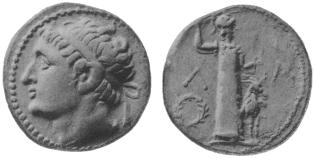
| Head of king diademed (Fig. 238). | Λ Α Archaic agalma of the Apollo of
Amyclae helmeted, holding spear and
bow, and adorned on the side with a
cock standing on an aplustre; beside
the statue, a goat; in field, wreath.
AR Tetradrachm.
|
The reverse type corresponds with the description given by Pausanias (iii. 19) of the Apollo of Amyclae, but he makes no mention of the goat, εχει δε επι τη κεφαλη κρανος, λογχην δε εν ταις χερσι και τοξον.
The coins which seem to follow next in order of time, and which I would assign to the period between the death of Areus and the usurpation of the tyrant Nabis, are the following :—
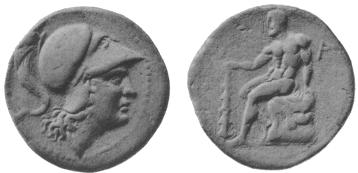
| Head of Athena in crested Corinthian helmet (Fig. 239). | Λ Α Herakles seated on rock, resting
on his club. AR Tetradr. 235 grs.
|
| Head of bearded Herakles in lion-skin. [B. M. C., Pelop., Pl. XXIV. 2.] |
Λ Α (?) Club between the two stars of
the Dioskuri. AR 14 grs.
|
| Head of young Herakles. [B. M.] | Λ Α Similar. Æ .8
|
| Eagle with closed wings on fulmen. [B. M. C., Pelop., Pl. XXIV. 3.] |
Λ Α Winged fulmen. Æ .9
|
| Eagle with open wings. [B. M.] | Λ Α Fulmen between stars. Æ .8
|
| Head of Nabis with short beard and
whiskers, bound with laurel-wreath
tied at back of neck. [N. C., 1897, Pl. V. 2.] |
ΒΑΙΛΕΟΣ ΝΑΒΙΟΣ Bearded Herakles
seated on rock and resting on his
club. AR Tetradr. 263 grs.
|
| Head of Athena in crested Corinthian helmet. [Lambros, Pelop., p. 89.] | Λ Α ΝΑΒΙΟΣ Similar type between
two stars. AR Tetradr.
|
On these coins ΒΑΙΛΕΟΣ and ΝΑΒΙΟΣ are not blunders for βασιλεος and Ναβιδος, but Laconian dialectic forms (see Perdrizet, N. C., 1898, 1). When, in B.C. 192, Sparta joined the Achaean League after the defeat of Nabis, she seems to have struck both Federal and autonomous coins down to the time of Augustus, though the silver money doubtless ceased in B.C. 146.
| Bearded head of Herakles diademed,
laureate, or crowned with ivy. [B. M. C., Pelop., Pl. XXIV. 4-6.] |
Λ Α Amphora between the pilei of the
Dioskuri; serpent sometimes twisted
round amphora. AR Tetrob.
|
The autonomous bronze money of Lacedaemon is plentiful. The series commences in the third century B.C., and extends into Roman times. The principal obverse types are heads of Apollo, of the Dioskuri, of Athena, of Herakles, of Lykurgos, &c., while those of the reverse are Club, Owl, Eagle, Two amphorae, head of Artemis, the Dioskuri, Pan seated on rock, Artemis huntress, Artemis with torch, Club and caduceus united, &c.
The following coin must also be ascribed to Lacedaemon :—
| ΡΩΜΑ Head of Roma bare. | ΚΟΙ[νον] ΛΑΚЄ[δαιμονιον] ΤΙ ΚΥΠΑ-
ΡΙCCΙΑ Artemis Kyparissia standing.
Æ .8
|
(See Zeit. f. Num., vii. p. 17.) The magistrate ΤΙ may be Timaristos the Ephor whose name occurs in full on other coins. It is doubtful whether Κυπαρισσια is here an epithet of Artemis or the name of an agonistic festival; the latter seems more probable.
Among other magistrates’ names is also that of ΕΥΡΥΚΛΗΣ, who was governor of Laconia under Augustus (Strab., p. 366), and of ΑΤΡΑΤΙΝΟΣ (Imhoof, Mon. gr., p. 172).
| ΣΠΑΡΤΗ Diademed bust of Sparta, daughter of Eurotas and wife of Lakedaemon, fourth king of Laconia. | ΛΑ ΕΠΙ ΕΥΡΥΚΛΕΟΣ The Dioskuri
galloping. Æ 1.0
|
| Head of Zeus. | ΛΑ ΕΠΙ ΛΑΚWΝΟΣ Heads of the
Dioskuri. Æ .8
|
C. Julius Lacon succeeded his father Eurycles in the government of Lacedaemon. His name also occurs on a coin of Claudius.
| Heads of the Dioskuri. | ΛΑ, Mag. ΑΡΙCΤΟΚΡΑΤΗC, in wreath.
Æ 1.0
|
| ΕΦΟΡΩΝ Head of Apollo. | ΛΑ Artemis running with torch. Mag.
ΤΙΜΑΡΙCΤΟC. Æ 1.15-.9
|
| ΛΥΚΟΥΡΓΟC Head of Lycurgus. | ΛΑ ЄΦΟΡWΝ ΤΙΜΑΡΙCΤΟC Club
and caduceus combined. Æ .9
|
These coins are remarkable for the mention of the Ephors, a title which does not occur, so far as I am aware, on the coins of any other city. For the history of the family of C. Julius Eurycles see R. Weil (Mittheilungen des Archëologischen Instituts in Athen, Band vi).
There are also Lacedaemonian bronze coins with the following re- markable inscriptions:—
| ΓΕΡΟΝΤΩΝ Head of Apollo. | Λ Α Artemis huntress. Æ .8
|
| ΝΟΜΟΦΥΛΛΚΕC Bust of Athena. | Λ Α The Dioskuri, Mag. ΑΡΙCΤΑΝ-
ΔΡΟC. Æ .8
|
Imperial—Augustus to Salonina. Inscr., ΛΑ, ΛΑΚЄΔΑΙΜΟΝΙΩΝ. Principal Types—The Dioskuri, Apollo Amyklaios, Apollo in the attitude of Apollo Lykios with his hand upon his head, Aphrodite Morpho veiled, seated on square cippus, and apparently with bonds about her feet, as described by Pausanias (iii. 15), Asklepios, Hygieia, Hermes Agoraios carrying infant Dionysos (Paus. iii. 11, 14), &c., sometimes with marks of value ΑC[σαρια], Δ, Ϛ, Η (= 4, 6, 8) in field (Imhoof, op. cit., p. 173).
(For illustrations see B. M. C., Pelop., Pls. XXIV-XXVI, and Lambros, Pelop., Pls. X, XI.)
Las. This ancient Homeric city was situated a few miles south of Gythium, near the western coast of the Laconic Gulf.
Imperial—Severus to Geta. Inscr., ΛΑΩΝ. Types—Athena, Artemis, Herakles, Asklepios, Hygieia, &c.
Cythera. This island had in early times received from the Phoe- nicians the worship of Aphrodite, and throughout historical times it continued to be a special seat of that cultus. Its coins are all of bronze, and for the most part belong apparently to the third and second centuries B.C. Inscr., ΚΥ, ΚΥΘ, ΚΥΘΗΡΙΩΝ &c.
| Head of Aphrodite, sometimes crowned
by flying Eros. [Zeit. f. Num., xiii. Pl. IV. 6.] |
Dove standing or flying. Æ .6
|
For varieties see B. M. C., Pelop., 107 ff, and Lambros, Pelop., 92.
Argos, renowned in legend as one of the most ancient cities in Greece, lay at the foot of a lofty hill overlooking a wide plain, bounded on the south by the broad Argolic Gulf. In the earliest historical times it is said to have been the centre of an amphictyony of all the neighbouring towns. None of these ancient cities, unless Aegina was one of them, seem to have coined money before the Persian wars. On the archaic staters with two dolphins, sometimes attributed to Argos, see Uncertain archaic coins of the Aegaean Islands, infra, p. 480 f.
A few years before the Persian wars Argos met with a crushing defeat at the hands of the Spartans, which crippled her power and put an end to her prosperity for the space of an entire generation. It was not until about B.C. 468 that, by the destruction of several neighbouring cities, including Mycenae, and the removal of their population to Argos, she regained her ancient importance and began to issue silver coins.
The coins which I would attribute to this period are the following :—
| Wolf. | Large Α, above which, two deep square
indentations: all in incuse square.
AR Dr.
|
| Half-Wolf. | Id. AR ½ Dr.
|
| Wolf’s head. | Id. AR Obol.
|
| ⊟. | Id. AR ½ Obol.
|
Most of these coins have from one to four pellets within or about the Α in the incuse square. They are not marks of value, as they do not correspond with the denominations on which they occur. Other small silver coins attributed to Argos bear a helmet On both sides or a rosette on the obverse, and a helmet on the reverse (B. M. C., Pelop., Pl. XXVII. 7, 8). The flower may be a symbol of Hera ‘Ανθεια.
The wolf is the well-known symbol of Apollo Lykios, whose worship at Argos dates from very remote times. Hence Sophocles (Electr. 6) calls the agora of Argos του λυκοκτονου θεου αγορα Αυκειος, for here stood the temple of the god (Paus. ii. 19). The archaic aspirate ⊟ on the Hemiobol can hardly in this instance stand for a mark of value for ημιοβολιον, for it frequently recurs on bronze coins of Argos, where such an interpretation is inadmissible. I take it to be the initial letter of the name of the goddess Hera, or of games (Heraea), handed down from archaic times like the Q at Corinth, the F at Elis, and the Μ (= Σ) at Sicyon (cf. the ☧ as a Christian symbol). That the letter ⊟ has this signification seems on other grounds highly probable, for it also occurs stamped upon a roof-tile from the old temple of Hera near Argos, with which may be compared a fragment of large bowl from the same site inscribed ΤAΜ⊟ΕΡAΜΕΙΝΙ (τας ‘Ηρας ειμι) (Waldstein, The Argive Heraeum, I. 224).
It is probable that down to the age of Pheidon, king of Argos, iron was the principal medium of exchange throughout Peloponnesus in the form of spits, οβελισκοι, and that the statement of Aristotle (Fr. 481), that Pheidon dedicated specimens of these οβελισκοι in the Heraeum, is worthy of credit. Whether he dedicated them as official standards for regulating the exact weights of the uncoined currency of his own time, as Reinach ingeniously suggests (L'hist. par les monnaies, p. 35 ff.), or whether he dedicated them to the goddess merely as specimens of the obsolete currency superseded by stamped lumps of silver, said to have been intro- duced by him into Peloponnesus in connexion with his reform of weights and measures, is a doubtful point. It is noteworthy, however, that a bundle of these iron οβελισκοι has actually been discovered on the site of the Heraeum (Waldstein, Heraeum, I. pp. 63, 177). In any case it would seem that even after the introduction of silver coins into Peloponnesus iron continued to be used as money, and that it was occasionally cast (not struck) in the form of coins. Only a few specimens of this iron coinage have survived. They bear the types of Argos, Heraea, and Tegea, and belong to the same period as the early silver coins of those cities (Ath. Mitth., vii. 2, 377; cf. Journ. Int. Num., 1907, p. 269, and Blätter für Münzfreunde, 1908). Those of Argos have on the obv. the forepart of a wolf and on the rev. the letter Α. (Cf. Heraea and Tegea.)
The coins of Argos in this period are among the most beautiful in Greece, as might be expected from the high standing of Argos as a school of art.
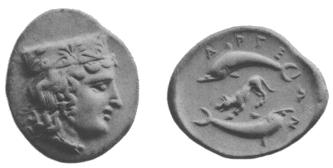
| Head of Hera wearing stephanos, on which floral ornament (Fig. 240). | ΑR^ΕΙΟΝ, ΑRΓΕΙΩΝ, and ΑΡΓΕΙΩΝ
Two dolphins in opposite directions;
between them, wolf, helmet, grapes,
ivy-branch, crab, tripod, bucranium,
swan, human head, lyre, pomegranate,
or column, &c. AR Stater.
|
| Id. [B. M. C., Pelop., Pl. XXVII. 12, 13.] | ΑΡΓΕΙΩΝ Diomedes, naked but for
chlamys, grasping sword, stepping
stealthily along and carrying the
Palladium on his extended hand; be-
low, sometimes, a swan. AR Drachm.
|
| Female head. [B. M. C., Pelop., Pl. XXVII. 14.] |
Harpa and club in parsley (?) wreath.
AR 37.2 grs.
|
| Head of Hera in stephanos. [Ibid., Fig. 15.] | ΑΡ or ΑΡΙ Athena Promachos or Palla-
dium. AR 23 grs.
|
| Wolf; above, ⊟ or Θ. [Ibid., Fig. 20.] | ΑΡ, ΠΥ, or ΔΕ Crested helmet.
AR 18 grs.
|
| Head of Hera in stephanos. [Ibid., Fig. 10.] |
ΤΤΤ (τριτετερτημοριον) round filleted
Temple-key. AR 9 grs.
|
| Head of Hera in stephanos. | Athena Promachos. Æ .75
|
| Head of Apollo. | Α; beneath, lyre. Æ .65
|
Concerning the beautiful head of Hera on these coins see Gardner (Types of Greek Coins, p. 138). The statue of the Argive Hera by Polycleitus wore a stephanos adorned with figures of the Horae and Charites (Paus. ii. 17. 4). As such complicated ornaments could not well be reproduced on a small scale, a coin-engraver might naturally substitute a more simple form of decoration. As the Argive hero Diomedes was believed to have brought to Argos the Palladium which he carried off from Troy, the exploit is appropriately represented on Argive coins. The swan and the dolphins are Apolline symbols.
The column which appears as a symbol between the dolphins on some of the staters has hitherto been called a quiver, but I believe it to repre- sent a columnar pump or drinking fountain, in connexion with the sacred ‘water of freedom' ελευθεριον υδορ, used by the priestesses in the Heraeum, which, after flowing down a rock-hewn aqueduct, supplied the holy well called Kynadra at Argos (Waldstein, Heraeum, i. p. 18). A minute examination of this object on a specimen in the Brit. Mus. reveals on one side of the column a pump-handle and on the other side a projection (basin (?)) supporting a vase thus placed to receive the water seen dripping from the cone-shaped top of the pillar. On late bronze coins the same pillar-fountain is represented furnished with spouts half- way up the column (B. M. C., Pelop., Pl. XXVIII. 8), and on a coin in the Hunter Coll. (Cat., vol. ii. Pl. XXXIX. 12) the pump is shown with two handles on each side of the shaft.
With regard to the Temple-key see Zeitschrift für Numismatik (iii. 113-22). This symbol may refer to Hera as the guardian and custodian goddess of Argos; cf. the epithet κληδουχος applied in this sense to Athena (Arist. Thesm. 1143).
During the century which followed the Lamian war it is probable that if large coins were struck at Argos they were tetradrachms of the Alexandrine types, resembling those of Sicyon of the same time. The smaller coins consisted of Attic tetrobols (or Aeginetic triobols) as follows :—
| Forepart of wolf. | Large Α in incuse square with adjunct
symbol and letters or magistrates’
names at full length.
AR Attic Tetrob.
|
| Wolf’s head. | Id. AR Aeginetic ¾ Ob.
|
It is to this period that the autonomous bronze money of Argos for the most part belongs, though some of it may be earlier.
| Head of Apollo. | Wolf. Æ .65
|
| Head of wolf or of Hera. | Α (various symbols). Æ .45
|
| Id. | Pillar fountain (see supra); symbols,
⊟, wolf’s head, helmet, trident, prow,
&c. Æ .65
|
| Head of Apollo. | Tripod; symbol, ⊟. Æ .65
|
| Forepart of wolf. | ΗΡΑΚΑΕΙΤΟΥ Forepart of bull.
Æ .65
|
This last type refers to the battle of the wolf and the bull, which took place while Danaos and Gelanor were contending for the sovereignty of Argolis. The omen was interpreted as deciding the contest in favour of Danaos, who, in consequence, erected a temple in honour of Apollo Lykios.
For coins of this period see Achaean League, p. 418.
Trajan to Salonina. Inscr., ΑΡΓЄΙΩΝ or ΝЄΜЄΙΑ, ΝЄΜЄΙΑ ΗΡΑΙΑ, or ΗΡΑΙΑ, without the ethnic, in allusion to the Nemean and Heraean games. The types are numerous and of considerable interest. The following are some of the more important :—Herakles strangling the Nemean lion. Opheltes, Hypsipyle and the serpent. Herakles resting at the foot of Mount Apesas. The three Charites. Hera seated with Hebe before her and a peacock between them. Perseus with Gorgon's head, sometimes resting his shield upon a cippus. Apollo variously represented. Zeus seated or standing. Tyche standing. Hermes standing. Kleobis and Biton drawing their mother in a chariot (Paus. ii. 20. 3). Asklepios. Leto with small figure, Chloris, beside her (Paus. ii. 21. 9). Demeter standing. Eileithyia holding in each hand a torch, one raised and one lowered. Hekate triformis. Palladium, sometimes in temple on Acropolis. Diomedes carrying off the Palladium. Dionysos. Danae receiving the golden shower. Ares. Aphrodite (?) standing. Poseidon pursuing Amymone. Nemesis. Isis, &c. Nearly all these types are figured in Imhoof and Gardner’s Numismatic Commentary on Pausanias, from which the above list is taken. Some of the later Im- perial coins of Valerian, Gallienus, &c., bear marks of value = 6, 7, or 10 Assaria (Imhoof, Gr. M., 162).
Cleonae, a small town on the road from Corinth to Argos, about twenty miles north of the latter. The Nemean games were celebrated in its territory. At Cleonae was a temple of Herakles on the spot where he slew Eurytos (Diod. iv. 33).
| Head of bearded Herakles in lion-skin. [B. M. C., Pelop., Pl. XXIX. 1-4.] |
Large Κ behind which two square in-
dentations; all in incuse square.
AR Obol.
|
| Lion’s head, l. | Similar. AR ½ Obol.
|
| Head of Asklepios (?), r. laur. | Κ Λ and club, in parsley wreath. Æ .7
|
| Head of young Herakles in lion-skin. | ΚΛΕΩ Similar. Æ .6
|
These bronze coins are, however, assigned by Gardner to the occasion of the Nemean Festival presided over by the Cleonaeans in B.C. 235 (B. M. C., Pelop., p. 154; Plut. Arat. xxviii).
For Federal money of the Achaean League see p. 418.
Imperial—Commodus to Geta. Inscr., ΚΛЄΟΝΑΙΩΝ or ΚΛЄΩΝΑΩΝ. A coin of Severus has for type Asklepios seated, as on silver coins of Epidaurus of the fourth century B.C. Another type which refers to Asklepian games at Cleonae is the head of Asklepios placed on the back of a bridled horse. (Cf. a coiled serpent on horseback, of similar signi- fication, on a coin of Philadelphia, Lydiae.) Among other Imperial types may be mentioned an archaic statue of Athena, perhaps copied from the one by Dipoenus and Scyllis mentioned by Pausanias (ii. 15. 1), Isis Pharia, Artemis between two cypress trees, &c.
Epidaurus. This city was in historical times chiefly celebrated for its great sanctuary of Asklepios, to whose cultus its coins bear ample testimony.
| Head of Asklepios laureate. | ΕΠ in wreath. AR Aeginetic ½ Dr.
|
| Head of Apollo. | Ε in wreath. AR Obol.
|
| Ε. [B. M. C., Pelop., Pl. XXIX. 11-13.] | Π. AR ¼ Obol.
|
| Head of Apollo. [Ibid., Fig. 14.] | Ε Asklepios seated on throne holding
sceptre, his other hand extended over
the head of a serpent; beneath throne,
a dog lying.
AR Aeginetic Dr. of light weight.
|
| Head of Asklepios, r. laur. [N. C., 1892, Pl. I. 17.] |
Similar. AR Dr. plated, 82.1 grs.
|
These remarkable coins are of considerable archaeological interest, corresponding as they do most minutely with the description given by Pausanias (ii. 27) of the chryselephantine statue of Asklepios at Epidaurus, the work of Thrasymedes of Paros (B.C. 350 or later, N. C., 1892, p. 15). The dog beside the god is the animal which watched over him when as an infant he was exposed on Mount Tittheion and suckled by a goat.
| Head of Asklepios laureate. | ΕΠ Epione wife of Asklepios carrying
phiale; symbol, sometimes, cupping
vessel σικυα (cf. Paus. ii. 27. 5;
29. 1). Æ .7
|
| Head of Asklepios. | ΕΠ She-goat recumbent. Æ .65
|
| Id. | ΕΠ Coiled serpent. Æ .5
|
| Head of Apollo. | ΕΠ Thymiaterion between two cupping
vessels. Æ .5
|
| Head of Asklepios or of Apollo. | Ε in wreath. Æ .45
|
In B.C. 243 Epidaurus became a member of the Achaean League (see p. 418).
Imperial—Ant. Pius to Sev. Alexander. Inscr., ΙЄΡΑC ЄΠΙΔΑΥΡΟΥ or ЄΠΙΔΑΥΡΟ[Υ] Bust of Asklepios (?). Rev. ΑCΚΛΗΠЄΙΑ in wreath, in reference to the Asklepian games celebrated at Epidaurus every five years. Types—Shepherd finding Asklepios suckled by goat. Asklepios seated with dog and serpent. Asklepios standing. Poseidon standing. Hygieia standing in round temple. Concerning this rotunda see Svoronos, Die Polykletische ‘Tholos’ in Epidauros (Journ. Int. d'arch. num., 1901, 1 ff.); Reinach (Rev. des Etudes grecq., 1901, 412), and Dörpfeld (Hermes, 1902, 250 and 483).
Hermione. An ancient Dryopian city on the south coast of Argolis, distinguished for its sanctuary of Demeter Chthonia, in whose honour an annual festival called Χθονια was celebrated.
| Head of Demeter crowned with corn. | ΕΡ in corn-wreath. AR Aeginetic Triob.
|
| Id. | Ε Ρ Torch in corn-wreath. AR Obol.
|
| Head of Demeter facing. | ΕΡ in wreath. Æ .65
|
| Id. in profile. | Ε Ρ Torch in corn-wreath. Æ .5
|
For Federal money of the Achaean League see p. 418.
Imperial—Severus to Geta. Inscr., ЄΡΜΙΟΝЄWΝ. Types—Hermes; Poseidon (Paus. ii. 35. 1); Zeus; Kybele; a victimarius leading a cow to the sacrifice (Paus. ii. 35. 4); Tyche standing (Paus. ii. 35. 3); Aphrodite with Eros (Paus. ii. 34. 11); Dionysos, &c.
Methana. An obscure town a few miles north of Troezen. Pausanias (ii. 34) mentions hot springs which burst forth near this city in the time of Antigonus Gonatas. The whole region still bears evidences of violent volcanic action. Hence the worship of Hephaestos and his head on the coins.
| Head of Hephaestos in conical pilos. | ΜΕΘ in corn-wreath. Æ .6-.5
|
Under Ptolemaic influence Methana bore for a time the name of Arsinoë and struck bronze coins, which have been hitherto assigned to Arsinoë in Crete, p. 459.
| Bust of Arsinoë wife of Ptolemy IV. [Journ. Int. d'arch. num., 1904, 397.] | ΑΡ ΣΙ Naked helmeted figure standing
resting with r. on spear, round which,
sometimes, a serpent twines, and with
l. on shield. Æ .75
|
Imperial—Severus to Geta. Inscr., ΜЄΘΑΝΑΙWΝ. Types—Zeus, Poseidon, Athena, Artemis huntress, Aphrodite Anadyomene.
Tiryns. This ancient city was destroyed by the Argives about the same time as Mycenae (B.C. 468), and its expelled inhabitants settled at the sea-port of Halice in the territory of Hermione at the entrance of the Argolic Gulf. Henceforth they were spoken of as ‘Αλιεις οι εκ Τιρυνθος or simply as ‘Αλιεις, but on their coins they clung to their ancient name (see Svoronos in Journ. Int. d'arch. num., 1907, 5 sqq.). The following coins belong undoubtedly to the fourth century B.C.
| Female head r. | Harpa and club in wreath. AR 40 grs.
|
| Head of bearded Herakles r. in lion-skin. | Club between two stars. AR 14 grs.
|
| Id. l. | Club. AR 14 grs.
|
| Id. | ΤΙΡΥΝ ΘΙΩΝ Club. AR 12 grs.
|
| Id. r. | Τ Ι Palm-tree. Æ size .7
|
| Head of Apollo. | Τ Ι, ΤΙRΥ, or ΤΙΡΥΝΘΙΩΝ &c. Palm-
tree between lyre and grapes. Æ .6-.4
|
Troezen occupied a fertile maritime plain in the south-east corner of Argolis. Poseidon and Athena are said to have contended for the land of the Troezenians, and these two divinities jointly received worship in the city. Hence, as Pausanias remarks (ii. 30), the trident and the head of Athena were placed upon the coinage και δη και νομισμα αυτοις το αρχαιον επισημα εχει τριαιναν και ‘Αθηνας προσωπον. Troezen was from of old intimately connected with Athens, which accounts for the fact that it is, perhaps, the only Peloponnesian city which made use of the Attic standard of weight.
| Head of Athena (?) facing. [Lambros, Pelop., Pl. XIII. 4.] |
ΤRΟ Trident in incuse square.
AR 61 grs.
|
| Id. | „ Id. AR 46 grs.
|
| Id. | „ Id. AR 10 grs.
|
| Head of Apollo (Thearios ?). [B. M. C., Pelop., Pl. XXX. 18-23.] |
ΤΡΟ Trident. AR Attic Drachm.
|
| Id. | „ Id. AR Attic Triobol and Obol.
|
| Id. | „ Double Trident. AR Attic Diob.
|
| Head of Athena. | ΤΡΟ Trident. Æ .65
|
| Head of Poseidon. | „ Id. Æ .65
|
| Head of Apollo (Thearios ?). | „ Id. Æ .55
|
For other varieties see Imhoof, Mon. gr., p. 181, and B. M. C., Pelop., Pl. XXXI; and for later Æ coins obv. Head of Apollo or Poseidon, rev. Demeter standing with torch, Artemis (?) seated, or Dolphin, see Lambros, Pelop., p. 107.
The oracular temple of Apollo Thearios stood in the agora of Troezen (Paus. ii. 31. 6).
Imperial—Commodus to Philip Jun. Inscr., ΤΡΟΙΖΗΝΙWΝ. Types— Acropolis rock surmounted by temple of Athena Sthenias (Paus. ii. 32. 5). Archaic statue of Athena Sthenias, by Kallon of Aegina.
Nearly all these Imperial types are fully discussed and figured in Imhoof and Gardner’s Numismatic Commentary on Pausanias, p. 47. Sestini mentions also a coin with the type of Artemis Lykia holding a wolf’s head (Num. Vet., p. 215), but it is highly probable that he was mistaken with regard to the object held by Artemis.
[A. v. Sallet, Zeitsehrift für Numismatik, ii. 139. J. Friedlaender, Ibid., ii. 246. Imhoof- Blumer, Ibid., iii. 289; Mon. gr., 184 ff. R. Weil, Z. f. N., ix. 18. Babelon, Traité, pp. 836 sqq.]
Concerning the political condition of Arcadia, from the time of the dissolution of the ancient monarchy in the early part of the seventh century B.C. down to the age of Epaminondas, our historical data lead us to infer that the country was split up into a number of independent cantons without any bond of union. Such an assumption is not, however, borne out by the evidence of the early Arcadian coinage. The extensive series of coins bearing the inscription ΑΡΚΑΔΙΚΟΝ, &c., ranging from circ. B.C. 490-417, proves most satisfactorily that the Arca- dians, in spite of their continual dissensions, maintained from first to last something more than a mere tradition of unity, for this coinage, although not politically a federal currency like that of the later Achaean League, shows that the independent Arcadian towns and villages held fast to the religious bond which brought them together from time to time to celebrate in common their national festivals Arcadica. The place of mintage of this series of coins was probably Heraea (see infra, p. 447, and Imhoof, Mon. gr., p. 184 ff.).
Concurrently with these Festival issues many of the Arcadian towns struck coins with their own local types for circulation within their respective territories.
From about B.C. 417-371 no Festival coins were struck in the name of the Arcadians; but, after the victory of Epaminondas at Leuctra, B.C. 371, the party in Arcadia opposed to Sparta seems to have re-established the national Arcadian Games, and to have issued Festival, or Federal, coins at the new Arcadian capital Megalopolis, which was founded, under the immediate auspices of Epaminondas, on the river Helisson, near the frontiers of Laconia. The money of the revived Arcadian κοινον derived its types from the cultus of Zeus Lykaeos, and of Pan, whose sanctuaries were situated on Mount Lycaeum, the Arcadian Olympus.
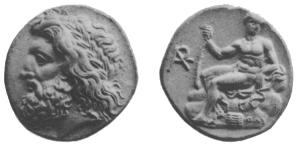
| Head of Zeus Lykaeos (Fig. 241). [B. M. C., Pelop., Pl. XXXII. 10.] | Pan seated on rock, his lagobolon in his
r. hand which rests on the rock; at
his feet the syrinx, and in the field
ΑΡΚ (in mon.); on the rock ΟΛΥΜ
or ΧΑΡΙ. AR Stater.
|
| Head of young Pan with short horns. [Z. f. N., ix. Pl. II. 5.] |
Arcadian mon. ΑΡΚ; beneath, syrinx.
AR Obol.
|
| Id. [Ibid., Pl. II. 6.] | Id. with ΠΟ and ΘΕ. Æ .65
|
| Head of Zeus Lykaeos. [Ibid., Pl. II. 13.] |
Id. Syrinx and fulmen. Æ .7
|
The inscriptions ΟΛΥΜ or ΧΑΡΙ in small characters on the side of the mountain or rock on which Pan is seated have been explained conjecturally as engravers’ signatures (B. M. C., Pelop., p. lix). May they not, however, be more probably abbreviated names of the Festival Games for which the coins were issued? e.g. ΟΛΥΜ, perhaps on the occasion of the 104th Olympiad celebrated by the Arcadians in B.C. 364 (cf. ΟΛVΝΠΙΚΟΝ on coins of Elis (p. 420). Similarly ΧΑΡΙ might stand for Charisia or Charitesia (Pauly-Wissowa, Encyclop., s. v. ‘Charites,’ III. 2155, n. 8), agonistic festivals in honour of the Charites; cf. also Charisios, the eponymous founder of the Arcadian town of Charisiae (Paus. viii. 3. 4).
The two names on the bronze coins are perhaps Possikrates and Theoxenos, two of the ten founders of Megalopolis (Paus. viii. 27. 2).
| Head of Zeus Lykaeos. [Z. f. N., ix. Pl. II. 11, 12.] |
Pan seated on rock; in field, Arcadian
mon. ΑΡΚ. AR Triob.
|
The later specimens have an eagle in the field as well as the monogram. Although Megalopolis issued these Festival, or possibly Federal, coins with the Arcadian monogram, it is abundantly proved by the local staters of Pheneus, Stymphalus, &c., which began to be issued after the fatal battle of Mantineia (B.C. 362), that Megalopolis can hardly have possessed a monopoly of coining money for the whole of Arcadia, for although triobols bearing the Arcadian monogram continued to be issued at Megalopolis apparently down to a much later date, this monogram is afterwards replaced by the letters ΜΕΓ (see Megalopolis, p. 450).
In the reign of Hadrian the cultus of Antinoüs was established on a grand scale at Mantineia, which was the mother city of Bithynium,
| ΒЄΤΟΥΡΙΟC Bust of Antinoüs. [B. M. C., Pelop., Pl. XXXIII. 1, 2.] |
ΤΟΙC ΑΡΚΑCΙ Horse stepping to right.
Æ 1.35 and .85
|
Alea, a small place between Orchomenus and Stymphalus, where were temples of Artemis Ephesia, Athena Alea, and Dionysos (Paus. viii. 23. 1).
| Head of Artemis. | ΑΛ Bow. [Imhoof, Choix, Pl. III. 82] AR Obol and Æ .6
|
| Head of Artemis. [Hirsch, Auctions-Cat., xiii, 2791.] | Α Λ Ε in spaces between Τ Τ Τ.
AR Tritartemorion.
|
| Head of Athena. [N. Z., 1884, 264.] | ΑΛΕΑ in wreath. Æ .6
|
See also under Achaean League (p. 418).
Alipheira. See Achaean League (p. 418)
Antigoneia. See Mantineia (p. 450).
Asea. See Achaean League (p. 418).
Callista. See Achaean League (p. 418).
Caphya. Autonomous bronze coins of the third century B.C.
| Head of Persephone. [Lambros, Pelop., Pl. XIV. 8.] |
ΚΑΦ Persephone standing holding
pomegranate and corn. Æ .6
|
| Head of Athena. [B. M. C., Pelop., Pl. XXXIII. 4.] |
ΚΑΦ in corn-wreath. Æ .5
|
See also Achaean League (p. 418).
Imperial—Severus to Geta. Inscr., ΚΑΦΥΙΑΤΩΝ. Types—Apollo, Artemis, Poseidon, Tyche, &c. (cf. Paus. viii. 23. 3).
Cleitor, between Pheneus and Psophis (Zeit. f. Num., ii. 168, iii. 280, ix. 19; Imh., Mon. gr., 187), said to have been founded by Kleitor, grandson of Arkas.
| Forepart of bridled horse. | Incuse square of mill-sail pattern.
AR Triobol.
|
| Horse’ s head. |  in incuse square. in incuse square. AR Hemiobol.
|
| ΚΛΕΤΟ Naked horseman. [B. M. C., Pelop., Pl. XXXIII. 9.] |
Incuse square of mill-sail pattern.
AR Triobol.
|
| Free horse. | Ε in incuse square. AR Hemiobol.
|
The letter Ε on the reverse of these coins is a mark of value standing for ‘Hemiobol'.
| Head of Athena. | ΛΗ Horse. AR Obol.
|
| Id. | ΚΛΗ Id. Æ .6
|
| Head of Helios facing. | ΚΛΗ Rushing bull; above, sometimes,
small centaur or ivy-leaf. AR Triob.
|
| Id. | ΚΛΗ (in mon.). Æ .5
|
| Id. in profile. | ΚΛΗ in laurel-wreath. Æ .4
|
See also Achaean League (p. 418).
Imperial—Severus, Domna, Plautilla. Inscr., ΚΛЄΙΤΟΡΙΩΝ. Types— Asklepios, Tyche, Dioskuri, Demeter (?), Rider (Z. f. N., xxiv. p. 65).
Cynaetha in northern Arcadia. Imperial of Caracalla. Inscr., ΚΥΝΑΙΘЄWΝ Agora with colonnade containing temple and another building with statue and tree beside it (Z. f. N., xxiv. p. 66).
Dipaea. See Achaean League (p. 418).
Elisphasii. See Achaean League (p. 418).
Gortys. See Achaean League (p. 418).
Heraea. The Heraeans were a numerous and influential clan occupy- ing western Arcadia and the valleys of the Alpheius and the Ladon on the confines of Elis. They derived their name, according to tradition, from Heraios, one of the sons of Lykaon. Down to the fourth century B.C. they are said to have dwelt in villages, κατα κωμας, but the Heraean coins of the sixth century prove that at any rate they possessed a central mint, and therefore that they formed a separate community; cf. the Treaty between the Eleians and the Heraeans, B.C. 550-500 (Hicks and Hill, Greek Hist. Inscr., p. 10).
| Head of Demeter of archaic style veiled,
wearing stephane and necklace. [Babelon, Traité, Pl. XXXVIII.] |
 , , Ρ, Ρ, , , Ρ, Ρ,  , ΡΑ, ΡΑ, RΑ,
R, ΕΡΑ, ΕΡΑΙ, &c., in an incuse
square often bordered by zig-zag lines
with dots in the angles or by a dotted
square without the zig-zags. , ΡΑ, ΡΑ, RΑ,
R, ΕΡΑ, ΕΡΑΙ, &c., in an incuse
square often bordered by zig-zag lines
with dots in the angles or by a dotted
square without the zig-zags.
AR Triobols and Obols.
|
| Head of goddess (Despoina) without
veil; her hair bound with string of
pearls. [Babelon, Traité, Pl. XXXVIII. 5.] |
ΕRΑ between plain and dotted lines
within an incuse square. AR Triobol.
|
Between the beginning and the latter part of the fifth century no coins appear to have been struck in the name of the Heraeans, but, as Imhoof- Blumer has shown, it is almost certain that the rich series of triobols reading ‘Αρκαδικον, variously abbreviated, was issued at Heraea through- out this period, so that in point of fact the Heraean mint may have continued active from the earliest times down to the age of Epaminondas. It would therefore seem that, early in the fifth century, the Heraeans assumed the presidency, or were entrusted with the management of the national Arcadian Games, and that at each recurring festival they issued
| Zeus Lykaios, enthroned, or rarely,
standing, letting fly his eagle from
his outstretched r. hand and resting
on sceptre. [Babelon, Traité, Pl. XXXVIII. 8-18.] |
ΑR, ΑRΚΑ, ΑR ΑDΙΟ, ΑRΚΑ-
ΔΙQΟ ΑDΙΟ, ΑRΚΑ-
ΔΙQΟ , ΑΡΚΑΔΙΚΟΝ, &c. Incuse
square, within which a female head
variously represented in profile or
three-quarter face, and ranging, ac-
cording to date, from the archaic to
the transitional style. , ΑΡΚΑΔΙΚΟΝ, &c. Incuse
square, within which a female head
variously represented in profile or
three-quarter face, and ranging, ac-
cording to date, from the archaic to
the transitional style.
AR Triobols and Obols.
|
The head on the reverses of the coins of this interesting series is doubt- less that of the goddess who was worshipped by the Arcadians under the name of Despoina (the Mistress), the daughter of Poseidon Hippios and Demeter, the dread goddess whose true name Pausanias (viii. 37) is afraid to communicate to the uninitiated.
The ancient Arcadian festivals appear to have been discontinued in the latter part of the fifth century, if we may draw this inference from the fact that Heraea after this time began again to coin money in her own name, which she continued to do, intermittently, down to the close of the fourth century. [1]
| Eagle with serpent in his claws,—type
borrowed from coins of Elis. [Lambros, Pelop., Pl. XIV. 3.] |
ΕΡΑΙ Young hunter (Heraeos the
oekist) seated, resting on spear and
holding bow. AR Obol.
|
| Head of Athena in Corinthian helmet. | ΕΡΑ (retrogr.) Three large Ε‘s in incuse
square. AR Trihemiobol 23.8 grs.
|
| Head of Artemis; in front, bow. | ΗΡΑ (retrogr.) Large Ε in incuse square.
AR 13 grs.
|
| Dolphin. | Ε in incuse square. AR 11.9 grs.
|
The letter Ε on the above coins cannot stand for hemiobolion, as the weights prove. It signifies the mint of Heraea; cf. Τ at Tegea, Μ at Mantineia, &c. But the Ε thrice repeated on the Trihemiobol seems to combine the two meanings.
| Pan standing at rest on spear, with foot on rock. | Η Ρ Female head; hair rolled.
AR 13 grs.
|
| Head of Artemis, or of Athena. | Η across the bar of which, a bow.
AR 12 grs.
|
| Head of Athena. | Η with or without pellets around it, in
plain field; symbol sometimes, bow.
Æ .7-.6
|
| Head of Athena, as on staters of Alex-
ander. [Zeit. f. Num., vii. Pl. VIII. 7.] |
Η across the bar of which a bow, inscr.
ΗΡΑΕΩΝ and ΘΕ or ΘΕΟ.
AR Triob.
|
| Head of Athena. | Η Artemis on one knee holding bow.
Æ .7
|
1 Iron money (?) circ. B.C. 400 (?). In Ath. Mitth. vii. 377, Köhler describes an iron coin, Obv. Head of Athena, Rev. incuse circle containing a very obscure inscription read by him ΗΡΑΟΑΙ. I doubt whether this is the correct reading, and consequently whether the coin (if indeed it be a coin) belongs to Heraea.
For many other varieties see Imhoof, Mon. gr., pp. 189 sqq.
See also Achaean League (p. 418).
Imperial—Severus and Caracalla. Inscr., ΗΡΑΙЄΩΝ. Types—Ar- chaic upright statue of Helios naked, facing. River-god Alpheios with a bull in front and fishes beneath, &c.
Lusi. See Achaean League (p. 418).
Mantineia, in eastern Arcadia, originally only the centre of a small group of villages surrounding an oracular sanctuary (μαντειον) of the Arcadian Poseidon Hippios, grew during the sixth century B.C. to be a fortified town, and from about B.C. 500 began to issue coins in its own name. Poseidon always remained the special god of Mantineia, and his emblem, the trident, was the scutcheon on the shields of the Mantineians (Frazer, Paus., vol. iv. p. 217; B. M. C., Pelop., Pl. XXXIV; Lambros, Pelop., Pl. XIV; Babelon, Traité, pp. 862 ff.).
| Bear. | ΜΑ In incuse square. AR Triob.
|
| Id. | „ Dolphin in incuse square. AR Triob.
|
| Id. | „ Trident in incuse square. AR Triob.
|
| Id. | „ Three acorns in incuse triangle.
AR Triob.
|
| Head of bear. | „ Acorn. AR Obol.
|
| Acorn. | ΜΑΝ Large Μ. AR Obol.
|
| ΜΑΝ Three acorns. | Three Τ‘s. AR Tritetartemorion.
|
| Acorn. | ΜΑΝ Large Ε. AR Hemiobol.
|
The bear refers to the myth of Kallisto, the mother of Arkas, who was transformed into a bear by Hera. The acorns remind us of the oak forest, Pelasgos, which encompassed the temple of Poseidon Hippios (Paus. viii. 9. 1). The Arcadians are called by Herodotus (i. 66) βαλα- νηφαγοι ανδρες, because they lived upon the edible acorn of the beech-oak (Zeit. f. Num., 1873, p. 125).
In B.C. 385 Mantineia was razed to the ground by the Spartans, and its inhabitants dispersed among the neighbouring villages. After the city was rebuilt, B.C. 370, its coins bear the following interesting types:—
| ΜΑΝΤΙ Bearded figure of Odysseus wearing conical pileus and tunic gathered up at waist, standing with bent knees in the act of planting his oar in the ground, and carrying a spear. | Altar of Poseidon (αναξ, ιππιος) sur-
mounted by two busts of the Dioskuri
wearing conical hats and holding
spears over their shoulders.
AR Drachm.
|
| Bearded helmeted head. | ΜΑΝΤΙ Head of Kallisto (?) with flow-
ing hair. AR Dr.
|
| ΜΑΝΤΙ Head of Athena. [B. M. C., Pelop., Pl. XXXIV. 29; XXXV. 1.] |
Female head with flowing hair. AR Triob.
|
| Id. [Hirsch, Auctions-Cat., xiii 2824.] | ΜΑΝΤΙΝ Trident. AR Trihemiob.
|
| Id. [B. M. C., Pelop., Pl. XXXV. 2.] | Μ. AR Obol.
|
The first of these coins refers to the myth of Odysseus fixing his oar in
| Head of Athena. (See also Imhoof, Mon. gr., 198 sqq.) | ΜΑΝ Odysseus as above, or Trident.
Æ .65
|
| Odysseus as above. [B. M. C., Pelop., Pl. XXXV. 3.] |
„ Altar. Æ .65
|
| Head of Poseidon. | „ Poseidon wielding trident. Æ .75
|
| Head of Athena. [Imhoof, Mon. gr., 200.] |
„ Poseidon seated. Æ .65
|
In B.C. 222 Mantineia was captured by Antigonus Doson, and its name changed to Antigoneia, under which designation it struck federal coins as a member of the Achaean League (see p. 418).
Imperial—Severus to Caracalla. Inscr., ΜΑΝΤΙΝΕΩΝ. Types— Apollo, Asklepios, Hygieia, Tyche, Artemis.
Pausanias informs us that in the reign of Hadrian the old name of the city was restored to it.
Megalopolis, founded circ. B.C. 370, under the auspices of Epaminon- das, as the capital of the new Arcadian League, struck festival or federal money in the name of the entire body of the Arcadians down to, and perhaps during, Macedonian times (see supra, p. 444). The subsequent issues are as follows :—
| Head of Zeus Lykaeos. [B. M. C., Pelop., Pl. XXXV. 10-13.] |
ΜΕΓ Pan seated on rocks; beside him,
eagle. Magistrates’ monograms.
AR Triob.
|
| Id. | ΜΕΓ Id. in oak-wreath. Æ .8
|
| Id. | „ Eagle or fulmen in oak-wreath.
Æ .7
|
The above coins belong apparently to the age of the tyranny of Aristodemus at Megalopolis. After his assassination, B.C. 251, by De- mophanes and Ecdemus, the disciples of the philosopher Arcesilaus, the federal constitution was for a time restored, and bronze coins issued at Megalopolis with the Arcadian monogram.
| Head of Zeus Lykaeos. [B. M. C., Pl. XXXII. 19.] |
ΑΡΚ Syrinx in oak-wreath. Æ .8
|
| Head of Athena. | „ in olive-wreath. Æ .7
|
But in B.C. 244 Megalopolis again fell into the hands of a tyrant by name Lydiadas, and the issue of coins reading ΜΕΓ as above was resumed and perhaps continued after Megalopolis joined the Achaean League, B.C. 234. For coins of the League see p. 418.
Methydrium, a town in central Arcadia founded from Orchomenus. Its inhabitants were transplanted to Megalopolis in B.C. 370, but sub- sequently the place became once more independent, when it struck bronze coins. Inscr., ΜΕΘΥΔΡΙΕΩΝ. Type—Kallisto pierced by the arrow of Artemis, her child Arkas on the ground beside her (Lambros, Pelop., Pl. XV. 3). See also Achaean League (p. 418).
Orchomenus. The ancient capital of a royal dynasty which in early times ruled over the greater part of Arcadia. The town stood aloof from the confederacy of the Arcadians on the foundation of Megalopolis, B.C. 370 (Xen. Hell. vi. 5. 11). Its coins belong to the period imme- diately following that event.
| Artemis clad in short chiton with petasos
slung behind her back, kneeling on
one knee and shooting arrow from
bow; behind her, a dog seated. [B. M. C., Pelop., Pl. XXXV. 15.] |
ΕΡΧΟΜΕΝΙΩΝ Kallisto falling back
pierced in the breast by arrow of
Artemis; on the ground beside her,
the infant Arkas stretching out his
arms towards his mother. Æ .75
|
| Head of bearded or beardless hero helmeted. | Ε Ρ Artemis standing shooting with
bow. Æ .7
|
| Female head; hair in sphendone. | Ε Ρ Armed figure standing at rest with
spear held obliquely. Æ .7
|
The story of the death of Kallisto as represented on these coins differs from the common version of the tale, according to which Kallisto was first transformed by Hera into a she-bear and then slain by Artemis (Dion Halic., Ant. Rom., i. 49).
Imperial—Severus to Geta. Inscr., ΟΡΧΟΜЄΝΙΩΝ. Types— Asklepios, Apollo, Herakles, Dionysos, Artemis, Poseidon, Herakles holding kantharos over his shoulder instead of his club and standing beside a satyr, Aphrodite holding apple, Tyche.
Pallantium. An ancient town in the district of Maenalia founded by Pallas, son of Lykaon.
| Young male head. [B. M. C., Pelop., Pl. XXXV. 21.] |
ΠΑΛ (retrogr.) Large Ε. AR Hemiobol.
|
See also Achaean League (p. 418).
Parrhasia was the district of which the ancient city of Lycosura was the capital. Coins may have been struck there in the name of the Parrhasians. A less probable attribution is the small town of Paroreia (Imh., Mon. gr., 204).
| Head of Apollo. | Large Π. AR Obol.
|
| Bearded male head. | ΠΑΡ (retrogr.) Large Π. AR Obol.
|
| Male figure standing at rest with one foot on rock. | „ Id. AR Obol.
|
Pheneus, in the north-east of Arcadia, would appear, from the number of its coins still extant, to have been a place of considerable importance in the fourth century B.C. Pausanias (viii. 14. 10) tells us that Hermes was the god especially worshipped there. At Pheneus there was also a temple of Demeter Eleusinia (Paus. viii. 15. 1). The heads of both these divinities and the ram, the emblem of Hermes, occur on the coins.
| Hermes naked, seated on basis of two steps. | Ε Ram standing [N. C., 1896, Pl.
VII. 5; J. H. S., xvii. p. 88]. AR Obol.
|
| Head of Hermes with petasos at back of neck. | Id. [B. M. C., Pelop., Pl. XXXVI. 2].
AR Obol.
|
| Id. [B. M. C., Pelop., Pl. XXXVI. 1.] | ΕΝΙΚΟΝ Bull feeding. AR Triob.
|
| Head of Demeter crowned with corn- leaves and wearing ear-ring with five pendants. [Z. f. N., ix. Pl. II. 8; cf. Lambros, Pelop., Pl. XVI. 8.] | ΦΕΝΕΩΝ Hermes naked, running to
left, and carrying on his arm the
infant Arkas, in his r. caduceus;
behind the child, sometimes, ΑΡΚΑΣ.
AR Stater.
|
| Head of Demeter as above. [B. M. C., Pelop., Pl. XXXVI. 8.] | ΦΕΝΕΩΝ Hermes with chlamys round
his shoulders and petasos hanging
behind neck, seated on rocks.
AR Drachm.
|
| Id. [Ibid., Fig. 9.] | ΦΕΝΙΚΟΝ Bull. AR Triob.
|
| Head of Hermes as above. [Ibid., Fig. 3.] | ΦΕ Ram, beneath Α Ρ. AR Obol.
|
| Head of Demeter as above. | Φ Ε Caduceus. Æ .7
|
| Head of Hermes as above. | „ Ram. Æ .5
|
| Head of Artemis Heurippe (cf. Paus. viii. 14. 4). | ΦΕΝΕΩΝ Horse feeding [Z. f N., ix.
Pl. II. 10]. Æ .65
|
| Id. | Φ Ε Caduceus in wreath. Æ .5
|
| Half ram. | Φ Ε Id. Æ .5
|
The head of Demeter crowned with corn-leaves is a close copy of the famous type first introduced by Euainetos of Syracuse. Cf. also con- temporary staters of the Locri Opuntii and of the Messenians. The reverse type of the stater refers to the myth of the rescue of the child of Kallisto by Hermes, who took him to the nymph Maia on Mount Cyllene to be brought up (Apollod. iii. 8. 2). The style of this coin shows that the artist was strongly influenced by the school of Praxiteles.
The feeding horse on the bronze coins is the emblem of Poseidon Hippios, whose statue at Pheneus was said to have been dedicated by Odysseus, απολεσθαι γαρ ιππους τω ‘Οδυσσει, και αυτον γην την Ελλαδα κατα ζητησιν επιοντα των ιππων, ιδρυσασθαι μεν ιερον ενταυθα ‘Αρτεμιδος, και Ευριππαν ονομασαι την θεον, ενθα της Φενεατικης χωρας ευρε τας ιππους αναθειναι δε και του Ποσειδωνος το αγαλμα του Ιππιου. Pausanias (viii. 14. 6) further relates that when Odysseus had found his mares he allowed them to pasture in the land of the Pheneatae. For other varieties of coins of Pheneus see Imhoof, Mon. gr., p. 205. Among them is a curious coin of a late period reading ΕΠΙ ΙΕΡΕΟΣ ΕΡΜΑΞΟΟΥ.
For federal money see Achaean League (p. 418).
Imperial—Severus to Geta. Inscr., ΦЄΝЄΑΤΩΝ.
Phigaleia or Phialia. See Achaean League (p. 418).
Imperial—Severus to Geta. Inscr., ΦΙΛΛЄΩΝ. Types—River Neda, naked figure, sometimes seated on rock holding sceptre (reed ?) and emptying vase, Athena, Artemis, Asklepios, Homonoia, Tyche (B. M. C., Pelop., Pl. XXXVI).
Psophis, in the narrow valley of the river Erymanthus, where it is joined by its tributary the Aroanius, was the scene of the contest of Herakles with the Erymanthian boar and the Keryneian stag. Of this city there are archaic silver coins of the fifth century (see Imhoof, Zeit. f. Num., i. pp. 117, 123).
| Keryneian stag, forepart of stag, or stag's
head. [B. M. C., Pelop., Pl. XXXVI. 18-21.] |
X, XΟ,  Ο, Ο,  Ο, or XΟΙ (archaic forms
of ΨΩ, ΨΩΦΙ) Fish, sometimes with
acorn, in incuse square. Ο, or XΟΙ (archaic forms
of ΨΩ, ΨΩΦΙ) Fish, sometimes with
acorn, in incuse square.
AR Tetrob. (62 grs.), Trihemiob.,
Obol, and ½ Obol, the last with
large Ε (mark of value).
|
| Head of Athena. | ΨΟΦΙΔΙΟΝ Club. AR Hemiobol.
|
The Keryneian stag, and on later coins the boar, were doubtless chosen as coin-types referring to the labours of Herakles. The river Aroanius was famed for its wonderful fish, which were said to sing like thrushes, a fable which is believed by the peasants of the neighbourhood to the present day (Frazer, Paus., iv. 265). Pausanias, who half credited the story, tells us how he saw the fish, but did not hear them utter a sound, though he tarried on the river bank till sunset, when they were said to sing most (Paus. viii. 21. 2).
| Head of Athena. | ΨΩΦ, ΨΩΦΙ, ΨΩΦΙΔ. Stag. Æ .65
|
| Young male head. | ΨΩΦΙ Fish. Æ .55
|
| Bust of Herakles. | „ Boar running. Æ .65
|
Imperial—Severus to Geta. Inscr., ΨΩΦΙΔΙΩΝ or ΨΩΦЄΙΔΙΩΝ. Types—River Erymanthos, Artemis, Pan, Dionysos.
Stymphalus. The ancient city of Stymphalus was situated in the immediate vicinity of a lake, a river, and a mountain all bearing the same name, and a few miles south-east of Pheneus. It derived its name from Stymphalos, a grandson of Arkas. It is chiefly celebrated as the scene of the destruction by Herakles of the Stymphalian birds, which are described by Pausanias (viii. 22) as being as large as cranes and in form resembling the ibis, but with stronger beaks and not crooked like those of the ibis. They were said to have been as dangerous as lions or leopards, and to have flown at even armed men who came to hunt them. In Stymphalus there was an ancient temple of Artemis Stymphalia, under the roof of which the Stymphalian birds were represented. At the back of this temple stood marble statues of virgins with the legs of birds. The following coins were doubtless struck during festivals of the Stymphalian Artemis (Paus. viii. 22. 8).
| Head of young Herakles in lion-skin. [B. M. C., Pelop., Pl. XXXVII. 1-3.] |
ΣΤΥΜΦΑΛΙΟΝ Head and neck of
Stymphalian bird springing from the
calyx of a flower with two poppy-
heads. AR Triob.
|
| Id. | ΣΤΥΜΦΑΛΙΟΝ Id. no flower Τ Υ.
AR Obol.
|
| Id. | ΣΤ Id. Æ .55
|
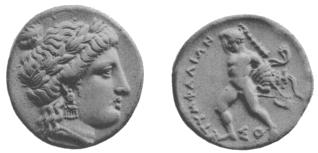
| Head of Artemis Stymphalia laureate
and wearing ear-ring with five pen-
dants (Fig. 242). [B. M. C., Pelop., Pl. XXXVII. 4.] |
ΣΤΥΜΦΑΛΙΩΝ Herakles striding to
left and striking with uplifted club;
bow, and quiver with lion-skin
wrapped round it, in left hand; be-
neath, ΣΟ. AR Stater.
|
| Similar head. | ΣΤΥΜΦΑ Bow and quiver. Æ .7
|
See also Achaean League (p. 418).
Tegea occupied the large valley in the south-east corner of Arcadia. The local mythology of the town is abundantly illustrated on its coins. (For illustrations see B. M. C., Pelop., Pl. XXXVII. 6-21, and Imhoof and Gardner, Paus., Pl. V. 20-24.)
| Τ Gorgon-head with snake on either side. | Three large Ε‘s back to back.
AR Trihemiobol.
|
| Laureate female head l., hair clubbed. | Τ. AR Obol
|
| Helmet. | Τ. AR Obol.
|
| Owl. | Ε. AR Hemiobol.
|
| Head of Athena Alea. | ΤΕ ΓΕ Owl on olive-branch.
AR Triobol.
|
| Id. | „ Id. Æ .65.
|
It is to this period that a specimen of what looks like money of iron must be attributed. Obv. Gorgon head, Rev. ΤΕΓΕ (?) Owl (Atth. Mitth. vii. 377). See also Argos and Heraea.
| Head of Athena Alea. | ΤΕΓΕΑΤΑΝ Warrior, Kepheus (?),
charging, armed with helmet, shield,
and sword; on the ground, between
his legs, a spear and ΑΡΚ (?).
AR Triobol.
|
| Id. [Zeit. f. Num., ix. Pl. II. 9.] | ΤΕΓΕΑ Kepheus (?) charging as above;
between legs ΑΡΚ. Æ .75
|
The type of the charging warrior is almost identical with that of Ajax on the contemporary coins of the Opuntian Locrians and with that of Leukaspis on somewhat earlier coins of Syracuse.
| Same head facing. | ΤΕΓΕΑΤΑΝ Infant Telephos suckled
by hind. Æ .7
|
| Id. to r. in Corinthian helmet. | ΤΕΓΕΑ Similar. Æ .7
|
| Head of Athena. | ΑΘΑΝΑΣ ΑΛΑΣ Owl on altar.
Æ .8
|
| Head of Eileithyia (?) with torch at her shoulder. | ΤΕΓΕΑ Athena presenting the hair of
Medusa to her young priestess Ster-
ope, who receives it in an amphora.
Æ .65
|
| Head of Athena. [N. C., 1888, Pl. I. 12.] | ΤΕΓΕ Cock. Æ .6
|
See also Achaean League (p. 418).
| Head of Eileithyia (?) with torch at shoulder. | ΤΕΓΕΑΤΑΝ Athena presenting hair
of Medusa to Sterope as above, but
the coin is of later fabric. In field,
magistrates’ monograms. Æ .75
|
| ΑΛΕΟΣ Head of Aleos bearded and diademed. | ΤΕΓΕΑΤΑΝ Athena and Kepheus both
armed; between them, Sterope receiv-
ing the hair of Medusa in an amphora.
Æ .9
|
Imperial—Severus, Domna, Caracalla, and Geta. Inscr., ΤЄΓЄΑΤΑΝ. Types—Atalanta spearing Kalydonian boar; Athena; Terminal figure of Herakles; Warrior, Kepheus (?) standing.
The myths referred to on the above interesting coins are the following. Aleos, one of the grandsons of Arkas, was the founder of the city of Tegea, and of the famous temple of Athena Alea, a full description of which is given by Pausanias (viii. 45). His daughter Auge became the mother by Herakles of Telephos who, by command of Aleos, was exposed on Mount Parthenium. Here he was suckled by a hind. The τεμενος of Telephos was still shown on the mountain in the time of Pausanias.
The son of Aleos was Kepheus, who on the silver coins is represented precisely as is Ajax, the son of Oïleus, on the coins of Opus (p. 336). The incident recorded on the bronze coins is related by Pausanias (viii. 47) Τεγεαταις δε εστι και αλλο ιερον ‘Αθηνας Πολιατιδος εκαστου δε απαξ ετους ιερευς ες αυτο εσεισι. το του ‘Ερυματος ιερον ονομαζουσι, λεγοντες ως Κηφει τω
Teuthis. See Achaean League (p. 418).
Thaliadae is mentioned by Paus. viii. 25. 2 among other small places in the territory of Cleitor, on the upper course of the river Ladon. The following archaic coins have been assigned to it, but the attribution is very doubtful.
| Hermes running, holding caduceus. [Babelon, Traité, Pl. XXXVIII. 21.] |
Incuse square divided into six triangles
by diagonal and upright bars.
AR Tetrobol, 61 grs.
|
ΘΑ Ι (?) Hermes running holding
caduceus. [N. C., 1888, Pl. V. 6.] Ι (?) Hermes running holding
caduceus. [N. C., 1888, Pl. V. 6.] |
Swastika’ in incuse square.
AR Obol, 16 grs.
|
Theisoa. See Achaean League (p. 418).
Thelpusa took its name from the nymph Thelpusa, daughter of the river Ladon, an affluent of the Alpheius in western Arcadia. Demeter was worshipped at Thelpusa under the name of Erinys (Paus. viii. 25), and on the banks of the Ladon arose the myth of the pursuit of Demeter by Poseidon, when, to escape him, she assumed the form of a mare. But the god was not to be so deceived, and transformed himself into a horse. The offspring of this union was the wondrous horse Areion, in the Arcadian dialect Εριων. (See Zeit. f. Num., i. p. 125.)
| Head of Demeter Erinys. | Θ Prancing horse (Areion) above ΕΡΙΩΝ.
AR Obol.
|
| ΘΕΛ Id. | ΕΡΙΩΝ Prancing horse (Areion). Æ .7
|
See also Achaean League (p. 418).
| Head of Helios radiate, right. | ΘΕΛ in laurel-wreath. Æ .7
|
Imperial—Severus to Geta. Inscr., ΘЄΛΠΟΥCΙΩΝ Types—Young Pan resting on lagobolon and placing his hand on the top of a reed. This type has been explained by Imhoof-Blumer (Zeit. f. Num., i. 134). It represents Pan in the act of seizing the nymph Syrinx, who in the same instant was transformed into a reed, ‘Ο Παν ουν εδιοκεν αυτην δρομον ερωτικον, την δ’ υλη τις δεχεται δασεια φευγουσαν. ‘Ο δε Παν κατa ποδας εισθορων, ωρεγε την χειρα ως επ’ αυτην. Και ο μεν ωετο τεθηρακεναι και εχεσθαι των τριχων, καλαμων δε κομην ειχεν η χειρ. (Achilles Tatius, viii. 6.) For other types see Imhoof and Gardner, Paus., p. 102.