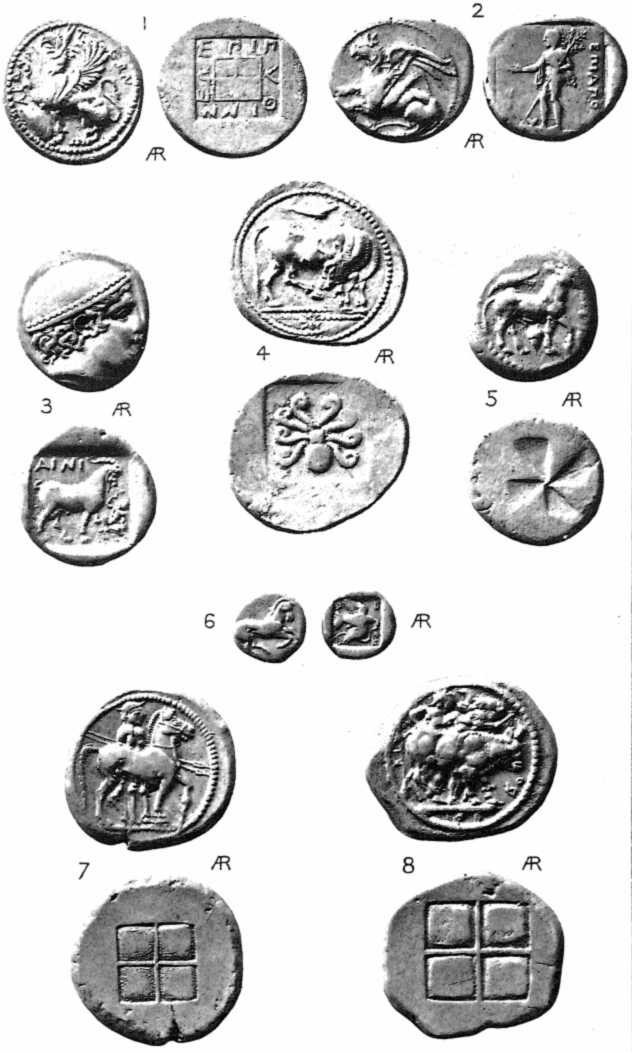
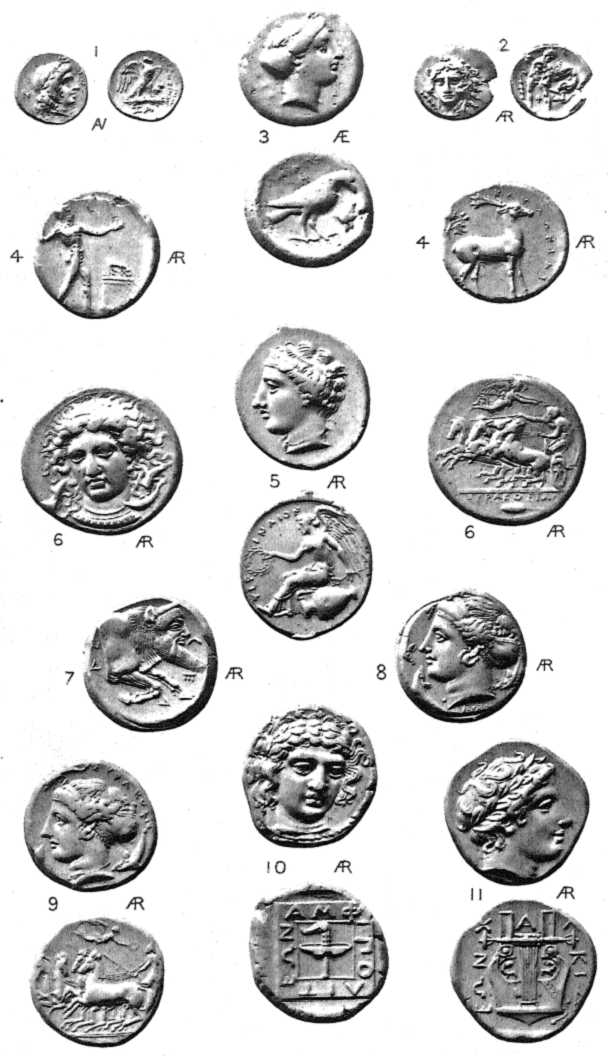
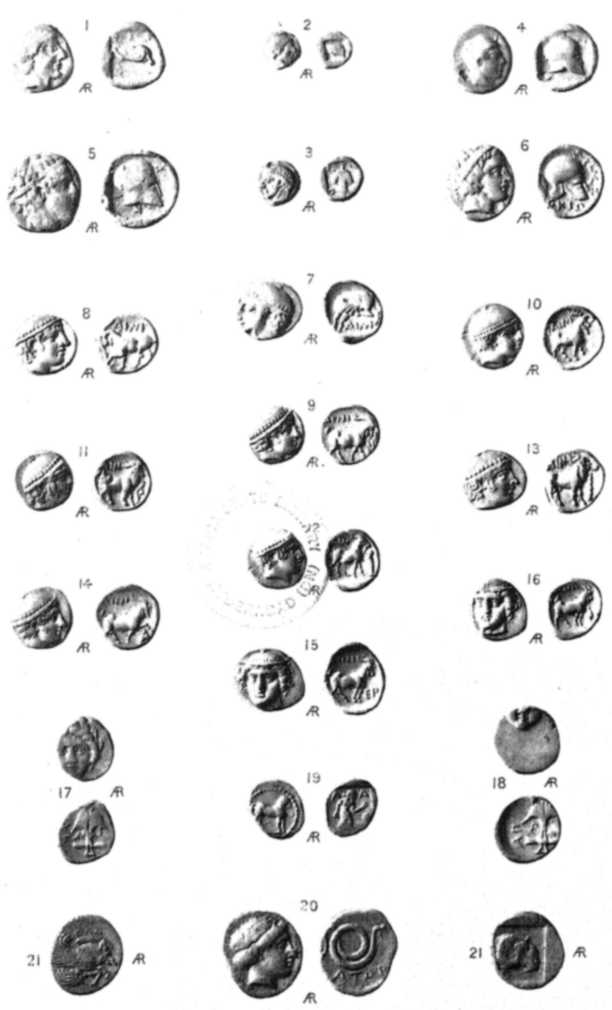
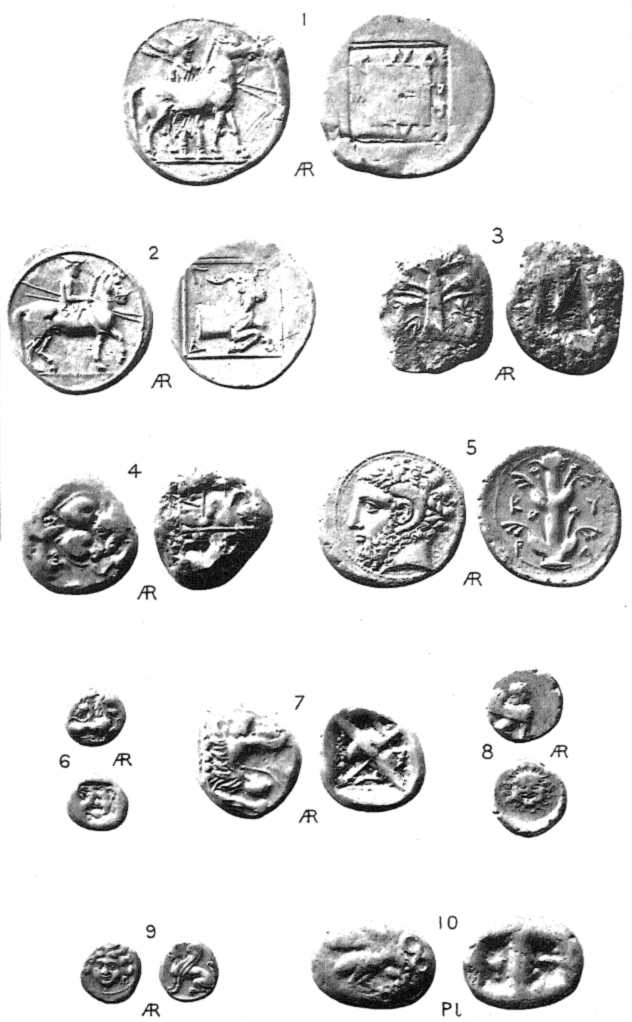
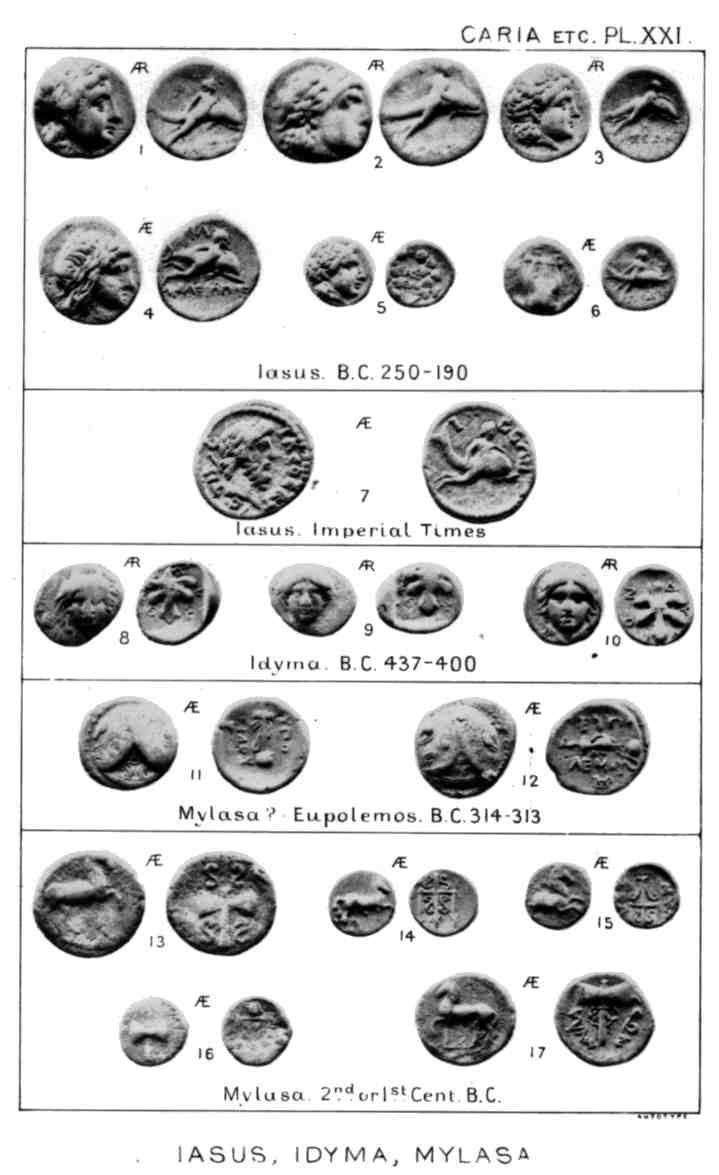
In addition to the numerous special monographs on the coins of various Macedonian and Thracian cities and kings, which are to be found in the volumes of the Numismatic Chronicle, the Revue numismatique, the Zeitschrift für Numismatik and other periodicals, the following are some of the more important works to which the student of the money of Northern Greece may be referred :—
In the following pages, which treat of the coins of Macedon, Thrace, and the north-western and northern coasts of the Euxine, an attempt has been made to present to the student a clearer method of classification by describing the coins of these northern regions in the following seventeen groups (A-H, Macedon and Paeonia, and I-R, Thrace and the northern coast of the Black Sea). The alphabetical arrangement has, therefore, in this section, been abandoned in favour of one which geographically, and to some extent chronologically, seems more instructive, although it may involve an occasional reference to the Index at the end of the volume.
(A.) The Pangaean District. Orrescii; ....naei (?); Diony....(?); Zaeelii; Neapolis (Datenon); Eïon.
(B.) The Emathian District. Lete; Aegae; Ichnae; Tynteni.
(C.) The Bisaltian District. Bisaltae; Dynasts—Mosses, Docimus (?). Demetrius; Edoni—King Getas; Derrones; Therma (?).
(D.) The Chalcidian District. Orthagoreia; Apollonia (?); Acanthus; Olophyxus; Uranopolis; Terone; Sermyle; Olynthus; the Chalcidian League; Aphytis; Scione; Mende; Capsa; Potidaea; Cassandreia; Bottice; Dicaea; Aeneia.
(E.) The Strymonian and Bottiaean Districts. Amphipolis; Tragilus; Philippi; Methone; Pydna.
(F.) Kingdom of Macedon. Alexander I; Perdiccas II; Archelaus I; Aëropus; Amyntas II; Pausanias; Amyntas III; Perdiccas III; Philip II; Alexander the Great; Philip III; Cassander; Antigonus; Demetrius Poliorcetes; Pyrrhus; Interval; Antigonus Gonatas; Antigonus Doson; Demetrius II; Philip V and contemporary autonomous coins of Macedon; T. Quinctius Flamininus; Perseus; Adaeus (? Dynast).
(G.) Kingdom of Paeonia. Lycceius; Patraus; Bastareus; Audoleon; Dropion (?); Nicarchus.
(H.) Macedon, semi-independent and, later, under the Romans. Re- volt of Andriscus; Amphaxitis; Beroea; Bottiaea Emathiae; Dium; Edessa; Heracleia Sintica; Pella; Phila (?); Scotussa; Stobi; Thessalonica.
(I.) Southern Thrace. Aenus; Mesembria; Maroneia; Phytia (?) Dicaea; Abdera; Trie[rus ?]; Cypsela.
(K.) The Thracian Chersonesus. Cherronesus; Aegospotami; Aga- thopolis; Alopeconnesus; Cardia; Coela; Crithote; Elaeus; Ly- simacheia; Madytus; Sestus.
(L.) The Islands of the Thracian Sea. Imbros; Lemnos-Hephaestia, Myrina; Samothrace; Thasos.
(M.) The European Coast of the Propontis. Bisanthe; Byzantium; Pe- rinthus; Selymbria; Odrysae.
(N.) The North-western Coast of the Euxine and the Danubian Dis- trict. Olbia; Tyra; Dacia; Viminacium; Callatis; Dionyso- polis; Istrus; Marcianopolis; Nicopolis; Tomis; Odessus; Anchia- lus; Apollonia; Cabyle; Mesembria.
(O.) The Tauric Chersonesus. Carcine; Cercinitis; Cherronesus; Nymphaeum (?); Panticapaeum; Theodosia.
(P.) Thracian Kings and Dynasts. Sparadocus; Seuthes I; Metocus; Amadocus; Teres; Eminacus; Samma....(?); Saratocus; Ber- gaeus; Spoces; Cetriporis; Hebryzelmis; Cotys I; Cersobleptes;
(Q.) Inland Cities of Thrace. Bizya; Deultum; Hadrianopolis; Ni- copolis ad Nestum; Pautalia; Philippopolis; Plotinopolis; Ser- dica; Topirus; Augusta Trajana; Trajanopolis.
(R.) Kings of the Scythians, &c. Acrosandrus; Aelis; Canites; Charaspes; Coson; Pharzoïus; Sarias; Saumacus; Scilurus; Scostoces.
Adhering to the above classification, we now proceed to describe the principal coins of the several Macedonian and Thracian localities in detail.
This mountainous region was inhabited by rude tribes whose chief occupation consisted in working the silver and gold mines with which the hills abounded. It is natural that, among a population whose one staple of trade was gold and silver, a currency should have been adopted at a much earlier period than was the case among agricultural or pastoral peoples.
The earliest Thraco-Macedonian coins date from the earlier half of the sixth century B.C. In style and types they bear a striking resemblance to another series of coins conjecturally assigned to Thasos.
In weight the largest denominations are octadrachms of the Phoenician standard, which was perhaps derived from the important city of Abdera. The staters however follow, for the most part, the Babylonic standard of the coins of Thasos (?). There exists also an uninscribed electrum stater of the Phocaic standard (Fig. 111) which may possibly belong to this region.
Orrescii. Leake (Northern Greece, iii. p. 213) is of opinion that these people were identical with the Satrae and closely connected with the Bessi, or priests of the oracular temple of the Thracian Bacchus on Mt. Pangaeum.
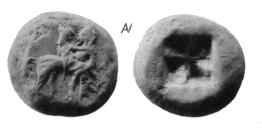
| Centaur bearing a woman in his arms. (Fig. 111). | Deep incuse square quartered.
EL. 252 grs.
|
Babelon (Traité, II. 133) disputes this conjectural attribution, and, in
Inscr. ΟRRΕ ΚΙΟΝ, ΟRRΗΚΙΟΝ, ΩRΗΣΚΙΟΝ, ΩRΗΣΚΙΩΝ, &c.,
sometimes retrogr.
ΚΙΟΝ, ΟRRΗΚΙΟΝ, ΩRΗΣΚΙΟΝ, ΩRΗΣΚΙΩΝ, &c.,
sometimes retrogr.
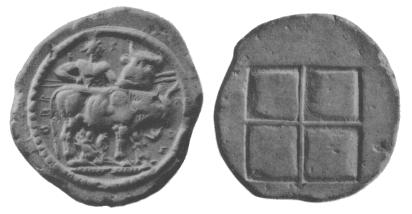
| Naked man with two spears or whip
conducting two oxen. [Cf. N. C., 1897, Pl. XIII. 8.] |
Incuse square quartered (Fig. 112).
AR Octadr. (Phoenician) 440 grs.
|
| Man holding prancing horse by bridle. [B. M. C., Mac., p. 146.] |
Id. (sometimes diagonally divided).
AR Stater (Babylonic) 150 grs.
|
| Centaur bearing off nymph. See also Imhoof, Mon. gr., p. 85.] |
Id. AR 157.8 grs.
|
For similar types see infra, Zaeelii, Edoni, Ichnae, Tynteni, and others without legible inscriptions.
| Similar. [Montagu Cat., 188.] | Crested helmet in incuse square.
AR 145.5 grs.
|
For inscribed specimens of this last type see Lete, infra.
.....naei (?) and Diony... (?). As the inscriptions on these coins are incomplete they can only be attributed by reason of their type and fabric, which are identical with coins of the Orrescii.
| ...ΝΑΙΩ ? or ΔΙΟΝΥ... ? Centaur with nymph. [B. M. C., Mac., p. 148, and Babelon, Traité, Pl. XLVI.] | Incuse square quartered. AR Staters.
|
Zaeelii. Known only from the following coin.
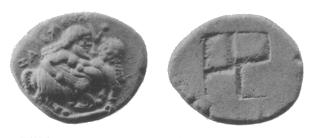
| ΖΑΙΕΛΕΩΝ Centaur with nymph. [B. M. C., Mac., p. 149.] |
Incuse square quartered (Fig. 113).
AR Stater.
|
Other staters with the same obverse type are inscribed  ΕΤΑΙΟΝ, and
have on the reverse a helmet in an incuse square (N. C., 1892, Pl. II. 4;
Berl. Cat., II. Pl. IV. 35, and p. 91; cf. also Hunter, I. Pl. XIX. 16).
ΕΤΑΙΟΝ, and
have on the reverse a helmet in an incuse square (N. C., 1892, Pl. II. 4;
Berl. Cat., II. Pl. IV. 35, and p. 91; cf. also Hunter, I. Pl. XIX. 16).
An uninscribed stater (Hunter, I. Pl. XIX. 15) has on the obv. a Centaur hurling a stone, rev. Inc. sq. quartered, wt. 145.5 grs.
Neapolis (originally Daton), the modern Kavala, lay on the coast at the foot of Mt. Pangaeum, opposite Thasos. Commercially it must have been a town of some importance, owing to its position at the only point where the great military high road through Thrace touched the sea. It was probably originally a Thasian settlement, subsequently tributary to Athens and partially occupied by Athenians, who derived much profit from the neighbouring Pangaean mines. Its silver coinage begins before B.C. 500 and continues in an unbroken series down to the time of Philip, exhibiting in fabric and weight much similarity to the money usually attributed to Thasos. The Gorgon-head as a coin-type appears to have been copied from the earliest coins of Eretria in Euboea (Hill, N. C., 1893, pp. 255 sqq.).
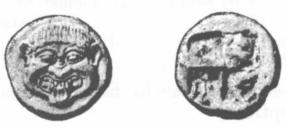
| Gorgon-head (Fig. 114). | Incuse square quartered or diagonally
divided; cf. N. C., 1899, p. 272,
Pl. XV. 5. AR Stater 150 grs.
AR Third 55 grs. AR Ninth 17 grs. |
About B.C. 411 the Phoenician standard seems to have superseded the Babylonic at Neapolis. The same change is noticeable in the coinage conjecturally given to Thasos.
| Gorgon-head. [B. M. Guide, Pl. XXI. 12; cf. Sotheby, Sale Cat., May, 1904; drachm with Dove under chin of goddess on rev.] |
ΝΕΟΠ Head of the Parthenos of
Neapolis (Artemis?) bound with
laurel wreath or plain cord.
AR Drachm (Phoenician) 58 grs.
AR ½ Dr. 29 grs. Æ Size .45 |
With regard to the head on the reverse of these coins see Hicks and Hill, Gr. Hist. Inscr., p. 152.
The two following coins seem also to belong to the latter part of this period :—
| Gorgon-head. [Berl. Cat., II. 102.] | ΝΕΟΠΟΛΙΤΕΩΝ Head of the Par-
thenos of Neapolis (Artemis?) as above.
AR Drachm 55 grs.
|
| Id. [Ibid., 103.] | ΝΕΑΠΟΛΙΤΩΝ Goddess standing to
front, crowned with polos and holding
phiale and poppy head (?)
Æ .7
|
Eïon, at the mouth of the Strymon, appears in early times to have been a prosperous port, but it was afterwards eclipsed, B.C. 437, by its near neighbour, Amphipolis. The attribution to this town of the coins with a duck or goose for type is only due to their having been fre- quently found in that locality. Aquatic birds in large numbers are said still to haunt the shores and marsh-lands of lake Cercinitis and the mouth of the Strymon. The letters Α, Η, Θ, Λ, and Ν, which occur on these little coins, are unexplained. Isolated letters in the field are also noticeable on coins of Neapolis and Thasos (?).
| Goose with head turned back; in field, lizard. [Berl. Cat., II. 84.] | Incuse square. El. Hecte 40 grs.
|
| Id. without lizard. | „ „ El. ½ Hecte 20 grs.
|
The attribution to Macedon of these electrum coins is questioned by Babelon (Traité, II. 141).
| One or two geese, usually accompanied
by lizard, often with letters in field. [B. M. C., Mac., pp. 72 sqq.; Babelon, Traité, Pl. LV.] |
Incuse square. AR 69 grs.
AR 20-13 grs. AR 10 grs. AR 6 grs. |
Lete. This town stood at the issue of a glen leading through the Dysôron ridge of mountains which overlooked the plain of Therma, at a distance of from two to four hours’ journey northwards from that place. (Archives des missions scientifiques et littéraires, Ser. iii. Tom. iii. pp. 276 sqq.) The rich coinage conjecturally attributed to a city so little known historically as Lete may be accounted for by the fact that it occupied a site commanding the route between the Pangaean district and the silver mines (Herod. v. 17) on the one side, and the fertile plain of lower Macedonia on the other (see map in B. M. C., Mac.).
The coinage here assigned to Lete closely resembles in style, fabric, and weight the money of the Orrescii and the other Pangaean tribes, and illustrates in a remarkable manner the cult of the mountain Bacchus with his following of Satyrs, Centaurs, and Nymphs, which was charac- teristic of the country of the Satrae (Herod. vii. 111). During these Bacchic festivals, for which coins would be required, rude and primitive dramatic performances may account for the obscenity of the types.
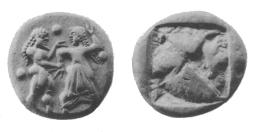
| Naked ithyphallic Satyr with horse's feet, ears, and tail, seizing by the wrist a Maenad clothed in a sleeve- less chiton; pellets in field. | Incuse square divided into four tri-
angular parts (Fig. 115).
AR Stater, 154 grs.; ½ Stater, 77 grs.
|
| Satyr squatting or kneeling, sometimes veretrum tenens. [B. M. C., Mac., p. 80.] | Incuse square. AR 19 grs. (= 1½ Obol).
|
Inscr. fragmentary, and barely legible, ΕΤΑΙΟ .
.
Staters with types as above. On this later series the incuse square is
usually divided into four quadrilateral parts. For varieties see Babelon,
Traité, and Berl. Cat., II. p. 92 ff. Cf. also other staters of the Pangaean
district (supra, p. 196), some of which belong to Lete. e.g. ΕΤΑΙΟ
Centaur carrying off Maenad, rev. Helmet in inc. sq. (Babelon, Traité,
Pl. L. 20, 21).
When Alexander I possessed himself of this region he appears to have monopolized the right of striking money, for none of the coins of Lete can be attributed to a later period than B.C. 480.
Concerning the types see Babelon, op. cit.
Aegae (later Edessa) was the original capital of the kingdom of Macedon, and the burial-place of its kings.
The early silver coins conjecturally attributed to it recall, in their type of the kneeling he-goat, the story told of Karanos its founder, a brother of Pheidon, king of Argos, who was directed by an oracle ‘to seek an empire by the guidance of goats’. Cf. a similar legend concern- ing Perdiccas I (Herod. viii. 137).
The standard of these early coins is the Babylonic, which must have penetrated into the highlands of Macedon by way of the Lydias valley through Lete and Ichnae (see map in B. M. C., Mac., and for coins, Imhoof Münzkab. Karlsruhe, p. 7).
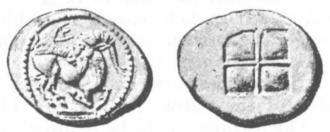
He-goat kneeling, looking back; above,
ΛΑ,  , Θ, , Θ,  , lotus flower, or pellets,
concerning which see Babelon, Traité,
p. 1101. , lotus flower, or pellets,
concerning which see Babelon, Traité,
p. 1101. |
Quadripartite incuse square (Fig. 116).
AR Staters, 150 grs.
[N. C., 1892, Pl. I. 7.]
AR Small coins, 16 grs. |
See also Imperial coins with inscr. ΕΔΕΣΣΑΙΩΝ (p. 244).
Ichnae, in lower Macedonia, lay between the Axius and the Lydias, not far from Pella. Herodotus (vii. 123) mentions it as one of the towns in which the army of Xerxes halted before advancing southwards into Greece.
The silver coins of Ichnae follow the Pangaean (Babylonic and Phoe- nician) standards. The obverse types are similar to those of the coins of the Orrescii and of the Edoni. These two facts show where the earliest silver coinage of Macedon took its rise.
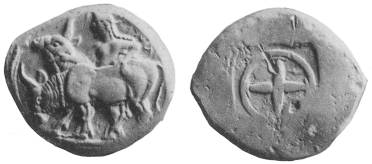
| Ι]ΨΝΑΙ[ΟΝ Naked man walking be- tween two oxen, one of which he holds by the collar. | Wheel in incuse square (Fig. 117).
AR Octadr. (Phoenician), 430 grs.
[Num. Chron., 1885, p. 3.]
|
| ΙΨΝΑΙΩΝ or ΙΨΝΑΟΝ (retrogr.) Warrior restraining a prancing horse. | Wheel. [Babelon, Traité, Pl. XLIX.
11-13].
AR Stater (Babylonic), 142 grs.
|
Tynteni. Whether there was a city called Tynte or whether the Tynteni were a Thraco-Macedonian tribe occupying scattered villages is uncertain. Babelon (Traité, p. 1109) suggests that Tynte may be identical with Daton. Or the coins, which resemble those of the Orrescii and of the town of Ichnae, may have been struck at Ichnae for the Tynteni (Rev. Num., 1903, 317, and Berl. Cat., II. p. 162, and Pl. VI. 55).
| ΤVΝΤΕΝΟΝ Man holding prancing horse. [Babelon, Traité, Pl. XLIX. 14.] | Wheel with axle crossed by two trans-
verse bars, in incuse square; or
incuse square of mill-sail pattern
without wheel.
AR Stater, wt. 144 grs.
|
Bisaltae. This tribe occupied the tract of land west of the Strymon, including the metalliferous mountains which separate the valley of the Strymon from Mygdonia. Their coins follow the Phoe-
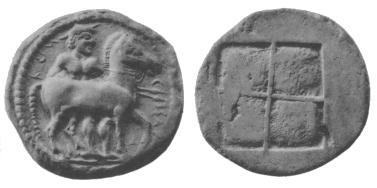
Inscr. CΙΣΑ ΤΙΚΩΝ, CΙΣΑΛΤΙΚ
 N, CΙΑΤΙΚΟ, <ΙΕ┻....
ΒΙΣΑΛΤΙΚΟΝ, &c., on octadrachms: smaller coins uninscribed.
N, CΙΑΤΙΚΟ, <ΙΕ┻....
ΒΙΣΑΛΤΙΚΟΝ, &c., on octadrachms: smaller coins uninscribed.
| Naked warrior, armed with two spears
and wearing kausia, standing beside
horse. Symbol in front sometimes,
, or bearded head. [Babelon, Traité, Pl. XLVII. 2.] |
Quadripartite incuse square (Fig. 118).
AR Octadrachm, 448 grs.
AR Drachm, 79-60 grs. |
| Horseman with two spears, chlamys, and kausia. | Id. AR Tetradrachm, 224 grs.
AR Tetrobol, 37 grs. |
Mosses. Perhaps a king of the Bisaltae or of the Edoni. Circ. B.C. 500-480. Known only from his coins.
| Warrior beside horse, as above. Sym-
bol, occasionally, helmet. [B. M. C., Mac., p. 143.] |
ΜΟΣΣΕΩ or ΜΩΣΣΕΟ in square
AR Drachms and Tetrobols.
|
Docimus (?). From the following coins of the earlier half of the fifth century B.C. it would seem that a dynast of this name may have ruled for a time over one or other of the Thraco-Macedonian tribes.
| ΔΟΚΙ (sometimes retrogr.) Bull, kneel- ing on one knee and looking back. | Helmet in inc. sq. AR 39-36 grs.
[B. M. C., Mac., p. 151.]
|
| No inscr. Similar type. | Wheel with axle-beam crossed by two
transverse bars.
AR 60 grs. and smaller divisions.
[Ib., p. 154.]
|
For varieties see Imhoof, Mon. gr., pp. 98 sqq.
Demetrius. An unknown dynast. Circ. B.C. 450-400.
| ΔΗΜΗΤΡΙΟ Horse walking. [Hunter, I. Pl. XIX. 19.] |
Male head bound with taenia, in incuse
square. AR 67.2
|
Edoni. This Thracian tribe occupied in historical times the parts about the lower Strymon, east of Lake Cercinitis. Their chief centre was the town of Myrcinus.
Getas. Concerning the Edoni (Herod. vii. 110) or Edones and their king Getas, known only from his coins, see Babelon, Journ. Int., 1898, 1.
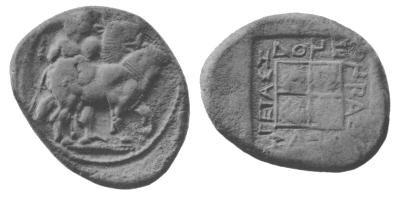
| Nude figure (Hermes?) guiding two oxen. [B. M. C., Mac., p. 144.] | ΓΕΤΑΒΑΣΙΛΕΩΣΗΔΩΝΑΝ Written
round an incuse square, in centre of
which a raised quadripartite square.
AR Octadrachm, 427.8 grs.
|
| Similar (Fig. 119). | ΓΕΤΑΣ ΗΔΟΝΕΟΝ ΒΑΣΙΛΕΥΣ
Similar. AR Octadr. 417.8 grs.
|
| Similar. [Journ. Int., 1898, Pl. I. 4.] |
ΓΕΤΑ ΒΑΣΙΛΕΥ ΗΔΩΝΕΩΝ Simi-
lar. AR Octadr. 437 grs.
|
| Similar. [Ib., Pl. I. 2.] | [ΓΕΤΑΣ Β]ΑΣΙΛ[ΕΥΣ ΗΔΩ]ΝΑΝ ??
Wheel with four spokes in shallow
inc. sq. AR Octadr. 448 grs.
|
Cf. with this last coin the octadrachm of Ichnae (N. C., 1885, 3).
Most of these coins come from Mesopotamia or Syria, whither, we may presume, they were conveyed by the Persians, to whom the Thraco- Macedonian tribes had been tributary since their conquest by Darius, B.C. 513.
Derrones. H. Gaebler (Z. f. N., xx. 289) has pointed out that the remarkable series of dekadrachms of Euboïc (?) weight, conjecturally attri- buted in the first edition of this work to an unknown king of the Odomanti, on the borders of the Bisaltian territory, by name Derronikos, belong in reality to a tribe called the Derrones, perhaps the Δερσαιοι (Herod. vii. 110) or Δερραιοι (Steph. Byz.), who, he thinks, may have occupied the central or Sithonian peninsula of Chalcidice, of which the city of Terone was the chief coast town. Th. Reinach, on the other hand (R. N., 1897, 125), would place the Derrones between the Crestones and the Odomanti, in the valleys of Mt. Dysôron, and there can be no doubt that their coins resemble in style those of the Bisaltians more than those of any place in Chalcidice. It is only their apparently Euboïc weight which connects them with the latter district. Reinach’s location of the Derrones is therefore probably correct, and in striking confirmation of it he publishes a unique silver stater of king Lykkeios of Paeonia (B.C. 359- 340), on the obverse of which is a beardless laureate head accompanied by the legend ΔΕΡΡΩΝΑΙΟΣ, proving that Paeonians and Derronians worshipped the same god, and that consequently they must have been near neighbours. The fact that the early Derronian coins may be deka-
Of these coins, ranging in weight from about 640-580 grs. or less, and dating from about B.C. 500, the following are the principal varieties.
| ΔΕRRΟΝΙΚΟS Two oxen yoked to car. In field, two circles (shields ?). [Babelon, Traité, Pl. XLIV. 2.] | Quadripartite inc. sq. AR 580 grs.
|
| ΔΕΡΡΟ Similar, but Hermes, bearded, with caduceus drives oxen. [Ib., Fig. 3.] | „ „ AR 620 grs.
|
| ΔΕRRΟΝΙΚΟN or no inscr. Bearded man driving car drawn by pair of oxen. Symbols, above, eagle carrying tortoise; large shield with star on it; Corinthian helmet (Fig. 120), Corin- thian helmet and shield. Symbols beneath, aplustre, flower, palmette. | Triskeles, sometimes with palmetto
between legs. AR 636-619 grs.
|
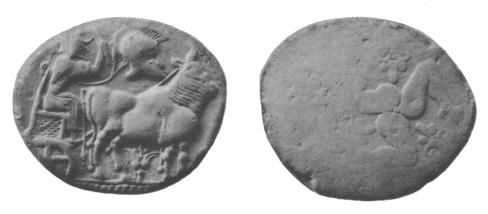
The two adjectival forms of the legend, Δερρωνικος and Δερρωνικον, correspond with Βισαλτικος and Βισαλτικον on the coins of the neighbour- ing tribe, the Bisaltae. Reinach (op. cit.) suggests that masculine and neuter nouns (e. g. χαρακτηρ and αργυριον) are to be understood.
In addition to the above described coins of the Derrones there are several barbarous imitations of them, issued by neighbouring tribes, e. g. those with the inscr. ΛΑΙΑΙ on the obv. and a Pegasos in a double linear square on the rev., which are attributed by Svoronos (Ephem., 1889, 94) to the Laeaei, a Paeonian tribe (Thuc. ii. 95, 96). With regard to these see Gaebler (op. cit.), and Babelon (Traité, p. 1048).
For references to illustrations see the above cited works, and B. M. C., Mac.; Imhoof, Mon. gr., Pl. D. 1; Ashburnham Cat., Pl. III. 71; Reinach, L'Histoire par les monnaies, 1902, Pl. V; and Babelon, Traité, Pl. XLIV.
Therma (?), later Thessalonica. The central position of this town (the modern Salonica), at the head of the Thermaic gulf, threw it of necessity into communication both by sea and land with various cities and tribes using money struck on various standards, Babylonic, Euboïc, and Phoe- nician. No early coins are, however, known which can be with certainty attributed to it, although it is possible that many uninscribed Mace- donian coins, which have been found at Salonica, may have been struck there. For some of these see B. M. C., Mac., pp. xxv and 135. The only coins which have been, with some probability, assigned to Therma are those with a Pegasos on the obverse, a type which seems especially applicable to Therma, supposing it to have been a colony of Corinth.
| Pegasos standing (symbol, sometimes, aplustre) or galloping with hound beneath him. | Flat incuse square, usually quartered.
[B. M. C., Mac., 136, 137.]
AR Tetradrachm, 210 grs.
|
The galloping Pegasos with hound beneath him may be compared for style with tetradrachms of Sermyle (p. 207).
Imhoof (Mon. gr., p. 105), while accepting the coins with the Pegasos
as probably of Therma, gives reasons for rejecting the hypothesis that
many other coins marked with the symbol or Θ, and bearing the
types of various Macedonian towns, were also struck at Therma.
For later coins see Thessalonica, p. 245.
The Greek towns which studded the coasts of Chalcidice, with its three huge tongues of land extending far into the sea, were for the most part sprung from the two enterprising Euboean cities, Chalcis and Eretria. From Euboea these colonies derived the Euboïc silver standard, which took firm root in those northern regions, and continued in general use until the latter part of the fifth century, when, as will presently be seen, it was in nearly all of them superseded by the Phoenician or Mace- donian standard.
Beginning with the eastern shores of the promontory, and taking the towns in order from east to west, the first town we come to of which coins are known is—
Orthagoreia. Eckhel (ii. 73), on the authority of a fragment of the Geographi Minores, identifies Orthagoreia with Stageira, on the Stry- monic gulf (but see Pliny iv. 11, 18). In style and weight its coins form an exception to those of the other Chalcidic cities, and correspond with those of the kings of Macedon from Archelaus to Perdiccas III (B.C. 413-359) as well as with the contemporary coins of Abdera and Maroneia.
| Head of Artemis in profile. [B. M. C., Mac., p. 88.] |
ΟΡΘΑΓΟΡΕΩΝ Macedonian helmet
to front, surmounted by star.
AR Persic Stater, 1.68 grs.
|
| Id. Three-quarter face. [Ib., p. 88.] | Id. AR Triobol. 42 grs.
|
| Head of Apollo. [Ib., p. 89.] | Id. Æ Size .5
|
Apollonia (?). There were three Macedonian towns of this name, one of which, situated to the south of Lake Bolbe, may, according to Imhoof, have issued the following bronze coins. The attribution is very doubtful. The inscr. ΑΠΟΛΛΩΝΟΣ occurs elsewhere only on some coins of Tau- romenium in Sicily. Imhoof (Mon. gr., p. 65) would supply the word πολις. In spite of the inscr. the types refer to the cult of Dionysos.
| Young male head crowned with ivy. [Hunter, I. 270; Berl. Cat., II. 65.] | ΑΠΟΛ ΛΩΝΟΣ Amphora. Æ .9
|
These uncertain coins may be compared for style with those of the unknown rulers Adaeus and Cavarus, and with the coins reading ΑΠΟΛΛΩΝΟΣ ΙΑΤΡΟΥ, assigned by Pick to Apollonia Pontica (Jahr. arch. Inst., xiii. 169), and by Svoronos (Journ. int. d'arch.-num., i. p. 86) to Peparethus (p. 313 infra).
Acanthus was an ancient colony from Andros, situated on the isthmus which connects the peninsula of Acte with the mainland of Chalcidice. It began to coin silver in large quantities about B.C. 500 or earlier. Until the time of the expedition of Brasidas, B.C. 424, the Euboïc standard was used, after that date the Phoenician.
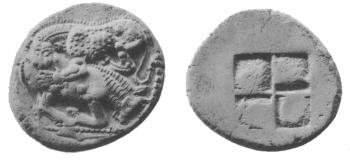
| Lion on the back of a bull, fastening upon him with his teeth and claws (Fig. 121); changing symbols in field or exergue on later specimens. | Quadripartite incuse square. Later
specimens inscribed ΑΚΑΝΘΙΟΝ.
AR Tetradr. 270 grs.
|
Herodotus (vii. 125 sq.) relates that while Xerxes was marching from Acanthus to Therma his camels were set upon by lions, and he proceeds to state that all these northern regions, west of the river Nestus, abounded with lions and wild bulls with gigantic horns. The coin-type may not, however, be derived from local incidents of this kind, as it is of far more ancient and perhaps Anatolian origin in connexion with the worship of Kybele (Soph., Philoktetes, 400; cf. J. H. S., xx. 118). There are also similar tetradrachms on which the animal seized by the lion is a boar instead of a bull (Z. f. N., xxiv. 48). This rare uninscribed variety was probably issued by some town in the neighbourhood of Acanthus, per- haps Stageira, whose port, north of Acanthus, was called Καπρος (Strab.
| Bull kneeling on one knee, head turned back; above or in ex., flower. [B. M.] | Quadripartite inc. sq. AR Dr. 62 grs.
|
| Forepart of lion or, more rarely, of
bull; above, flower, or |
Id. [B. M. C., Mac., p. 32].
AR Tetrobols.
|
| Head of Athena. | Id. [Ibid., p. 33]. AR Diobols.
|
| Lion’s head facing, with neck. | Id. [Ibid., p. 34]. AR Obols.
|
To Acanthus may also in all probability be assigned many other uninscribed specimens figured by Babelon (Traité, Pl. LIV).
The change of standard which took place when Acanthus joined the Spartan alliance (B.C. 424) is accompanied by a marked change in the style, which is now far softer and less energetic.
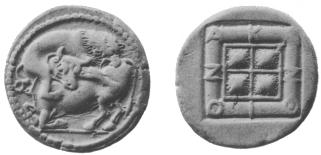
| Lion seizing bull; often with magis- trate’s name, ΑΛΕΞΙΣ, ΑΛΕΞΙΟΣ, ΕΥΚ, ΟΝΟΜΑΣΤΟ, ΠΟ, &c. | ΑΚΑΝΘΙΟΝ around the border of an
incuse square, within which a quadri-
partite linear square (Fig. 122).
AR Tetradr. 224 grs.
|
| Forepart of bull turning round. Various symbols and letters. | Quadripartite incuse square. [B. M.
C., Mac., p. 35.]. AR Tetrob. 37 grs.
AR Triob. 28 grs. |
| Head of Athena, helmet wreathed with olive. [Imhoof, Mon. gr., 61.] | ΑΚΑΝ in the four quarters of a square.
AR Diob. 20 grs.
|
| Head of Apollo, with short hair. [B. M. C., Mac., p. 36.] | ΑΚΑΝΘΙΟΝ Lyre in incuse square.
AR Obol, 9 grs.
|
These obols are clearly contemporary with the money of the Chalcidian League struck at Olynthus, and we may infer from them that Acanthus maintained its independence as against the Confederacy.
The bronze coins of Acanthus are all subsequent to B.C. 400.
| Head of Athena. | ΑΚΑΝ in the four quarters of a wheel
Æ .65
|
| Id. | ΑΚΑΝ in the four quarters of a linear
Square. Æ .45
|
Olophyxus. A small town near the summit of Mt. Athos (Herod. vii. 22; Strab. vii. Fr. 33, 35). Its name is mentioned in the Athenian quota-lists, and its weights and measures are alluded to in Aristoph. Av. 1041.
| Female head of fine style in stephane, hair rolled. [B. M.] | ΟΛΟΦΥΞΙΩΝ Eagle standing, wings
closed, in linear sq. Æ .6
[N. C., 1903, 319.]
|
Uranopolis, on the peninsula of Acte, probably on Mt. Athos, is said to have been founded by Alexarchus, brother of Cassander (Athen. iii. 20). The silver coins of this city are the only ones in Macedon which adhere to the Phoenician standard in post-Alexandrine times. On the types, which are suggested by the name of the town, see Num. Chron., 1880, p. 58, and Imhoof (Mon. gr., p. 96).
| Sun, moon, and five stars. [Zeit. f. Num., v. Pl. I. 2.] |
ΟΥΡΑΝΙΔΩΝ Aphrodite Urania hold-
ing sceptre and seated
on globe; in field Λ
over hand-torch.
AR Tetradr. 209 grs.
|
| Radiate globe (the sun). [B. M. C., Mac., p. 133.] |
„ Id. AR Didr. 107 grs.
|
| The sun as a star of eight rays. | ΟΥΡΑΝΙΔΩΝ ΠΟΛΕΩΣ.
AR Drachm, 56 grs.
|
| Id. | „ Id. Æ Size .65
|
| Star and crescent (sun and moon). | „ „ Id. Æ Size .5
|
Terone or Torone, on the Sithonian peninsula, was one of the most flourishing of the Chalcidian colonies. During the expedition of Xerxes it was one of the towns which furnished ships and men to the Persian armament. The tetradrachms are probably all anterior to B.C. 480. Of the period of the Athenian supremacy tetrobols only are known.
In B.C. 424 Terone opened its gates to Brasidas, but was shortly after- wards recovered for Athens by Cleon.
Here, as elsewhere in Chalcidice, the Euboïc standard appears to have been replaced, circ. B.C. 424, by the Phoenician, but there are no coins of Terone after circ. B.C. 420.
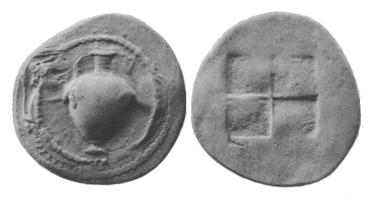
| ΗΕ, or ΤΕ, or no inscription; Amphora, on which one or more bunches of grapes. | Quadripartite shallow incuse square.
(Fig. 123). AR Tetradr. 270 grs.
|
| Oenochoë. | Id. AR Tetrobol.
|
| ΤΕ Oenochoë. | Id. AR Tetrobol.
|
| Oenochoë. [Imhoof, Mon. gr., Pl. C. 25.] |
Forepart of goat in incuse square.
AR ½ Obol.
|
| Naked Satyr looking down into an
oenochoë. [Imhoof, Mon. gr., Pl. C. 23.] |
ΤΕ Goat in incuse square; or
ΤΕΡΩΝΑΟΝ, around a quadri-
partite square. AR Tetrobol.
|
| ΤΕ Oenochoë. | Goat’s bead in incuse square. AR Obol.
|
| Stork plunging his bill into an oeno- choë. [Imhoof, Mon. gr., Pl. C. 24.] | Quadripartite incuse square. AR ½ Obol.
|
Sermyle (Ormylia) near the head of the Toronaïc gulf (Herod. vii. 122). The only known coins of this city are archaic tetradrachms of the Euboïc standard.
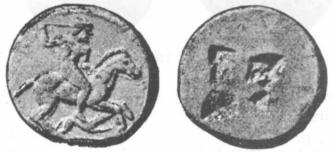
| ΣΕΡΜVΛΙΚΟΝ, ΣΕΡΜVΛΙΑΟΝ,&c. Naked horseman with spear, gallop- ing; hound, sometimes, beneath the horse. | Quadripartite incuse square. (Fig. 124.)
AR Tetradrachm.
|
Olynthus, at the head of the Toronaïc gulf, was a colony of Chalcis, subsequently, in the time of the Persian wars, occupied by Bottiaeans, but restored, B.C. 479, by Artabazus to the Chalcidians.
The following coins, which can hardly be later than the end of the sixth century B.C., have been assigned by some numismatists to Chalcis in Euboea. The Chalcidian colony Olynthus appears however to be a far more probable place of mintage. In any case the engravers of these remarkable coins were unrivalled masters of the difficult art of repre- senting in relief a horse and his rider seen from the front. The types, like those of Elis, seem to be agonistic, and to refer to contests at Olympia. Thus the Eagle and Serpent, as at Elis and at Chalcis, is the well-known omen of victory of the Olympian Zeus. The chariot, the horses, and the horse (sometimes standing beside the ‘meta’) are equally significant of Olympian contests.
The weight-standard of the early Olynthian coins, like that of the
| Quadriga of walking horses r. driven
by bearded charioteer. [N. C., 1878, p. 85.] |
Inc. sq. of irregular mill-sail pattern.
AR Tetradr. 259 grs.
|
| Quadriga seen from front, in plain
linear circle. [N. C., 1892, Pl. XV. 8.] |
Similar. AR Tetradr. 258.8 grs.
|
| Man riding horse to front and leading another by bridle : the whole on raised disk. [Ibid., Pl. XV. 9.] | Similar. AR Octobol, 86.3 grs.
|
| Man riding horse to front. [Ibid., Pl. XV. 10.] |
Similar. AR Tetrobol, 43.2 grs.
|
| Horseman r. on raised disk. [B. M.] | Similar. AR Tetrobol, 41.5 grs.
|
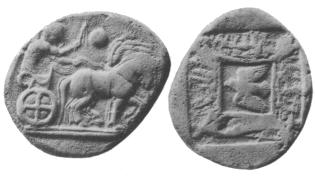
| Quadriga r. driven by man holding
whip; above, large disk. [B. M. C., Mac., p. 86.] |
Eagle flying in inc. sq. in the midst of
a larger inc. sq. (Fig. 125).
AR Tetradr. 255.6 grs.
|
| Beardless male (?) head l. laur. (?); hair
in bunch behind. [N. C., 1892, Pl. XV. 11.] |
Quadriga seen from front in inc. sq.
AR Tetradrachm, 242.1 grs.
|
| Man to front, holding horse also to front. [N. C., 1892, p. 191.] | Eagle flying in inc. sq. AR Tetrobol (?)
|
| Free horse cantering. [N. C., 1897, Pl. XIII. 6.] |
↓ΑΚ in four corners of inc. sq., within
which, flying eagle.
AR Tetrobol, 41 grs.
|
| Similar. [B. M. C., Mac., p. 87.] | ΟΛ ΝΛ (=ΟΛΥΝ) Similar. AR Tetrobol, 36 grs.
|
| Horse attached by bridle to Ionic column (meta ?). [Ibid.] | Similar. AR Tetrobol, 36 grs.
|
| Forepart of prancing horse. [Ibid.] | No inscr. Eagle with serpent in inc.
sq. AR Diobol, 20.3 grs.
|
| Young male head in crested Athenian helmet, on which, dolphin. [B. M.] | Similar. AR Obol, 8.7 grs.
|
For other coins with Eagle and Serpent see Sparadocus, Chalcis Eub., and Elis. Although this type, as at Elis, may symbolize the Olympian Zeus, and thus refer to victories at the Olympian games, it may also be considered as affording an instance of a colony adopting the type of the money of its mother-city (Chalcis in Euboea). The coin
Κ suggests that, even in the earlier half of the fifth cen-
tury, Olynthus issued money for Olympic festivals in the name of all the
Chalcidian colonists who attended the games.
The Chalcidian League. Into this period falls the beautiful federal currency of the Chalcidian League, constituted B.C. 392, of which the head quarters and doubtless the mint were at Olynthus. There is every reason to suppose that this series was continued until Philip made himself master of Chalcidice, B.C. 358. The heads of Apollo on these coins are remarkable for their great variety, no less than for the strength and beauty of their style (see Wroth in N. C., 1897, p. 100 [citing Pl. III. 11 and B. M. Guide, Pl. XXI. 10-11]).
| Head of Apollo laureate. [B. M. Guide, Pl. XXI. 9; Berl. Cat., II. Pl. IV. 29.] | ΧΑΛΚΙΔΕΩΝ Lyre. Sometimes with
magistrates’ names, ΕΠΙ ΑΡΧΙ ΕΠΙ ΕΥΔΩΡΙΔΑ ΕΠΙ ΟΛΥΜΠΙΧΟ[Υ]. AV Staters.
|
These beautiful gold staters were doubtless issued for war expenses shortly before B.C. 358.
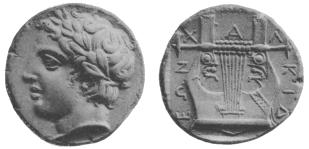
| Head of Apollo, laureate (Fig. 126). | ΧΑΛΚΙΔΕΩΝ Lyre; occasionally
with adjunct symbol above it. Ma-
gistrates sometimes— ΕΠΙ ΑΝΝΙΚΑ,
ΑΡΙΣΤΩΝΟΣ, ΑΡΧΙΔΑΜΟ, ΑΣ-
ΚΛΗΠΙΟΔΩΡΟ and ΚΡΑ, ΕΥΔΩ-
ΡΙΔΑ, ΛΕΑΔΕΟΣ, ΟΛΥ[ΜΠΙ-
ΧΟΥ], ΠΟΛΥΞΕΝΟΥ, ΣΤΡΑΤΩ-
ΝΟΣ, &c. AR Tetradr. 224 grs.
|
| Id. | ΧΑΛΚΙΔΕΩΝ Lyre, sometimes in
incuse square. AR Tetrobols, 37 grs.
|
| ΟΛΥΝΘ[Ι] Head of Apollo, laureate. [B. M. C., Mac., p. 87.] |
ΧΑΛΚΙΔΕΩΝ Lyre in incuse square.
AR Tetrob.
|
| Head of Apollo, laureate. | ΧΑΛΚΙΔ Tripod. AR Fractions of obol.
|
| Id. | ΧΑΛΚΙΔΕΩΝ Lyre. Æ .65
|
| Id. | Tripod. Æ .45
|
A tetradrachm at Berlin and another at Paris have in small characters ΤΕΤ above the lyre. Various single letters also occur on the obverses of the tetrobols.
Aphytis, on the eastern shore of the peninsula of Pallene, was cele- brated for its temple of Zeus Ammon (Plut., Lys., xx; Paus. iii. 18. 3
‘Αφυταιοι δε τιμωσιν Αμμωνα ουδεν ησσον η οι ‘Αμμωνιοι Λιβυων). While tributary to Athens, before B.C. 424, it struck no coins (Corp. Inscr. Att., vol. i. p. 229). The following appear to have been issued before its conquest by Philip (B.C. 358).
| Head of Zeus Ammon with ram’s horns facing. | ΑΦΥΤΑΙΩΝ Kantharos. Æ .65
[B. M. C., Mac., p. 61.]
|
| Id. in profile. | ΑΦΥ Two eagles face to face. Æ .65
|
| Id. | ΑΦΥ One eagle. Æ .55
|
The head of Ammon at Aphytis, as at Cyrene, Tenos, Mytilene, and Lesbos, is represented either bearded or youthful. The kantharos refers to the worship of Dionysos at Aphytis, where, according to Xenophon (Hell. v. 3. 19), there was a temple of that god. The next coins, of later style, were probably issued shortly before the overthrow of the Macedonian kingdom (B.C. 168).
| Head of Zeus Ammon. [See also Imhoof, Mon. gr., p. 64.] |
ΑΦΥΤΑΙ Eagle, or two eagles face to
face. Æ .8-.6
|
Scione, the chief town on the south coast of Pallene, was probably of Euboean origin, notwithstanding the fact that the inhabitants ascribed the foundation of their city to some one of the Achaean heroes returning from Troy. In B.C. 424 it revolted from Athens, and two years after- wards was captured and its inhabitants put to the sword.
The archaic coins of Scione are more numerous than has been hitherto suspected, although the tetradrachms of Euboïc weight with a bunch of grapes on the obv., and on the rev. a winged genius, a head of bearded Herakles, or a crested helmet, formerly assigned by me (N. C., 1891) to Cyrene, and later by Hill (J. H. S., 1897) conjecturally to a city in Chalcidice (Scione?), have been recently shown by Wroth (J. H. S., 1907) to have been issued in the island of Peparethus (q.v.). The following inscribed specimens, beginning in archaic times, lead us however to suppose that Scione may have previously struck the uninscribed coins figured by Babelon, Traité, Pl. LII. 1-3.
| Young heroic head of archaic style bound with taenia with spike in front. [B. M. and Imhoof, Mon. gr., Pl. E. 27.] | ΣΚΙΟ in corners of inc. sq. containing
large human eye. AR 33 grs.
AR 5.6 grs. |
| Similar. [B. M.] | ΣΚΙΟ in corners of inc. sq. containing
bunch of grapes. AR 9.4 grs.
|
| Similar. [B. M.] | ΣΚΙΟ in corners of inc. sq. containing
helmet. AR 42.5 grs.
|
| Similar, of later style. [N. C., 1891, Pl. IV. 4.] |
ΣΚΙΟ Similar. AR 34.8 grs.
[B. M.]. AR 5.7 grs. |
| Similar. [B. M.] | ΣΚΙΩΝΑΙΩΝ Helmet. AR 30.5 grs.
|
| Similar. [B. M.] | ΣΚΙΩ Helmet. Æ Size .8
|
| Female head. [B. M.] | ΣΚΙΩ Two doves billing. Æ Size .6
|
Cf. also N. C., 1898, pp. 193, 255, and 1905, pp. 325-329 [citing Pl. XIV. 1-6]; Berl. Cat., II. 124; and Hunter Cat., I. 272.
The large Eye on some of the archaic specimens is probably ‘short- hand’ for a prow, of which the eye was the most conspicuous feature.
Mende was an ancient colony of Eretria, situate on the south-west
| ΜΙΝ or ΜΕΝ, ΜΙΝΔΑΟΝ, ΜΙΝ- ΔΑΙΟΝ, or no inscription. Ass (ithyphallic) standing usually before vine; on his back a crow pecking at his tail. Symbol, sometimes cres- cent moon, cock, or bunch of grapes. | Four or more incuse triangles in mill-
sail pattern; in centre sometimes Θ.
[B. M. Guide, Pl. IV. 8, &c.; Zeit.
f. Num., x. Taf. III. 3.].
AR Euboïc tetradrachm.
|
| Ass. | Id. AR Tetradr. and divisions.
|
| Head of Ass. | Id. AR Hemiobol.
|
For illustrations see Babelon, Traité, Pl. LI. 6-22.
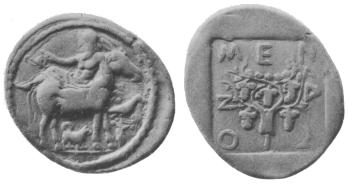
| Seilenos reclining on back of ass. He holds a kantharos. In front a crow seated on an ivy-tree, and beneath ass, sometimes a dog. | ΜΕΝΔΑΙΟΝ Vine in incuse square
(Fig. 127). AR Tetradrachm.
|
| Seilenos standing beside ass and hold- ing it by the ears. | „ Crow in incuse square.
AR Tetrobol.
[Imhoof, Mon. gr., Pl. C. 19, 20.]
|
| Forepart of ass. | Kantharos. AR Obol.
|
| Head of young Dionysos crowned with ivy. [Imhoof, Mon. gr., Pl. C. 21.] | ΜΕΝΔΑΙΩΝ Ass standing; on his
back a crow pecking at his tail; in-
cuse circle.
AR Tetradr. (Phoenician), 190 grs.
|
| Id. [Imhoof, op. cit., p. 83, No. 89.] |
ΜΕΝΔΑΙΩΝ Amphora between two
branches of ivy. 104 grs.
|
| Seilenos reclining on ass. | ΜΕΝΔΑΙΗ or ΜΕΝΔΑΙΩΝ Am-
phora in shallow inc. square.
AR Tetrobol.
|
| Head of young Dionysos. | ΜΕΝΔΑ One or two amphorae
accompanied by ivy-sprays.
Æ .65-.4
|
For other varieties, mostly small, see Imhoof, Mon. gr., p. 83; and N. C., 1890, 2, 11; 1892, 6; 1893, 2; 1896, 15; 1897, 275 [citing Pl. XIII. 5]; 1898, 251, 256; 1900, 6.
Capsa or Scapsa, north of Mende and near Assa or Assera, see Imhoof, Mon. gr., p. 69; and Wroth, N. C., 1900, 275.
| Ass; above, vase (kylix). [Babelon, Traité, Pl. LI. 23.] |
Κ Α in two of four incuse triangles.
AR Tetrob., 45 grs.
|
Potidaea, a colony of Corinth on the Thermaic gulf, began to coin money about B.C. 500. Its name is clearly derived from Poseidon (cf. Poseidonia). The type of the tetradrachm was doubtless suggested by the sacred image of Poseidon, which Herodotus (viii. 129) mentions as standing in front of the city, εν τω προαστειω. Millingen (Syll., p. 48) thinks that the female head on the tetrobol may represent Pallene, from whom the peninsula received its name. With the celebrated blockade of Potidaea by the Athenians, B.C. 432-429, the silver coinage comes to an end. The bronze coins belong to the fourth century, but they are no doubt earlier than B.C. 358, when Philip of Macedon seized the city and handed it over to the Olynthians.
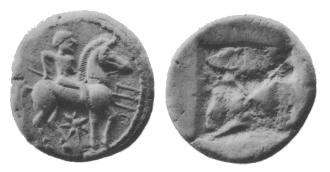
| Π Poseidon Hippios on horseback. He holds trident; under horse, star. | Incuse square, diagonally divided
(Fig. 128). AR Euboïc tetradr.
|
| ΠΟ Id. [B. M.; cf. N. C., 1900, Pl. XIII. 4.] |
Incuse square quartered. Fleur-de-lys
in two quarters. AR Tetrob.
|
| ΠΟ or Π Id. | Female head of archaic style in spiked
leather cap covered with dots, all in
incuse square. AR Tetrobol.
|
| Π Naked horseman on forepart of prancing horse. | Similar. AR Diobol.
|
| Head of Athena in Corinthian helmet. | ΠΟΤ Pegasos or Trident. Æ .7
|
| Female head with ear-ring. | ΠΟΤΕΙ Bull butting. Æ .4
|
For other varieties and illustrations see B. M. C., Mac.; Berl. Cat., II. 123; and N. C., 1892, 7; 1898, 254; 1900, 276; 1902, 315, &c.
Cassandreia. This town was founded by Cassander on the site of Potidaea.
No coins are known until after the time of Augustus, when the city received a Roman colony, and struck bronze coins with Latin legends between the reigns of Claudius and Philippus.
Inscr. COLONIA IVLIA AVG. CASSANDRENSIS variously abbre- viated.
Types. Vexillum between military standards, Rev. Wreath; Head of Zeus Ammon; Poseidon with foot on prow. (B. M. C., Mac., 65; Berl. Cat., II. 70; Hunter, I. 273.)
In the Molthein Cat. (971) an earlier coin is ascribed to Cassandreia, but cf. 1141. Both are probably coins of Cassander.
Bottice. The Bottiaeans originally occupied the fertile plains between the lower courses of the Axius, Lydias, and Haliacmon, a district of Emathia which retained the name of Bottiaea until after the Roman conquest. The original Bottiaeans were however expelled at an early date and settled near Olynthus in the district called after them Bottice. Their chief city was Spartolus (B. M. C., Mac., p. xl).
| Head of Demeter in low stephanos wreathed with corn. [Imhoof, Choix, Pl. I. 16; B. M. C., Mac., 63.] | ΒΟΤΤΙΑΙΩΝ Forepart of bull in
incuse square.
AR Phoenician Tetrob. 36 grs.
|
| Head of Apollo laureate. [B. M. C., Mac., 63; Berl. Cat., 69.] |
ΒΟΤΤΙΑΙΩΝ Lyre. Æ .65
|
| Head of Artemis. | „ Id. Æ .45
|
| Female head. | „ Bull butting. Æ .7
|
(See also Bottiaea Emathiae, p. 243.)
Dicaea, on the Thermaic gulf, was a colony of Eretria, from which its oldest coin-types are borrowed. On the distinction between the coins of this town and those of Dicaea in Thrace, see J. P. Six (Num. Chron., N. S., Vol. xv. p. 97). In the Athenian Quota-lists (Corp. Inscr. Att., Vol. i. p. 230) it is called Δικαια ‘Ερετρι[ων], and the inhabitants Δικαιο- πολιται ‘Ερετριων αποικοι.
| Cow scratching herself, with bird on
back; beneath and ΔΙ. [Imhoof, Gr. M., Pl. I. 9.] |
Octopus in inc. sq.
AR Euboïc tetradr. 264 grs.
|
| Cow scratching herself; inscr. sometimes
ΔΙΚΑ. [Babelon, Traité, Pl. LI. 1-3.] |
Inc. sq. quartered or divided into
several triangular sinkings.
AR Tetrob. 44 grs.
|
| Cock. [Imh., Mon. gr., Pl. C. 14.] | Octopus in inc. sq.
AR Tetrob. 41 grs.
|
| Cock; above, (solar ?) disk containing elaborate stellate pattern; in front, volute. [N. C., 1893, Pl. I. 1.] | Id. AR Tetrob. 36.4 grs.
|
| ΔΙΚΑΙ Cock. [Imh., Mon. gr., Pl. C. 15.] |
Scallop shell in inc. sq.
AR Diob. 13 grs.
|
| Horse standing; in field, : [B. M.] | Δ in inc. sq. AR Diob. 12.6 grs.
|
| ΔΙΚΑ Bull standing. [Imh., Mon. gr., Pl. C. 16.] |
Octopus in inc. sq.
AR Diob. 13 grs.
|
| ΔΙ Forepart of bull. [Ibid., Pl. C. 17.] |
Id. AR Obol, 6 grs.
|
| Head of Athena. [Ibid., p. 73.] | ΔΙ Bull’s head facing. Æ Size .4
|
| Female head crowned with corn. [Ibid.] |
ΔΙΚΑΙ ΟΠΟΛ Bull standing.
Æ .65
|
Compare with some of the above the coins attributed to Dicaea and Selymbria in Thrace.
Aeneia, on the Thermaic gulf, was said to have been founded by Aeneas (Otto Abel, Makedonien vor König Philipp, p. 37, and Fried- lander, Monatsberichte d. K. Akad. d. Wissensch, 1878).
| ΑΙΝΕΑΣ Aeneas carrying Anchises,
preceded by his wife Kreusa carrying
Ascanius: in field, |
Quadripartite incuse square.
[Zeit. f. Num., vii. 221].
AR Euboïc tetradr.
|
Concerning this remarkable coin, which affords the oldest represents- tion of a Trojan myth which has come down to us, see Friedlander (l. c.). The smaller silver coins are of two periods.
| Head of bearded Aeneas, helmeted, of archaic style. | Quadripartite incuse square.
AR Euboïc tetrobol, 39 grs.,
and Diobol, 21 grs. |
| Head of Aeneas of more recent style. | ΑΙΝΕΑΣ Quadripartite incuse square.
AR Phoenician tetrobol, 35 grs.
|
| Head of Athena in Athenian helmet
bound with olive. [Imhoof, Mon. gr., Pl. C. 12.] |
„ Bull looking back, in inc.
square. AR Phoenician tetrob. 36 grs.
|
| Head of Ascanius in Phrygian cap. [Imhoof, Choix, Pl. I. 15.] |
ΑΙΝΕΙΑΤΩΝ Bull rushing. Æ .6
|
Other coins of this last type read ΑΙΝΕΗΤΩΝ (N. Z., 1884, 242), and ΑΙΝΑΩΝ (Berl. Cat., II. p. 33).
Amphipolis, on the Strymon, although founded B.C. 437 by the Athenians, does not seem to have struck money until some years after its capture by Brasidas B.C. 424, from which time until it was taken by Philip in B.C. 358 it remained practically free. The magnificent series
of full-face heads of Apollo on the coins of Amphipolis, as works of art, perhaps excel the types of any other city of Northern Greece. Kimon of Syracuse was probably the first die-engraver who successfully mastered the difficulty of worthily representing a full-face head on coins. His wonderful Arethusa-head with flowing hair seems to have roused the emulation of the die-engravers of many cities, Catana, Croton, and Pandosia in the west, Larissa and Thebes in Central Greece, Aenus and Amphipolis in the north, Rhodes and Clazomenae in the east, among others. But none of all these has left us such a rich and varied series of full-face heads as Amphipolis. The fashion, however, was found to be unsuitable for current coins, and it prevailed only during the period of finest art, circ. B.C. 410-360. The Race-torch, the usual reverse-type of the coins of Amphipolis, reminds us of the worship of Artemis Tauro- polos or Brauronia, who was especially revered at Amphipolis, and in whose honour Torch-races, Lampadephoria, were held (Leake, Num. Hell., p. 11). The weight-standard is the Phoenician.
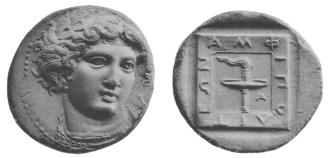
| Head of Apollo, three-quarter face; various symbols in field : Bee, tripod, Boeotian shield, plant, or ear of corn, crab, dog, &c. [B. M. Guide, Pl. 21. 7, 8; Berl. Cat., II. 34. [1]] | ΑΜΦΙΠΟΛΙΤΕΩΝ (rarely, and on the
earlier (?) issues, ΑΜΦΙΠΟΛΙΤΩΝ)
written on a raised frame in an in-
cuse square. In the midst, a race-
torch and various symbols or letters.
(Fig. 129). AR Tetradr. 224 grs.,
Drachm, and Triob.
|
| Similar. | ΑΜΦΙ Race-torch in wreath.
AR Tetradr. and Tetrob.
|
| Young head, r., wearing taenia. | „ Dolphin in incuse square
AR Obol.
|
| Head of Apollo, or young head, bound with taenia. | ΑΜΦΙ Race-torch in linear square
[B. M. C., Mac., p. 45]. Æ .7-.45
|
To this period (circ. B.C. 400) the following rare gold coin also belongs :—
1 On an exceptional tetradrachm (Berl. Cat., II. Pl. III. 25) the head on the obv. is repre- sented with ear-rings. In this instance it is doubtful whether it is intended for Apollo or for a personification of the city or a goddess. The flamboyant hair is not characteristic of Apollo, and reminds us of Kimon’s Arethusa-head at Syracuse. (p. 177 supra).
| Young male head l. bound with taenia. (Cf. contemporary coins of Macedonian kings.) [Sotheby, Sale Cat., May, 1904, Lot 44.] | ΑΜΦΙΠΟΛΙΤΕΩΝ on raised frame con-
taining race-torch; symbol, grapes.
AV ½ stater 63.5 grs.
|
During this period Amphipolis was one of the principal places of mintage of the kings of Macedon, and, from about B.C. 185 down to the Roman conquest in 168, of numerous coins reading ΜΑΚΕ, ΜΑΚΕ- ΔΟΝΩΝ, &c. (see infra, under Philip V). After the defeat of Perseus the issue of silver coins in Macedon was prohibited by the Romans, and it was not until ten years later, B.C. 158, that it was again permitted.
At Amphipolis as the Capital of the First Region the coins reading ΜΑΚΕΔΟΝΩΝ ΠΡΩΤΗΣ were struck, B.C. 158-149; see also below (p. 239) for coins issued in the following year, 149-148, during the revolt of Andriscus-tetradrachms of the Roman Legatus reading LEG., which, on the victory of Andriscus, were restruck, some merely without the letters LEG, and others with the types of Philip V, presumptive grand- father of the pretender, and the legend ΒΑΣΙΛΕΩΣ ΦΙΛΙΠΠΟΥ.
For the coins struck at Amphipolis and at Thessalonica by the Quaestors L. Fulcinnius and G. Publilius (148-146), and, later, by the Praetor L. Julius Caesar (93-92), by the Quaestor Aesillas, and the Legatus pro quaestore L. Bruttius Sura (92-88), see below under Mace- donia, a Roman Province (p. 239). None of these coins bear the name of Amphipolis as they were issued for the whole Province of Macedonia. The local or municipal bronze coins reading ΑΜΦΙΠΟΛΙΤΩΝ or ΑΜΦΙΠΟΛΕΙΤΩΝ are of various types, but afford few indications of date. In style they seem to range from the Roman conquest, or even earlier, down to the time of Augustus. The following types are of more or less frequent occurrence :—
| Head of Herakles. | Centaur [B. M. C., Mac., p. 46]. Æ .8
|
| Id. [Hunter Cat., Pl. XX. 2.] | Lion standing. Æ .8
|
| Macedonian shield. | Scorpion. Æ .7
|
| Head of hero Perseus (or Roma ?). | Wreath. Æ .75
|
| Head of Poseidon. | Club in oak wreath. Æ .8
|
| Head of Strymon crowned with reeds. | Dolphin in wreath, or Trident. Æ .6
|
| Head of Artemis Tauropolos. | Bull butting. Æ .8
|
| Id. | Two goats on their hind legs. Æ .85
|
| Head of young Dionysos. | Goat. Æ .75
|
| Head of Medusa. | Athena Nikephoros. Æ .8
|
| Head of Poseidon. | Horse. Æ .8
|
| Head of Apollo (?). | Ear of corn. Æ .7
|
| Head of Artemis. | Id. Æ .75
|
| Bust of Artemis. | Artemis Tauropolos with inflated veil,
riding on bull. Æ 1.1
|
| Head of Janus. Mark of value Ι | Two Centaurs back to back.
As. Æ 1., wt. 290 grs.
|
| Head of Zeus. „ S | S Prow. Semis Æ .9, wt. 101 grs.
|
Most of the remaining types, even when without the name of the Emperor, belong to Imperial times.
Augustus to Salonina. Chief types. Head of ΑΜΦΙΠΟΛΙC; ΡWΜΗ standing; ΤΑΥΡΟΠΟΛΟC Artemis standing; CΤΡΥΜWΝ River recum- bent; Artemis Tauropolos, standing or riding on bull; Tyche-Artemis standing or enthroned; Head of Poseidon, &c., &c. (B. M. C., Mac., 50 sqq.; Berl. Cat., 47 sqq.; Hunter Cat., I. 278 sqq.).
Tragilus. The site of this town is fixed, almost certainly, by Perdrizet (Congrès int. de Num., 1900, p. 149 ff) near the modern Aëdonochori, three hours NW. of Amphipolis. The small silver coins of Tragilus belong evidently to the period before Amphipolis began to coin money. The bronze coinage is somewhat later in style, but it can hardly be brought down much below B.C. 400.
The form of the inscr. ΤΡΑΙΛΙΟΝ (= Τρα(γ)ιλιων or Τρα(γ)ιλιον) is an example of the omission of γ between two vowels.
| Ear of corn. [B. M. C., Mac., p. 130.] | ΤRΑΙ or ΤΡΑΙ in the four quarters of
an incuse square. AR 5.6 grs.
|
| Bunch of grapes. | Id. AR 3 grs.
|
| Head of Hermes in petasos. | ΤΡΑΙ between the four spokes of
a wheel. Æ .6-.35
|
| Id. | ΤΡΑΙΛΙΟΝ Rose. Æ .65
|
Philippi. As early as the sixth century B.C. the Thasians possessed a mining settlement on the mainland of Thrace, called Daton, a district which extended inland as far as the springs called Crenides. Subse- quently the Pangaean tribes expelled the Thasians, but in B.C. 361 the Athenian orator Callistratus refounded the colony of Daton at Crenides with the assistance of a number of Thasians.
Gold and bronze coins were now issued at the revived colony with the inscription ΘΑΣΙΟΝ ΗΠΕΙΡΟ, obv. Head of Herakles, rev. Tripod (Mion. I. 433, and Suppl. II. Pl. VIII. 5; Berl. Cat., II. 120). In B.C. 358 Philip made himself master of the district with its rich mines, renamed the town after himself, Philippi, and allowed it the privilege of striking money identical in type with the Thasian coins above described, but with the legend ΦΙΛΙΠΠΩΝ, AV Staters 133 grs., AR Phoenician tetradrachms, 215 grs.; drachms, hemidrachms, and Æ Size .7-.65 (B. M. C., Mac., p. 96 f.; Berl. Cat., II. 118; Sotheby, Sale Cat., May, 1904, Lot 47). Before the end of Philip’s reign Philippi was deprived of the right of striking money in its own name, but it remained a royal mint under Philip and his successors, if the tripod, which is a common symbol on
From the Roman conquest to the time of Augustus no coins appear to have been struck at Philippi with the legend ΦΙΛΙΠΠΩΝ. It was not until after the battle of Philippi that the right of coinage was conferred upon the veterans of the Praetorian cohort whom Augustus settled at Philippi. The legends of the coins of this series are in Latin, COHOR. PRAE. PHIL.; COL. AVG. IVL. PHIL. IVSSV. AVG.; COL. AVG. IVL. PHILIP; COL. PHILIP; COL. AVG. IVL. V. PHILIPP.; A. I. C. V. P., &c. ‘Colonia Augusta Iulia Victrix Philippensium.’ For the types see B. M. C., Mac., pp. xlvi and 98, and Berl. Cat., II. p. 121 f.
Methone, in Pieria. The few coins known of this town are all anterior to its siege by Philip, B.C. 354.
| Female head. [R. N., 1870, Pl. VI. 4.] | ΜΕΘΩ Lion breaking spear. Æ .65
|
See also another coin with inscr. ΜΕΘΟ in Margaritis Cat., p. 9 (Paris, 1874).
Pydna was originally a Greek city established on the Macedonian coast, on the western side of the Thermaic gulf. It subsequently fell into the hands of the kings of Macedon. Amyntas III, however, found himself compelled to hand over the maritime district of Macedon to the Olynthians, and it is to this interval that the bronze coins of Pydna, identical in type with those of Amyntas, belong.
| Head of young Herakles. [B. M. C., Mac., p. 101.] |
ΠΥΔΝΑΙΩΝ Eagle devouring serpent.
Æ .65
|
Another interval of autonomy occurred during the reign of Per- diccas III. Pydna at this time again struck bronze coins, the reverse type of which, the Owl, betrays Athenian influence. Pydna is indeed said to have been subject to Athens B.C. 364-358, but we may infer that it enjoyed free institutions under Athenian control, for it was by no means eager to be handed over again to the kings of Macedon (Theopomp., Fragm. 189).
| Female head with hair in sphendone. [B. M. C., Mac., p. 101.] |
ΠΥΔΝΑΙΩΝ Owl in olive wreath.
Æ .65
|
Alexander I, B.C. 498-454. With the possible exception of certain coins struck at Aegae, the old capital of Macedon, with the letters ΑΛ, ΑΛΕ, &c. (Babelon, Traité, II. i. p. 1098), there are no coins of Alexander I of an earlier date than B.C. 480, about which time, by his conquest of the Bisaltae, he made himself master of those prolific mines which are said to have yielded him as much as a talent of silver daily.
This fresh influx of money, and the opening up of a new commercial route from Macedon to the Greek towns of the Thracian coast, by way of the valley of the Strymon, doubtless occasioned the change in standard from Babylonic to Phoenician, which now took place in the Macedonian currency.
The earlier coins of Alexander’s long reign resemble in their rude and forcible style, and frequently also in type, the inscribed octadrachms of the Bisaltae. The specimens assignable to the latter part of his reign are much more refined in style, but as they are frequently without inscriptions it is in many cases impossible to draw a line between these and the coins of his successor Perdiccas.
| Naked horseman wearing kausia and
armed with two spears, riding r. [Electrotype in B. M.] |
ΑΛΕΞΑΝΔΡΟ written round an incuse
square within which is a linear sq.
containing a goat to r. AR Octadrachm.
|
| Similar type l. [B. M. C., Mac., 158.] | No inscr. Goat’s head and caduceus
in incuse containing linear square
AR Tetradrachm, 192 grs.
|
| Similar type r. [N. C., 1896, Pl. II. 5.] | No inscr. Granulated inc. sq. contain-
ing head in crested helmet.
AR Tetradrachm, 197.6 grs.
|
| Warrior wearing kausia and chlamys, and armed with two spears, standing beside his horse, as on coins of the Bisaltae. [Brit. Mus. Guide, Pl. 12. 11; B. M. C., Mac., p. 157.] | ΑΛΕΞΑΝΔΡΟ written round an inc.
sq. within which is a quadripartite
linear sq. in low relief (Fig. 130)
AR Octadrachm, 448 grs.
AR Octobol (?), 66 grs. |
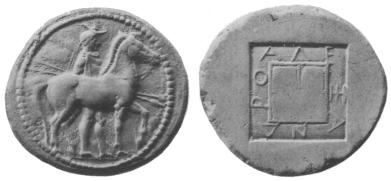
| Horseman wearing kausia and chlamys and armed with two spears, riding r.; beneath horse, a dog (Spitz ?), or, on ruder specimen, a frog or toad. [Montagu Cat., 207; Hunter, I. Pl. XX. 5.] | Similar. AR Octadrachm, 417 grs.
|
| Similar (no animal beneath). [N. C., 1897, Pl. XIV. 2.] |
ΑΛΕ in three corners of inc. and linear
sq. containing forepart of goat, &c.
AR Tetradr., 202.3 grs.
|
| Similar. Α beneath horse (sometimes uninscribed). [Montagu Cat., 209.] | No inscr. Similar. AR Tetradr., 197 grs.
|
| Horseman; dog (sometimes) beneath
horse, as on octadrachm. [B. M. C., Mac., 161.] |
Inc. sq. containing forepart of lion;
symbol, sometimes, caduceus.
AR Tetrobol, 44-36 grs.
|
| Free horse, with (sometimes) Α, above or beneath. [B. M. C., Mac., 159.] | Inc. sq. quartered, or inc. and linear sq.
containing crested helmet.
AR Tetrob.(?), 33-25 grs.
|
| Free horse. [B. M. C., Mac., 160.] | Inc. and linear sq. containing caduceus.
AR Tetrob., 30.8 grs.
|
| Forepart of prancing horse. [B. M. C., Mac., 160.] |
Inc. and linear sq. containing crested
helmet. AR Diob., 16.2 grs.
|
| Young head in kausia. [B. M. C., Mac., 158.] |
Inc. sq. quartered. AR Obol, 8.2 grs.
|
For illustrations of these and other varieties of Alexander’s coins see Babelon, Traité, Pls. XLVII, XLVIII.
Perdiccas II, B.C. 454-413. There are various, mostly uninscribed, Macedonian coins of Phoenician weight, with types resembling those here assigned to Alexander I, but of more recent style, which probably belong to the reign of Perdiccas. The absolutely certain and inscribed coins of this king are less numerous.
| Horse prancing. [B. M. C., Mac., p. 162.] |
ΠΕΡΔΙΚ Helmet in incuse square.
AR Tetrobol.
|
| Horse fastened to ring. [Ibid.] | Π]ΕΡ Forepart of lion in incuse square.
AR Diobol.
|
| Head of bearded Herakles. [Ibid., p. 163.] |
ΠΕΡ Club and bow in incuse square.
AR Diobol.
|
Archelaus I, B.C. 413-399. From the beginning of the fifth century we have seen that the Phoenician stater (wt. 230-220 grs.) had been in use for the royal coinage of Macedon, but with the accession of Archelaus this stater was exchanged for one of 170 grs., which, from its weight (equivalent to two Persian sigli), has been designated as the Persic stater. The money of the two important cities of Abdera and Maroneia also underwent a like transformation at the same time. The causes of this change of standard remain unexplained.
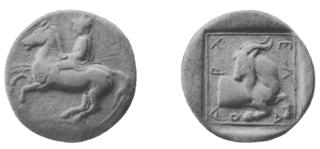
| Horseman prancing, wearing kausia
and chlamys, armed with two spears. [B. M. C., Mac., 163.] |
ΑΡΧΕΛΑΟ Forepart of goat in incuse
and linear square (Fig. 131).
AR Stater, 160 grs.
|
| Young male head, wearing taenia. [B. M. C., Mac., p. 164.] |
ΑΡΧΕΛΑΟ Horse with loose rein in
inc. and linear sq. AR Stater.
|
| Horse. [Ibid.] | ΑΡΧΕΛΑΟ Helmet in incuse square.
AR Diobol, 28 grs.
|
| Id. [Ibid., p. 165.] | ΑΡΧΕΛ Eagle in incuse square.
AR Diobol.
|
| Head of bearded Herakles. [Ibid.] | ΑΡΧ Forepart of wolf; above, club.
AR Obol, 14 grs.
|
| Head of young Herakles. [Ibid.] | „ Wolf’s head and club.
AR ½ Obol, 6 grs.
|
| Id. [Ibid., p. 166.] | ΑΡ Lion’s head and club.
AR ½ Obol (?), 5.5-4.7 grs.
|
| Id. [Ibid.] | ΑΡΧΕΛΑΟ Club, quiver, and bow.
Æ Size .7
|
| Lion’s head facing. [Berl. Cat., II. 188.] |
ΑΡΧΕ Forepart of boar or forepart of
butting bull. Æ .5
|
Aëropus (= Archelaus II), B.C. 396-392.
| Young male head bound with taenia. [Berl. Cat., II. Pl. VIII. 75.] |
ΑΕΡΟ[Π]Ο Horse with loose rein.
AR Stater, 159 grs.
|
| Head of bearded Herakles in lion- skin. [Sestini, Descr., Pl. III. 6.] | ΑΕΡΟ Forepart of wolf; above, club.
AR Obol.
|
| Head of young Herakles in lion-skin. [N. C., 1888, 1.] |
ΑΕΡΟ Wolf’s head and club.
AR ½ Obol, 7 grs.
|
| Young male head in kausia. | ΑΕΡΟΠΟ Horse walking. Æ .6
|
| Id. [B. M. C., Mac., p. 167.] | „ Forepart of lion. Æ .5
|
Amyntas II, B.C. 392-390. See Amyntas III.
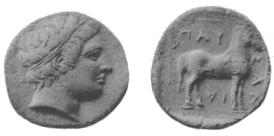
| Young male head bound with taenia (Fig. 132). | ΠΑΥΣΑΝΙΑ Horse standing in linear
sq. AR Stater, 160 grs.
|
| Free horse prancing. [B. M.] | „ Forepart of lion.
AR 47.9 grs.
|
| Young male head bound with taenia. [B. M. C., Mac., p. 170.] |
„ Id. Æ .65
|
| Id. [Berl. Cat., Pl. VIII. 77.] | „ Forepart of boar. Æ .6
|
Amyntas III, First Reign, B.C. 389-383.
„ „ Second Reign, B.C. 381-369.
Some of the coins bearing the name of Amyntas may belong to the short reign of Amyntas II.
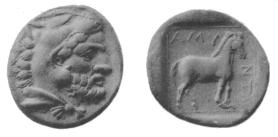
| Head of bearded Herakles in lion- skin (Fig. 133). | ΑΜΥΝΤΑ Horse standing in linear
and inc. sq. AR Stater, 143 grs.
|
| Head of young Herakles. | ΑΜΥΝΤΑ Eagle looking back.
AR Diobol, 22 grs.
|
| Head of bearded Herakles. [B. M. C., Mac., p. 172.] |
„ Forepart of boar; above,
club. Æ .55
|
| Head of Pan with short horns. | ΑΜΥΝΤΑ Forepart of wolf. Æ .4
|
| Young male head bare. | „ Helmet. Æ .5
|
| Horseman prancing, striking with javelin. [B. M. C., Mac., p. 173.] | ΑΜΥΝΤΑ Lion breaking spear.
AR Stater, 162 grs.
|
| Head of young Herakles in lion-skin. [Ibid., p. 174.] |
„ Eagle devouring serpent.
Æ .6
|
| Id. [Ibid.] | „ Bow and club crossed. Æ .4
|
| Id. | „ Club. Æ .4
|
Alexander II, B.C. 369-368. No coins can be certainly attributed to this king; but see Imhoof, Porträtköpfe, p. 13.
Perdiccas III, B.C. 365 or 364-359.
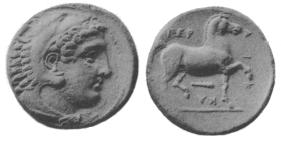
| Head of young Herakles in lion-skin (Fig. 134). | ΠΕΡΔΙΚΚΑ Horse trotting; beneath,
club. AR Stater, 159 grs.
|
| Id. [B. M. C., Mac., p. 175.] | ΠΕΡΔΙΚΚΑ Lion breaking spear. Æ .8
|
| Id. [Ibid., p. 176.] | „ Eagle looking back. Æ .6
|
Philip II, B.C. 359-336. Philip of Macedon, having obtained posses- sion of the hitherto unworked gold mines of Pangaeum (B.C. 356), the immense output of which rapidly brought down the market price of gold in relation to silver in European Greece from 12: 1 (its then rate of exchange at Athens) to 10: 1, found it politically as well as financially expedient to reorganize the Macedonian currency on a new system modelled upon, though not identical with, that of Athens. His new gold stater, which was destined to obtain a world-wide reputation, rivalling that of the old Persian daric, he made equivalent to the Athenian gold stater of 135 grs., which had, hitherto, at the existing ratio of 12:1, been tariffed at 24 Attic drachms of 67.5 grs.
In order to preserve the customary Greek (though not Asiatic) habit of exchanging 1 gold stater against 24 silver drachms, while, at the same time taking account of the sudden fall in the silver value of gold, he now issued side by side with his gold stater, silver drachms of circ.
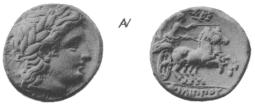
| Head of Apollo, laureate, with short hair (Fig. 135). | ΦΙΛΙΠΠΟΥ Biga. AV Stater, 133 grs.
|
| Head of young Herakles in lion-skin. | „ Forepart of lion.
AV ½ Stater.
|
| Id. | „ Club and bow. AV ¼ Stater.
|
| Id. | „ Various types, Fulmen—
Trident — Club — Kan-
tharos-Goat’s leg.
AV 1/8 Stater.
|
| Head of Apollo as on stater. | „ Fulmen. AV 1/12 Stater.
|
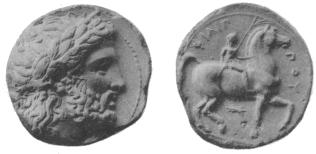
| Head of Zeus, laureate (Fig. 136). | ΦΙΛΙΠΠΟΥ Naked boy-rider bearing
palm or crowning his horse, κελης.
AR Tetradr., 224 grs.
|
| Id. | ΦΙΛΙΠΠΟΥ Bearded Macedonian horse-
man wearing kausia and chlamys,
right hand raised. AR Tetradr.
|
| Head of young Herakles in lion-skin. | ΦΙΛΙΠΠΟΥ Youth on horse.
AR Didr., 112 grs.
|
| Id. | „ Id. AR Octobol, 66 grs.
|
| Id. | „ Id. AR Drachm, 56 grs.
|
| Id. | „ Macedonian horseman
AR Drachm.
|
| Head of Apollo, laureate, or bound with plain taenia. | ΦΙΛΙΠΠΟΥ Naked horseman prancing
AR Tetrob., 40 grs.
|
| Head of Artemis, facing. | „ Youth on horse. AR Tetrobol.
|
| Head of Apollo with plain taenia. | Id. AR Triobol, 28 grs.
|
| Id. | „ Half-horse AR Diobol, 18 grs. |
| Id. | „ Horse’s head. AR Diobol.
|
| Head of young Herakles. | „ Club. AR Obol (?).
|
| Head of Apollo with plain taenia. | ΦΙΛΙΠΠΟΥ Naked horseman. Æ .75-.6
|
| Head of young Herakles in lion-skin. | „ Club. Æ .55-.4
|
The reverse-types of Philip’s coins are nearly all agonistic, and refer either to the games celebrated by him at Dium in honour of the Olympian Zeus (Müller, Mon. d'Alex., pp. II and 344), or, preferably, to the great Olympian games where his chariots were victorious. We have, indeed, the direct assertion of Plutarch (Alex., c. 4) in favour of the latter hypothesis, τας εν ‘Ολυμπια νικας των αρματων εγχαραττων τοις νομισμασιν. Philip was also successful at Olympia with the race-horse (ιππω κελητι; Plut., Alex., 3), a victory of which he perpetuated the memory on his tetradrachms. The horseman with kausia and chlamys is less certainly agonistic, and may (perhaps with a play upon his name) represent the king himself as a typical Macedonian ιππευς.
Philip’s coins were struck at many mints in various parts of his empire. For the various mint-marks which they bear see Müller’s Num. d'Alex. le Grand, the local attributions in which are, however, to be accepted with great caution. They continued to circulate in Europe long after his death, and the Gauls, when they invaded and pillaged Greece, took vast numbers of them back into their own land, where they long continued to serve as models for the native currency of Gaul and Britain.
Alexander the Great, B.C. 336-323. The coinage of Alexander is a branch of Numismatics too extensive and complicated for discussion in detail in the present work. The gold Philippi and the silver tetra- drachms (225 grs.) of his father Philip had, for a period of about twenty years, been the chief currency throughout Philip’s European dominions, and it is hardly likely that Alexander would have abolished these coins and introduced a new standard (the Attic) for his silver money until he found himself compelled to do so for commercial reasons. The fall in the price of gold in relation to silver was probably one, though not per- haps the chief, of these reasons. The general depreciation of gold made it no doubt impossible for him to maintain, by royal decree, the old relation of 13.3: 1 to silver which had prevailed in the East down to the fall of the Persian Empire, according to which 1 gold Daric of about 130 grs. was tariffed as equivalent to 20 silver sigloi of about 86½ grs., or to 10 silver staters of Persic wt., of about 173 grs. The inveterate con- servatism of the East, which could brook no change in the number of silver coins exchangeable for a gold piece, would not however be startled by a modification of the weights of the two denominations.
The duodecimal exchange system of Philip’s coinage, which might have
There were, however, some countries, such as Phoenicia and probably India, where the Attic standard had never taken firm root and where the new Alexandrine coinage would be less welcome, and it is to an Indian satrapy shortly after Alexander’s death, B.C. 323, that I would attribute the rare tetradrachms of Indian weight (227 grs.), obv. Head of Zeus, rev. ΑΛΕΞΑΝΔΡΟΥ, Eagle with head reverted on fulmen, which Imhoof (Mon. gr., Pl. D. 8) believed to have been Alexander’s first coinage in Macedon, issued immediately after his father’s death. A cogent argument in favour of giving these tetradrachms to one of the Eastern satrapies rather than to Macedon is the adjunct symbol, a satrapal tiara, in front of the eagle on the reverse. This very characteristic symbol, formerly mistaken for a prow, would seem to specialize the issue as that of a governor of one of the satrapies of Alexander’s empire between B.C. 323 and 305, and the Eagle with head reverted on fulmen as the reverse-type points distinctly to India. On this attribution see N. C., 1906, 1 sqq. The following smaller denominations of Attic weight with Eagles on their reverses are probably also Indian, though perhaps not struck at the same mint as the tetradrachm with the satrapal tiara.
| Head of young Herakles in lion-skin. | ΑΛΕΞΑΝΔΡΟΥ Eagle on fulmen, his
head usually turned back; symbols,
caduceus, eagle’s head, bull’s head
facing, ear of corn.
AR Drachm (Attic).
|
| Id. | ΑΛΕΞΑΝΔΡΟΥ Eagle on fulmen;
symbols, pentalpha, caduceus, cres-
cent. AR ½ Drachm.
|
| Id. | ΑΛΕΞΑΝΔΡΟΥ Two eagles face to
face, on fulmen; symbol, ivy-leaf.
AR Diobol.
|
| Id. | ΑΛΕΞΑΝΔΡΟΥ Fulmen. AR Obol.
|
| Id. | „ Eagle on fulmen, head
turned back. Æ .65
|
| Head of Apollo, hair long. | ΑΛΕΞΑΝΔΡΟΥ Fulmen. Æ .55
|
For convenience I describe these coins in this place because Imhoof's attribution of the series to Macedon has been generally accepted. For my own part I would include them among the post-Alexandrine issues of Eastern and probably Indian origin.
It was doubtless after his invasion of Asia that Alexander instituted his vast international currency, of which the following are the principal types:—
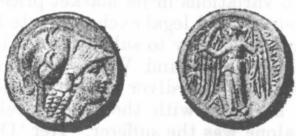
| Head of Athena in crested Corinthian helmet, adorned with serpent, griffin, or sphinx (Fig. 137). | ΑΛΕΞΑΝΔΡΟΥ (rarely with ΒΑΣΙ-
ΛΕΩΣ) Winged Nike holding mast
with spar (naval standard, Z. f. N.,
xxv. p. 215); various mint-marks
and monograms. AV Distater, 266 grs.
|
| Id. [Brit. Mus. Guide, Pl. XXX. 4.] | Id. AV Stater 133 grs.
|
| Id. | Id. AV ½ Stater, 66 grs.
|
| Id. | Id. AV ¼ Stater, 33 grs.
|
| Head of Athena. | Club and bow. AV ¼ Stater, 33 grs.
|
| Id. | Fulmen. AV 1/8 Stater, 16 grs.
|
The usual denomination is the stater; the rest are only exceptionally met with. The types of Athena and of her attendant Nike were intro- duced by Alexander, before whose time there is no trace of them on Macedonian coins.
| Head of young Herakles in lion-skin. [Brit. Mus. Guide, Pl. XXX. 5, 6, 7.] |
ΑΛΕΞΑΝΔΡΟΥ (often with ΒΑΣΙ-
ΛΕΩΣ) Zeus seated on throne, hold-
ing eagle and resting on sceptre.
AR Tetradrachm.
|
| Id. | Id. AR Drachm.
|
Dekadrachms with similar types also exist, but are of great rarity; didrachms, triobols, and obols occur somewhat more frequently. All coins of these unusual denominations appear to be of Eastern origin.
| Head of young Herakles in lion-skin. | ΑΛΕΞΑΝΔΡΟΥ Club, and bow in case
Æ .8-.5
|
| Id. | „ Club, bow, and quiver.
Æ .75-.55
|
| Young male head, wearing taenia. | „ Free horse. Æ .6
|
Other varieties less frequent than the above are the following, for the most part of post-Alexandrine style:—
| Head of Herakles. | ΑΛΕΞΑΝΔΡΟΥ Biga. Æ .8
|
| Head of Athena. | „ Nike. Æ .7
|
| Young head wearing taenia. | „ [ΒΑΣΙΛΕΩΣ] Horse-
man. Æ .7-.6
|
| Head of Herakles. | „ Horseman. Æ .7
|
| Head of Apollo. | „ Id. Æ .7
|
| Head of Herakles. | Β Α Bow, club and quiver. Æ .7
|
| Id. | „ Horseman. Æ .7
|
| Head of Athena. | „ Prow. Æ .7-.5
|
| Head of Poseidon. | „ Prow. Æ .6
|
| Macedonian shield. | „ Helmet. Æ .6
|
The difficulties with which we are confronted in attempting a syste- matic classification of the enormous series of coins which bear the name of Alexander, are of two kinds:— (i) We have to decide as to whether a particular coin belongs to the reign of Alexander himself, or, if not, to what subsequent period it should be assigned, for in some parts of the ancient world silver coins continued to be struck in the name and with the types of Alexander for some centuries after his death. (ii) We have to determine the geographical attribution.
The tetradrachms have been arranged by Müller in seven classes, which he distinguishes in the main by the following characteristics:—
These classes belong in part to Europe, and in part to Asia, and may be arranged somewhat as follows :—
| EUROPE. | ASIA. |
| Class I. Kingdom of Macedon, &c. „ III. „ „ |
Class II. Cilicia, Syria, Phoenicia. „ III. „ ,, |
| Class IV. Macedon, &c., Peloponnesus, and Islands. | Class IV. Cilicia, Syria, Phoenicia, and Egypt. |
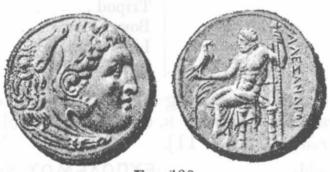
| Class V. Thrace | Class V. Greek cities of western Asia
Minor (Fig. 138). Phoenician cities (circ. 244-183). |
| Classes VI, VII. Thrace, down almost to Imperial times. | Class VI. Free cities of western Asia Minor (B.C. 190-133). |
The conjectural attributions to individual cities depend upon the correspondence of the adjunct symbols with known coin-types of the cities in question. On the coins of the later classes these symbols in the field of the reverse are undoubtedly mint marks, but there is not sufficient evidence to show that this was always the case on the coins of Classes I-IV, and in many cases we have no safer guide to the local attribution than a knowledge of the countries from which certain sorts of tetradrachms usually come to us.
No gold or bronze coins bearing Alexander’s name would seem to have been issued after circ. B.C. 280.
Philip III (Aridaeus), B.C. 323-316. The coins of this king are identical in type with those of Alexander of Classes III and IV. Inscr., ΦΙΛΙΠΠΟΥ or ΒΑΣΙΛΕΩΣ ΦΙΛΙΠΠΟΥ. They were issued both in his European dominions and in Asia Minor, Cilicia, Syria, Phoenicia, and Egypt. [Brit. Mus. Guide, Pl. XXVII. 9, 10; Pl. XXX. 8, 9.] (Fig. 139, AV Stater.)
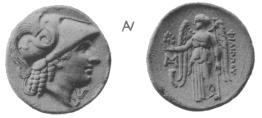
Alexander IV, son of Roxana, B.C. 323-311. See below under Ptolemy Soter.
Cassander, B.C. 316-297. This king did not place his name upon the gold or silver money, which continued to be issued in the name of Alexander the Great (Class IV). He struck in bronze as follows :—
| Head of Herakles. | Seated lion. Æ .7
|
| Head of Apollo. | Tripod. Æ .75
|
| Head of Herakles. | Boy on horse. Æ .85-.7
|
| Id. | Lion walking. Æ .65
|
| Helmet. | Spear-head. Æ .7
|
To the reign of Cassander belong also the bronze coins struck in the name of his general, Eupolemus, B.C. 314-313, probably at Mylasa in Caria (B. M. C., Caria, Pl. XXI. 11).
| Three Macedonian shields. | ΕΥΠΟΛΕΜΟΥ Sword with belt. Æ .7
|
Philip IV, B.C. 297-296, son of Cassander.
Alexander V, B.C. 295, son of Cassander.
To these reigns no money can be confidently assigned, though some of the coins of late style, bearing the types of Philip II and Alexander the Great, may belong to this period.
Antigonus, B.C. 306-301, the father of Demetrius Poliorcetes, was acknowledged ‘King of Asia’ in B.C. 311. In B.C. 306 he first assumed the title Βασιλευς. In all his Asiatic mints it is probable that he con- tinued the issue of gold and silver with Alexander’s types and name unchanged (Class IV).
There are, however, gold staters of the Alexandrine type (except that Nike holds in her right hand an acrostolion instead of a wreath), reading ΑΝΤΙΓΟΝΟΥ ΒΑΣΙΛΕΩΣ, and tetradrachms, the latter probably struck in Peloponnesus, in the year B.C. 303, by Demetrius in the name of his father Antigonus.
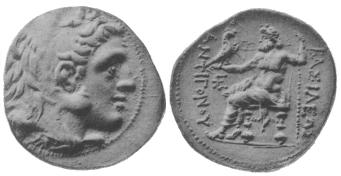
| Head of Herakles (Fig. 140). | ΒΑΣΙΛΕΩΣ ΑΝΤΙΓΟΝΟΥ Zeus
seated on throne, holding eagle.
AR Tetradr.
|
See also Antigonus Gonatas.
Demetrius Poliorcetes, B.C. 306-283.
| Head of Athena. | ΒΑΣΙΛΕΩΣ ΔΗΜΗΤΡΙΟΥ Nike.
AV Stater.
|
| Head of Demetrius diademed and with
bull’s horn. [Brit. Mus. Guide, Pl. XXX. 15.] |
ΒΑΣΙΛΕΩΣ ΔΗΜΗΤΡΙΟΥ Armed
horseman with spear. AV Stater.
|
| Nike blowing trumpet, and holding naval standard standing on prow. | ΒΑΣΙΛΕΩΣ ΔΗΜΗΤΡΙΟΥ Athena
Promachos with shield and spear.
AV Stater.
|
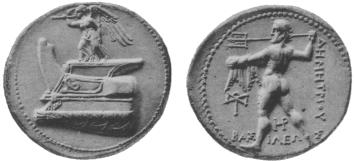
| Nike on prow, as above (Fig. 141). | ΒΑΣΙΛΕΩΣ ΔΗΜΗΤΡΙΟΥ Poseidon
wielding trident.
AR Tetradr., Dr., and ½ Dr.
|
| Head of Demetrius horned. | ΒΑΣΙΛΕΩΣ ΔΗΜΗΤΡΙΟΥ Poseidon,
as above. AR Drachm and ½ Dr.
|
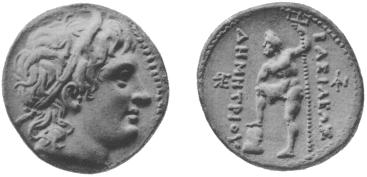
| Head of Demetrius horned (Fig. 142). | ΒΑΣΙΛΕΩΣ ΔΗΜΗΤΡΙΟΥ Poseidon
resting foot on rock, and leaning on
trident. AR Tetradr., Dr., and ½ Dr.
|
| Id. | ΒΑΣΙΛΕΩΣ ΔΗΜΗΤΡΙΟΥ Poseidon
seated on rock, holds aplustre and
trident. AR Tetradr.
|
The types of these coins refer to the naval victory gained by the fleet of Antigonus, commanded by Demetrius, over that of Ptolemy off the island of Cyprus in B.C. 306. The same victory is commemorated by a monument discovered in the island of Samothrace, now in the Louvre, consisting of a colossal Nike standing on a prow, as on the coins. See Conze, &c., Samothrake, Bd. ii. pp. 47 sqq.
With very few exceptions the bronze coins of Demetrius Poliorcetes have a prow on the reverse, and the letters ΒΑ (for ΒΑΣΙΛΕΩΣ). The obverse type is usually a head of Athena or of Zeus.
Pyrrhus was king of all Macedon, B.C. 287-286, and of west Macedon until B.C. 284, and again B.C. 274-272. If he issued silver coins in Macedon, they were probably, like those of Cassander, impressed with the name of Alexander (Class IV). His Macedonian bronze coins are of the following types:—
| Macedonian shield, with monogram of Pyrrhus in the centre (ΠΥΡ). | ΒΑΣΙ Helmet and mon. ΠΥΡ, all in
oak wreath. Æ .5
|
Interval, B.C. 286-277. During this period, while the government of Macedon passed rapidly from Pyrrhus to Lysimachus, Seleucus, Ptolemy Keraunos, Antipater, Sosthenes, &c., few coins were struck in Macedon.
Lysimachus, it is true, appears to have struck tetradrachms at some of the Macedonian mints in his own name, but of the rest no coins are known. There is, however, one series of Alexandrine tetradrachms of Class IV (Müller, Nos. 225-236, and Brit. Mus. Guide, Pl. XXX. 11) with a Macedonian helmet in the field on the reverse, which I would attribute to this date, together with a corresponding set of bronze coins:—
| Macedonian shield; in centre, various symbols. | ΒΑ Macedonian helmet. Æ .75-.5
|
| Head of young Herakles. | ΒΑΣΙΛΕΩΣ Bow in case, and club;
symbol: Race-torch. Æ .75
|
Antigonus Gonatas, B.C. 277-239
Antigonus Doson, B.C. 229-220
It is not as yet possible to dis- tinguish from one another the coins of these two kings.
Dr. Imhoof-Blumer is in favour of attributing all the silver money to Gonatas.
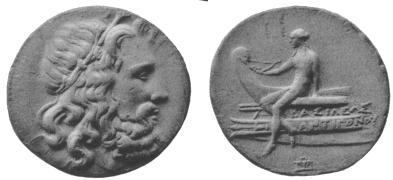
| Head of Poseidon, with flowing locks bound with marine plant (Fig. 143). | ΒΑΣΙΛΕΩΣ ΑΝΤΙΓΟΝΟΥ inscribed
on prow, upon which Apollo is
seated naked, holding bow.
AR Tetradr.
|
| Similar head of earlier style. [Imhoof, Choix, Pl. I. 23.] | ΒΑΣΙΛΕΩΣ ΑΝΤΙΓΟΝΟΥ Athena
Alkis of archaistic style, hurling
fulmen, and holding shield.
AR Drachm.
|
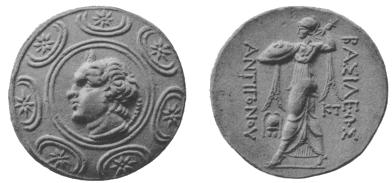
| Macedonian shield, in centre of which, head of Pan horned, with pedum at shoulder. | ΒΑΣΙΛΕΩΣ ΑΝΤΙΓΟΝΟΥ Similar
type (Fig. 144). AR Tetradr.
|
The types of the first of the above tetradrachms refer clearly to a naval victory. Imhoof (Mon. gr., p. 128) thinks that the victory recorded is that of Gonatas over the Egyptian fleet off the island of Cos, B.C. circ. 253 (Beitr. zur alt. Gesch., I. pp. 289 ff.). On the mainland, opposite Cos, was the hieron of Apollo Triopios, where games were celebrated in honour of Apollo and Poseidon, the two divinities represented on the coins, ‘C'était là sans doute, que le vainqueur a consacré sa trière; et c'est là aussi, suivant une inscription trouvée près de l'hiéron, qu'existait plus tard un autre sanctuaire, très riche et très vénéré des Cnidiens, celui du héros Antigone fils de l'Epigone (Démétrius).’ This sanctuary doubtless owed its origin to some exploit, such as the victory off Cos, by means of which Antigonus had rendered himself the benefactor of the town of Cnidus and its temple of Apollo.
But if, on the other hand, as the late style of the head of Poseidon on
The coins mentioned in the Inventory of the Asklepieion at Athens as τετραχμα ‘Αντιγονεια, specimens of which appear among the dedications in the years B.C. 261-0, 256-5, 255-4, and 254-3, are probably those with the head of Pan on the Macedonian shield (Babelon, Traité, I. 485, and Ferguson in University of California Publ., Class. Phil., I. 148).
The bronze coins of the two Antigoni most frequently met with are of the following types :—
| Head of Athena. | ΒΑ and ΑΝΤΙ (in monogram) Pan
erecting a trophy. Æ .85-.55
|
| Head of Poseidon as on silver. | Prow. Æ .6
|
| Head of young Herakles. | ΒΑ and ΑΝΤΙ (in mon.) Naked rider
crowning his horse. Æ .65
|
| Id. | ΒΑΣΙΛΕΩΣ ΑΝΤΙΓΟΝΟΥ Id. Æ .7
|
| Macedonian shield, on which ΑΝΤΙ (in mon.). | ΒΑΣΙ Macedonian helmet. Æ .7
|
Demetrius II, B.C. 239-229. Apparently no gold or silver coins.
| Macedonian shield, in centre of which monogram composed of the letters ΔΗΜΗΤΡΙ. | ΒΑΣΙ Macedonian helmet
Æ .65 and .35
|
| Id., but in centre, star. | ΒΑΣΙΛΕΩΣ ΔΗΜΗΤΡΙΟΥ Id. Æ .65
|
| Head of young Herakles. | ΒΑ ΔΗ Rider crowning horse. Æ .65
|
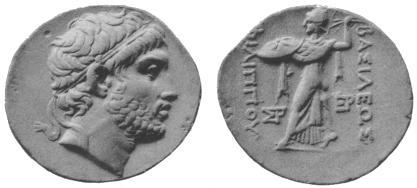
| Head of king diademed and slightly bearded (Fig. 145). | ΒΑΣΙΛΕΩΣ ΦΙΛΙΠΠΟΥ Athena Alkis
Armed with shield, hurling fulmen.
AR Tetradr.
|
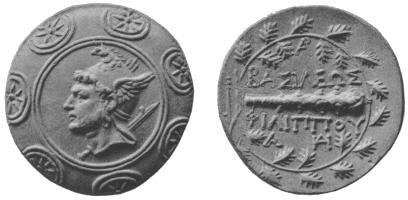
| Macedonian shield, with portrait of Philip’s son Perseus, slightly bearded, as the hero Perseus, in the centre, wearing winged cap of Phrygian form, ending at top in griffin’s head. (See N. C., 1896, p. 35.) | ΒΑΣΙΛΕΩΣ ΦΙΛΙΠΠΟΥ Club in oak
wreath, three monograms, and adjunct
symbol in margin (Fig. 146).
AR Tetradr.
|
| Head of king diademed. | ΒΑΣΙΛΕΩΣ ΦΙΛΙΠΠΟΥ Id. AR Didr.
|
| Id. | „ Id. AR Dr.
|
| Id. | „ Id. AR ½ Dr.
|
For varieties of the tetradrachm attributed to the Pretender Andriscus under name of Philip see below, p. 239.
| Head of Zeus in oak-wreath. | ΒΑ ΦΙ Rider crowning horse.
Æ .75
|
| Head of Poseidon. | „ „ Athena Alkis. Æ .8-.55
|
| Id. | „ „ Prow. Æ .55
|
| Head of Helios, radiate. | ΒΑΣΙΛΕΩΣ ΦΙΛΙΠΠΟΥ Fulmen in
oak-wreath. Æ 1.0
|
| Head of Artemis. | ΒΑ Φ Eagle on fulmen in oak-wreath.
Æ .75
|
| Head of bearded Herakles. | ΒΑΣΙΛΕΩΣ ΦΙΛΙΠΠΟΥ Harpa in
oak-wreath. Æ .9
|
| Id. | ΒΑ Φ Prow. Æ .45
|
| Head of young Herakles. | „ Two goats at rest. Æ .85
|
| Head of Pan. | „ Id. Æ .5
|
| Head of young Herakles. | „ Rider crowning horse
Æ .75
|
| Do., laur., lion-skin round neck but not over his head. | ΒΑ ΦΙ Prow. Æ .75
|
| Head of hero Perseus. | ΒΑ Φ Eagle on plough or fulmen.
Æ .75-.7
|
| Id. | ΒΑΣΙΛΕΩΣ ΦΙΛΙΠΠΟΥ Horse.
Æ .7
|
| Id. | „ „ Harpa in
oak-wreath. Æ .7
|
| Id. | ΒΑ Harpa and club. Æ .4
|
| Macedonian shield with wheel-orna- ment in centre. | ΒΑ ΦΙ Club. Æ .65
|
| Id. | ΒΑ Φ Helmet. Æ .5
|
| Similar; head of Perseus in centre. | ΒΑΣΙΛΕΩΣ ΦΙΛΙΠΠΟΥ Helmet sur-
mounted by star. Æ .65
|
H. Gaebler (Zeit. f. Num., xx. 169 ff., and Die antiken Münzen Nord- Griechenlands, Band iii. 1 and Tafel I) has proved that Philip, probably about B.C. 185, allowed his subjects to issue small silver and bronze coins in the name of the whole people, ΜΑΚΕΔΟΝΩΝ, his own name being omitted. That these issues are contemporary with the royal coinage is clear from the identity of the symbols and monograms which they bear with those on the regal money. The chief varieties are the following :—
| ΜΑΚΕ and Club in centre of Macedo- nian shield. | Macedonian helmet, around which usu-
ally three monograms and symbol
as on coins bearing Philip’s name.
AR Tetrobols and Diobols.
|
| Macedonian shield with crescent-rayed star in centre. | ΜΑΚΕ ΔΟΝΩΝ After-part of ship.
AR Tetrobols.
|
| Head of Maenad in vine-wreath, as on contemporary coins of Histiaea in Euboea. | Id. Id. AR Tetrobols.
|
| ΜΑΚΕ (in mon.) in centre of Mace- donian shield. | Macedonian helmet and  (mon. of
Amphaxitis). [Gaebler, Münz. N.
Gr., Taf. I. 4.]. (mon. of
Amphaxitis). [Gaebler, Münz. N.
Gr., Taf. I. 4.]. Æ .65
|
| Head of Poseidon, trident at shoulder. | ΜΑΚΕ ΔΟΝΩΝ Club in oak-wreath
[Gaebler, op. cit., Taf. I. 28.].
Æ .95 (serrated).
|
| Head of Poseidon, with lank hair; no trident. | Similar. Æ .95
|
| Head of Strymon to front, crowned with reeds. | ΜΑΚΕ ΔΟΝΩΝ Artemis standing,
holding long torch. [Gaebler, op. cit.,
Taf. I. 14.]. Æ .85
|
| Head of Strymon in profile, crowned with reeds. | ΜΑΚΕ ΔΟΝΩΝ Trident.
[Ibid., Taf. I. 22.]. Æ .9-.7
|
| Head of Apollo. | ΜΑΚΕ ΔΟΝΩΝ Lyre and bow.
[Ibid., Taf. I. 19.]. Æ .9
|
| Id. | ΜΑΚΕ ΔΟΝΩΝ Tripod (mon. of Am- phaxitis). [Ibid., Taf. I. 21.] Æ .8 |
| Head of Dionysos in ivy-wreath. | ΜΑΚΕ ΔΟΝΩΝ Goat standing (mon.
of Amphaxitis). [Ibid., Taf. I. 15.].
Æ 1.0-.8
|
| Head of Pan with pedum at shoulder. |  (mon. of Bottiaea) Two goats re-
cumbent in oak-wreath. [Ibid.,
Taf. XII. 10.]. (mon. of Bottiaea) Two goats re-
cumbent in oak-wreath. [Ibid.,
Taf. XII. 10.]. Æ .8
|
| Head of young Herakles in lion-skin. | ΜΑΚΕ ΔΟΝΩΝ Naked rider
crowning his horse. [B. M. C., Mac.,
p. 13.]. Æ .9
|
| Head of Zeus. | ΜΑΚΕ ΔΟΝΩΝ Winged fulmen.
[Ibid.]. Æ .85
|
| Head of Zeus. | Eagle on fulmen (on larger coins with
head reverted). Monogram  , and
another varying mon. or symbol.
[Ibid., p. 15.]. , and
another varying mon. or symbol.
[Ibid., p. 15.]. Æ .85-.45
|
For varieties and details see Gaebler (op. cit.).
T. Quinctius Flamininus. B.C. 196-190. Of this illustrious Roman general a gold stater of Attic weight is known. It is of great rarity, only three specimens having up to the present time been discovered. Friedländer (Zeit. f. Num., xii. p. 2) was of opinion that it was struck in Macedon after the battle of Cynoscephalae, but there is nothing to prove that it was not issued during the sojourn of Flamininus in Pelopon- nesus, perhaps on the occasion of the great Convention at Corinth, when the Romans proclaimed the freedom and independence of Greece. As, however, the reverse-type is that of the gold staters of Alexander the Great, I prefer to describe it in this place. The obverse type is specially interesting as presenting us with the first portrait of a living Roman known on coins. (See Macdonald, Coin Types, pp. 153 ff.)
| Head of Flamininus to r., slightly bearded [Zeit. f. Num., xii. Pl. VII. 2]. | T. QVINCTI Nike standing, holding
wreath and palm. AV Stater.
|
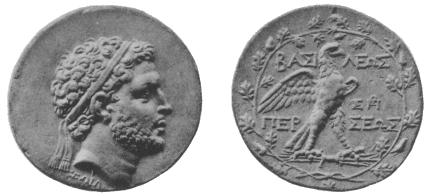
| Head of king Perseus, diademed (Fig. 147). | ΒΑΣΙΛΕΩΣ ΓΙΕΡΣΕΩΣ Eagle on ful-
men, all in oak-wreath. AR Tetradr.
|
| Id. | ΒΑΣΙΛΕΩΣΠΕΡΣΕΩΣ Harpa in oak-
wreath. AR Didr.
|
| Id. | „ Club in oak-wreath.
AR Didr.
|
| Head of hero Perseus. | ΒΑ ΠΕ (or ΠΕΡ) Eagle on plough or
fulmen. Æ .95-.7
|
| Head of young Herakles. | „ Rider crowning horse
Æ .75-.65
|
| Macedonian shield; wheel-ornament in centre. | „ Harpa. Æ .65-.5
|
Adaeus. Perhaps a dynast in Macedonia not mentioned in history. His coins appear to have been struck either at Heracleia Sintica or at the town of Scotussa (Plin. iv. 17, s. 18) on the road between Heracleia and Philippi (Berl. Cat., II. p. 90).
| Head of Apollo. | ΑΔΑΙΟΥ Tripod. Æ .85-.65
|
| Head of Herakles. | „ Club. Æ .65
|
| Head of Athena. | „ Owl. Æ .7
|
| Head of boar. | „ Spear-head. Æ .6
|
The death of Perdiccas III, King of Macedon (B.C. 359), was followed by a period of confusion during which the Paeonians rose and shook off the yoke of the royal house of Macedon.
The independent kings of Paeonia between this date and B.C. 286 are as follows:—
Lycceius. Circ. B.C. 359-340. Silver coins of debased Macedonian weight. Tetradrachms 214-188 grs.
| Head of Apollo. | ΛΥΚΠΕΙΟ or ΛΥΚΚΕΙΟΥ Herakles
and lion (Fig. 148). AR Tetradr.
|
| ΔΕΡΡΩΝΑΙ ΟΣ Young male head laur. with short hair. | ΛΥΚΚΕΙΟΥ Same type. [Rev. Num.,
1897, Pl. III. 2]. AR Tetradr. 197 grs.
|
| Head of Zeus. [Coll. de Hirsch.] | ΛΥΚΚΕΙΟΥ Same type. AR Tetradr.
|
| Head of Apollo. [Berl. Cat., II. Pl. I. 2.] | ΛΥΚΚΕΙΟΥ Lion. AR Dr.
|
| Female head. [Berl. Cat., II. Pl. I. 3.] | ΛΥΚΚ[ΕΙ]Ο Lion standing. AR Dr.
|
A fragment of an inscription found some years ago at Athens (Hicks and Hill, Gk. Hist. Inscr., p. 255) mentions a treaty of alliance between the Athenians, on the one part, and Cetriporis of Thrace, Lyppeius of Paeonia, and Grabus of Illyris on the other. There can be no doubt about the identity of the Lyppeius of the inscription with the Lycpeius or Lycceius of the coins. The coin with the head of Apollo (?) accompanied by the inscr. ΔΕΡΡΩΝΑΙΟΣ seems to prove that the district inhabited by the Derrones (see supra, p. 201) was included in the dominions of Lycceius.
| Young male head with short hair, usually laureate. | ΠΑΤΡΑΟΥ Horseman spearing pros-
trate foe (Fig. 149). AR Tetradr.
|
| Young male head, wearing taenia. | ΠΑΤΡΑΟΥ Forepart of boar. AR Dr.
|
| Young male head, laureate. [Berl. Cat., II. p. 4.] |
ΠΑΤ(?)... Eagle. AR Tetrob.
|
Bastareus. An unknown king of some tribe bordering upon the Paeonian district. Two tetradrachms only known, found with coins of Patraus:—
| Large crested helmet r.; circle of dots. [Sotheby Sale Cat., May, 1904, Lot 232.] |
ΒΑΣΤΑΡΕΟΣ Bull butting r.; circle of
dots. AR Tetradr. 203 grs.
|
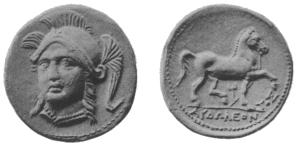
| Head of Athena, facing. | ΑΥΔΩΛΕΟΝΤΟΣ Free horse (Fig. 150) AR Tetradr. |
| Id. | „ Id. AR Dr.
|
| Head of Athena in Corinthian helmet to right, as on gold staters of Alex- ander the Great. | „ Id. AR Didr.
|
| Head of Athena, facing. | „ Forepart of horse.
AR Tetrob.
|
| Head of young Dionysos. | „ Id. AR Tetrob.
|
There are also barbarous imitations of the tetradrachms of Philip of Macedon, obv. Head of Zeus, rev. Horseman, with the inscr. ΑΥΔΩΛΕΟΝΤΟΣ (Berl. Cat., II. Pl. I. 9).
After circ. B.C. 306 Audoleon followed the example of the Diadochi, and adopted the title Βασιλευς. He then struck Attic tetradrachms, similar in type to the money of Alexander the Great, but with the inscription ΑΥΔΩΛΕΟΝΤΟΣ ΒΑΣΙΛΕΩΣ. Audoleon’s coins were fre- quently imitated by barbarians of the interior.
Dropion (?), after circ. B.C. 279. See J. P. Six, Annuaire de Numis- matique, 1883, p. 5.
| Head of Zeus. | ΠΑΙΟΝΩΝ Fulmen, beneath which
ΔΡ. Æ .85
|
In 1877 an inscription was discovered at Olympia, on the base of a statue, stating that it was set up by the community of the Paeonians in honour of their king and founder, Dropion, who probably recon- stituted the country after the invasion of the Gauls. The monogram ΔΡ also occurs on tetradrachms of Lysimachus (Müller, No. 489). There is,
however, in the British Museum, a coin similar to that described above,
except that it reads ΠΑΟΝΩΝ and has the monogram  (Audoleon (?)).
This casts some doubt upon the attribution to Dropion proposed by Six.
(Audoleon (?)).
This casts some doubt upon the attribution to Dropion proposed by Six.
Nicarchus. An unknown dynast, probably contemporary with Patraus.
| Head of Apollo, r. laureate. [Bull. Corr. Hell., vi. 211.] |
ΝΙΚΑΡΧΟΥ Tripod.
AR Tetradr. 204 grs.
|
After the defeat of Perseus, the last king of Macedon, by the Romans at the battle of Pydna (B.C. 168) Macedonia was divided into four Regiones, but it was not until ten years later (B.C. 158) that the right of coining silver money was conceded to it by the Senate (Mommsen- Blacas, III. p. 281). These four divisions were dissolved in B.C. 148, when the country was finally constituted a Roman Province.
| Head of Zeus, or perhaps Poseidon, wearing oak-wreath. [Gaebler, Die ant. Münzen Nord-Griechenlands, Bd. iii, Taf. II. 1.] | ΜΑΚΕΔΟΝΩΝ ΠΡΩΤΗΣ Artemis
Tauropolos with two torches, riding
on bull, with fillet over its head.
AR Attic Tetradr.
|
Only two specimens of this earliest coin of the first region of Macedon are known, one in Berlin and the other in Naples.
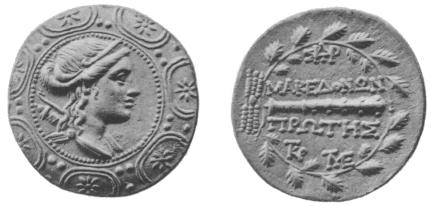
| Macedonian shield, in centre of which, bust of Artemis. | ΜΑΚΕΔΟΝΩΝ ΠΡΩΤΗΣ Club in
oak-wreath, three mons., and adjunct
symbol in margin (Fig. 151).
AR Tetradr.
|
| Id. [Gaebler, op. cit., Taf. II. 4.] | ΜΑΚΕΔΟΝΩΝ ΔΕΥΤΕΡΑΣ Similar
AR Tetradr.
|
| Head of Zeus. [Gaebler, op. cit., Taf. II. 6.] |
ΜΑΚΕΔΟΝΩΝ ΤΕΤΑΡΤΗΣ Club in
oak-wreath. Æ .85
|
| Head of Athena. [Ibid., Taf. II. 5.] | ΜΑΚΕΔΟΝΩΝ ΤΕΤΑΡΤΗΣ The
Dioskuri. Æ .8
|
The capitals of the four Regions of Macedonia were Amphipolis of the
Macedonia a Roman Province. In B.C. 149 a pretender, by name Andriscus, who claimed to be grandson of Philip V, was, for a short time, successful in raising a revolt against Roman domination, and in defeating the Praetor P. Juventius Thalna. The Praetor, however, in B.C. 149, before his defeat, issued a few coins, through his LEGatus pro quaestore, as follows:—
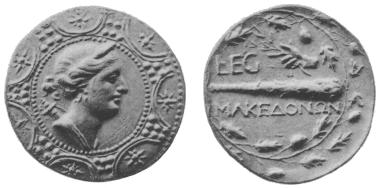
| Bust of Artemis in centre of Mace- donian shield (Fig. 152). | LEG, and hand holding olive-branch
over club, beneath which is ΜΑΚΕ-
ΔΟΝΩΝ, the whole in wreath of
oak-leaves and acorns. AR Tetradr.
|
On the defeat of the Romans by Andriscus these coins were restruck with the omission of LEG and of the hand holding the olive-branch, θαλλος, probably the signet of Thalna (Z. f. N., xxiii. p. 150).
Andriscus, B.C. 149-148, now claimed openly the throne of Macedon, adopted the name and title of his presumptive grandfather, and struck tetradrachms distinguishable only by style, and by a youthful instead of a bearded head on the obverse, from those of Philip V (Z. f. N., xxiii. p. 153).
| Macedonian shield with, in centre, a head of the young Philip Andriscus without heard, wearing winged hel- met of hero Perseus, ending at top in griffin’s head. | ΒΑΣΙΛΕΩΣ ΦΙΛΙΠΠΟΥ Club of
thicker and clumsier make than on
coins of Philip V. No monograms or
symbol. The whole in oak-wreath.
AR Tetradr.
|
On the defeat of ‘Philip’ Andriscus and on the reduction of Macedonia to a Roman Province, B.C. 148, all coinage of silver in Macedon ceases for more than half a century. Bronze money was, however, issued for a few years longer, B.C. 148-141, in the names of the following Roman governors, Lucius Fulcinnius and Gaius Publilius, Quaestors of the Praetor Metellus, B.C. 148-146, and by the Praetor, Decimus Junius Silanus, B.C. 142-141, and also by individual cities for local currency.
| Head of Roma in winged helmet like that of the hero Perseus, ending at top in griffin’s head. | ΜΑΚΕΔΟΝΩΝ, ΤΑΜΙΟΥ ΛΕΥΚΙΟΥ
ΦΟΛΚΙΝΝΙΟΥ in oak-wreath
[B. M. C., Mac., p. 19.]. Æ .85
|
| Head of Roma in winged helmet like that of the hero Perseus, ending at top in griffins head. | ΜΑΚΕΔΟΝΩΝ, ΤΑΜΙΟΥ ΓΑΙΟΥ ΠΟΠΛΙΛΙΟΥ Similar. [B. M. C., Mac., p. 18.] Æ 1.-.85 |
| Head of Poseidon. | Similar, but club between lines of inscr.
[B. M. C., Mac., p. 17.]. Æ .9
|
| Head of Athena Parthenon. [Gaebler, op. cit., Taf. XII. 21.] |
ΓΑΙΟΥ ΠΟΠΛΙΛΙΟΥ (the last name in
mon.) ΤΑΜΙΟΥ Ox feeding. Æ .85
|
| Head of young Dionysos in ivy-wreath. [Ibid., Taf. II. 9.] |
ΤΑΜΙΟΥ ΓΑΙΟΥ ΠΟΠΛΙΛΙΟΥ Goat
standing. Æ .85
|
| Head of Pan with pedum at shoulder. [Ibid., Taf. XII. 20.] |
ΓΑΙΟΥ ΤΑΜΙΟΥ Two goats recum-
bent. Æ .75
|
These coins seem to have been struck at three mints—Amphipolis without monogram; Thessalonica with mon. of Amphaxitis; and Pella with mon. of Bottiaea.
| Head of Seilenos facing in ivy-wreath. [Z. f. N., xxiii. 158.] | D (for Decreto) above ΜΑΚΕΔΟΝΩΝ
in ivy-wreath. Æ .75
|
The head of Seilenos is probably a play upon the cognomen of the Praetor. The meaning of the Roman letter, D, on the reverse is explained by Gaebler (op. cit., p. 9).
The financial reasons which compelled the Roman governors of Macedon to issue silver tetradrachms with the inscr. ΜΑΚΕΔΟΝΩΝ after an interval of more than half a century are explained by Gaebler (Z. f. N., xxiii. 172). These issues, though limited to five or six years, must have been very plentiful if we may judge from the number of still extant specimens:—
| CÆ. ΡR. ΜΑΚΕΔΟΝΩΝ Head of
Alexander the Great with flowing hair
and Ammon’s horn; Θ, mint-mark of
Thessalonica, behind head. [Berl. Cat., II. Pl. II. 13.] |
AESILLAS Q Club between money-
chest (fiscus) and Quaestor’s chair;
the whole in laurel-wreath.
AR Tetradr.
|
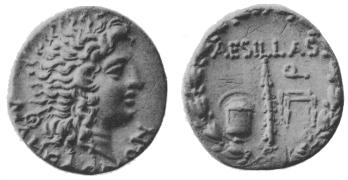
Tetradrachms and drachms similar to preceding, but without Praetor's
name, and usually with mint-marks Θ,  or Β for Thessalonica and Bot-
tiaea, beside head on obv. (Fig. 153).
or Β for Thessalonica and Bot-
tiaea, beside head on obv. (Fig. 153).
Tetradrachms similar to preceding, but with SVVRA LEG. PRO Q. on reverse. On some of the above-described tetradrachms the numerals SI appear on the obv. before the head of Alexander. This SI is probably a mark of value (= 16) indicating that the tetradrachm was equivalent to 16 sestertii, or 4 Roman denarii.
Imperial Times. The Imperial coinage of the Province of Macedon extends from Claudius to Philip. At first, down to Vespasian’s time, the inscr. is simply ΜΑΚΕΔΟΝΩΝ or ΣΕΒΑΣΤΟΣ ΜΑΚΕΔΟΝΩΝ. After this it is ΚΟΙΝΟΝ ΜΑΚΕΔΟΝΩΝ, to which Macrinus (A.D. 218) added the title ΝΕΩΚΟΡΟC and Elagabalus that of Β ΝΕΩΚΟΡΟC. The latter also conferred upon the κοινον the additional privilege of issuing most of its bronze coins without the Imperial bust. From Elagabalus to Philip the usual obverse type is a head or bust of Alexander the Great with legend ΑΛΕΞΑΝΔΡΟΥ. For some years after the death of Elagabalus the title Νεωκορος on the reverse is omitted, and it is to this period that Gaebler assigns the specimens reading ΚΟΙΝΟΝ ΜΑΚΕΔΟΝΩΝ ΟΜΟΝΟΙΑ (Z. f. N., xxiv), the types of which point to Thessalonica as the city in alliance with the province.
Sev. Alexander seems to have restored the title Νεωκορος probably in A.D. 231. The chief types of the Imperial and Provincial quasi- autonomous coins are Macedonian shield; Ares standing; Fulmen; Athena Nikephoros seated; Lion and Club; Alexander taming Buke- ohalos, or on horseback; Macedonia enthroned holding Kabeiros; Cista mystica; two temples or two agonistic crowns on table in allusion to the Second Neocory. The provincial games (κοινα) appear to have been first celebrated under the name of ‘Ολυμπια or ‘Ολυμπια ‘Αλεξανδρια in 242, and a second time in 246, on which occasion coins were struck reading ΟΛΥΜΠΙΑ Β. The first of these festivals was coincident with the visit of Gordian III and seems to have been celebrated with great splendour, if the gold medallions of various types which have come to light are to be referred to this time. Two years later Philip visited Macedon, on which occasion dated coins, both civic and provincial, were struck at Beroea with ΕΟC = A.D. 244, and again gold medallions were issued, on one of which the inscription ΒΑCΙΛΕΩΝ ΦΙΛΙΠΠΩΝ is perhaps explicable as referring to the two Philips, senior and junior, though it is more probable that the two figures, represented as bearded warriors, are intended for Alexander’s royal ancestors. See Dressel, Goldmedaillons aus dem Funde von Abukir (1906), p. 53.
The authenticity of the twenty remarkable gold medallions discovered in Egypt (at Abukir?) in 1902 is still questioned by some leading numis- matists, notwithstanding the powerful arguments in their favour advanced
Amphaxitis. The district through which the Axius flowed into the Thermaic gulf. The coins bearing the name of the Amphaxians can hardly have been struck elsewhere than at Thessalonica (the ancient Therma), which, as the port of Amphaxitis, may have been also known as ‘Αμφαξιον (cf. Steph. Byz.). They belong to the time of Philip V or Perseus.
| Macedonian shield with crescent-rayed
wheel in centre. [Rev. Num., 1866, Pl. X. 14.] |
ΜΑΚΕΔΟΝΩΝ ΑΜΦΑΞΙΩΝ Club
in oak-wreath. AR Tetradr.
|
| Head of Herakles in lion-skin. [B. M. C., Mac., p. 42.] |
ΑΜΦΑ ΞΙΩΝ Id. Æ 1.-.8
|
In addition to these there are bronze coins of various types reading
ΜΑΚΕΔΟΝΩΝ (mon. of Amphaxitis). Even after the Roman con-
quest coins were struck by the Roman Quaestor G. Publilius, doubtless
at Thessalonica, with the same monogram (p. 240).
Amphipolis. B.C. 168-148. See above, p. 216.
Beroea in Emathia was in Imperial times the Metropolis of Macedonia. Its coins must be studied in connexion with those of the Macedonian κοινον, which were as a rule struck at Beroea. The few specimens which bear the name of Beroea and which may therefore be regarded as municipal issues as distinct from those of the Province, seem to have been struck on three special occasions, viz.:—
(i) In the reign of Gordian for the first celebration of the Games called ‘Ολυμπια, A.D. 242. Inscr., ΚΟΙ. ΜΑΚΕΔΟΝΩΝ Β or ΔΙC ΝΕΩ. ΒЄΡΟΙЄ.
(ii) In the reign of Philip, when in A.D. 244 he made a stay in the city. Inscr., ΚΟΙΝ. ΜΑΚЄ. Β ΝЄΩ. ΒЄΡΑΙΩΝ with date ЄΟC (= 275 of the Actian era = A.D. 243-244).
(iii) In the reign of Philip two years later, A.D. 246, on the occasion of the second celebration of the ‘Ολυμπια at Beroea. Inscr., ΚΟΙΝΟΝ ΜΑΚЄΔΟΝΩΝ Β ΝΕΩΚΟ. ΒЄΡΟΙΑΙΩΝ; ΚΟΙ. ΜΑΚЄΔΟΝ. Β ΝЄΩ. ЄΝ ΒЄΡΟΙΑ; or ΚΟΙ. ΜΑΚЄΔΟ. ΟΛΥΝΠΙΑ ЄΝ ΒЄΡΟΙΑ.
The types are—obv. heads of Alexander in lion-skin, diademed or helmeted, inscr. ΑΛЄΞΑΝΔΡΟV: rev. Olympias seated; Ares standing; Rider; two temples; agonistic table; two prize crowns, &c. For details see Gaebler (in Nomisma i. p. 23, 1907).
Bottiaea Emathiae. The district of which Pella was the chief city
continued to be known as Bottiaea long after its original inhabitants had
been expelled and had made a new home for themselves near Olynthus in
Chalcidice, where in the early part of the fourth century they struck
autonomous coins reading ΒΟΤΤΙΑΙΩΝ (Bottice supra, p. 213). The
coins reading ΒΟΤΤΕΑΤΩΝ ΜΑΚΕΔΟΝΩΝ(= mon. of Bottiaea) or
only, are to be distinguished from the autonomous coins of the original
Bottiaeans. They are merely the coins issued for circulation in the Bot-
tiaean district of Macedon under Philip V and, still later, after the
Roman conquest of Macedon.
| Macedonian shield with crescent-rayed
wheel in centre. [B. M. C., Mac., 64.] |
ΒΟΤΤΕΑΤΩΝ on after-part of ship.
AR Dr. and smaller divisions.
|
| Head of Athena in helmet adorned with foreparts of horses. | ΒΟΤΤΕΑΤΩΝ Feeding bull. Æ .85
|
| Young head of Pan with pedum at shoulder. | Two recumbent goats in oak-wreath
Æ .75
|
| Macedonian shield, as above. | ΜΑΚΕΔΟΝΩΝ Macedonian helmet
Æ .6
|
| Head of young Herakles. | „ „ Horseman. Æ .7
|
| Head of Zeus. | „ „ Winged fulmen.
Æ .9-.75
|
The feeding bull is a common type on coins of Pella, and later coins of
this type, bearing the name of the Roman Quaestor G. Publilius, ΓΑΙΟΥ
ΤΑΜΙΟΥ, 148 to 146, were also struck at Pella with the mon. (p. 240).
Cotusa. See Scotussa, p. 244.
Dium in Pieria was situated near the southern frontier of the Mace- donian kingdom. Of this town no coins exist of the times before the Empire, when, having received a Roman colony, it struck coins with Latin inscriptions: COLONIA IVLIA DIENSIS, or COL. IVL. AVG. DIENSIS, D. D. Augustus (?) to Gallienus. See Imhoof, Mon. gr., p. 74, and Berl. Cat., II. 76 ff.
Edessa, the later name of Aegae (p. 198). Imperial coins from Augustus to Gallienus. Inscr., ΕΔΕΣΣΑΙΩΝ, ΕΔΕCCΑΙΩΝ or ΕΔΕCCΕΩΝ. Type, Roma Nikephoros seated and crowned by female figure (Edessa); beside them a goat, in allusion to the name of Aegae and the myth of Karanos.
The inscr. ΟΜΟΝΟΙΑ on a coin of Philip Sen. implies a Concordia between Edessa and the Macedonian κοινον (see supra, p. 241, on the Imp. coins of the Province) or with Rome itself.
Heracleia Sintica. To this city may belong some small silver coins apparently of Macedonian style. It is, however, somewhat doubtful whether they were struck at Heracleia Sintica or at Heracleia Pontica (Bithyniae). Information as to their provenance would determine their correct attribution.
| Head of bearded Herakles in lion-skin. [Berl. Cat., II. p. 89.] |
ΗΡΑΚΛΕΙΑ written round shallow
inc. sq. within which smaller quadri-
partite inc. containing sometimes the
letters ΔΑΜ or ΔΑΣ ?
AR Attic triob., 28.5 grs.
|
| Id. | ΗΡΑΚ Similar; no letters.
AR ½ ob., 5.2 grs.
|
The coins of Adaeus (p. 235, supra), circ. B.C. 200 (?), bearing the mono-
gram  Σ have been also attributed to this town (Berl. Cat., II. p. 90).
The following quasi-autonomous coins probably belong to Trajan’s time.
| ΗΡΑΚΛΕWΤWΝ Macedonian shield. | ΕΠΙ CΤΡVΜΟΝΙ Club. Æ .6
[Imhoof, Mon. gr., p. 77.]
|
| Free horse, walking, r. | ΗΡΑΚΛΕWΤWΝ in laurel wreath.
[Ibid., p. 78.]. Æ .45
|
Pella, between the rivers Axius and Lydias, was promoted by Philip to be the seat of government instead of the old capital Aegae or Edessa. From this time it was probably one of the chief royal mints of the kings of Macedon, but it struck no autonomous coins until shortly before the Roman conquest in B.C. 168. Bronze. Second century B.C. Inscr. ΠΕΛΛΗΣ. Chief types, Head of Perseus, Rx oak-wreath; Head of Athena, as on late AR of Athens, Rx Nike in biga; Id. Rx Bull feeding; Head of Pan, Rx Athena Alkis (cf. Livy xlii. 51); Head of Apollo, Rx Lyre; Head of Poseidon, Rx Bull standing. On some special occasion, in the time of M. Antony, Pella and Thessalonica struck some larger Æ; the former have ΠΕΛΛΑΙΩΝ Head of Octavia (?) as Nike, Rx Nike with wreath. As a Roman colony under the Empire, the coins of Pella bear the Latin inscr. COL. IVL. AVG. PELLA. Types, Pan, seated on rock; Spes enthroned. See Berl. Cat., II. p. 107 ff.
Phila ?, near the mouth of the Peneius. The bronze coin of the Roman period,—Obv. Nike, Rev. ΦΙΛΑ Club (Imhoof, Mon. gr., p. 90),—and another coin,—Obv. Prancing horse, Rev. ΦΙΛ and crescent in wreath of olive (Berl. Cat., II. 116),—attributed to Phila, are not, in my opinion, Macedonian coins.
Scotussa or Cotusa, on the right bank of the Strymon, not far from Heracleia Sintica. To this town Imhoof-Blumer (Mon. gr., p. 114)
would attribute the coins struck by the dynast named Adaeus, after circ. B.C. 200 (see above, p. 244), and the following bronze coin which resembles the money of Adaeus:—
| Head of bearded Herakles. | ΚΟΤΟΥΣΑΙΩΝ Club. Æ .8
|
It is, however, quite possible that this coin may belong to the Thessalian Scotussa.
Stobi was situate at the confluence of the rivers Axius and Erigon. No coins are known to have been struck there before it became a Roman Municipium. Imperial. Titus and Domitian to Geta.
Inscr., MVNICPIVM STOBENSIVM. The most frequent type is Victory with wreath and palm, accompanied sometimes by a wheel, the attribute of Nemesis; but the most interesting shows the City standing between the two river-gods Axius and Erigon (B. M. C., Mac., p. 106, 18; Imhoof, Mon. gr., p. 91). The letters GS after both obv. and rev. inscriptions on coins of M. Aurelius are of doubtful import. Von Sallet suggests that they may stand for ‘Germanicus Sarmaticus’, titles of M. Aurelius (Berl. Cat., II. 127).
Thessalonica (Salonica, the ancient Therma) was so named by Cassander (B.C. 315) in honour of his wife. No autonomous coins were struck there until shortly before the fall of the Macedonian monarchy in B.C. 168. Thessalonica was made by the Romans the capital of the second Region, and the silver coins reading ΜΑΚΕΔΟΝΩΝ ΔΕΥΤΕΡΑΣ were issued from its mint, B.C. 158-149; as were also, at a later date, the tetradrachms of the Quaestor Aesillas, and of the Legatus pro quaestore L. Bruttius Sura, B.C. 92-88, if, as I think, the Θ behind the head on the obverses of these coins is to be interpreted as a mint-letter. The bronze coins of Thessalonica reading ΘΕΣΣΑΛΟΝΙΚΗΣ or ΘΕΣΣΑΛΟΝΙΚΕΩΝ range apparently from the time of Philip V down to Imperial times. Chief Types, Head of Apollo, Rx Tripod; Head of Perseus or Roma, Rx Oak- wreath; Head of Dionysos, Rx Grapes or goat standing; Head of Hermes, Rx Pan standing; Head of young Herakles, Rx Club; Head of Zeus, Rx Two goats on their hind legs face to face; Head of Athena, Rx Bull feeding; Head of Poseidon, Rx Prow; Head of Artemis, Rx Quiver and Bow; with many others (B. M. C., Mac., 108 ff.; Berl. Cat., 132 ff.). Most of these coins have one or more monograms which may conceal the names of Roman or of municipal officials. There are also Asses after circ. B.C. 88; Head of Janus and mark of value Ι, Rx the Dioskuri or two Centaurs (B. M. C., Mac., p. 112).
Imperial. Time of M. Antony to Gallienus. Inscr., ΕΛΕΥΘΕΡΙΑΣ ΘΕΣΣΑΛΟΝΙΚΕΩΝ, ΑΓΩΝΟΘΕΣΙΑ, accompanying a head personify- ing the Presidency of the municipal games, ΘΕCCΑΛΟΝΙΚΗ, &c. As a Civitas Libera and the residence of the. Roman governor, Thessalonica was of greater importance commercially than its rival Beroea, although the latter succeeded in obtaining Imperial recognition as Νεωκορος as early as the reign of Nerva. Thessalonica, as a free city, was not a member of the Macedonian Κοινον, and the ‘common’ games were celebrated at Beroea. Thessalonica, however, received the title ΝΕΩΚΟΡΟC under